QUESTION IMAGE
Question
5 | the quadratic formula.
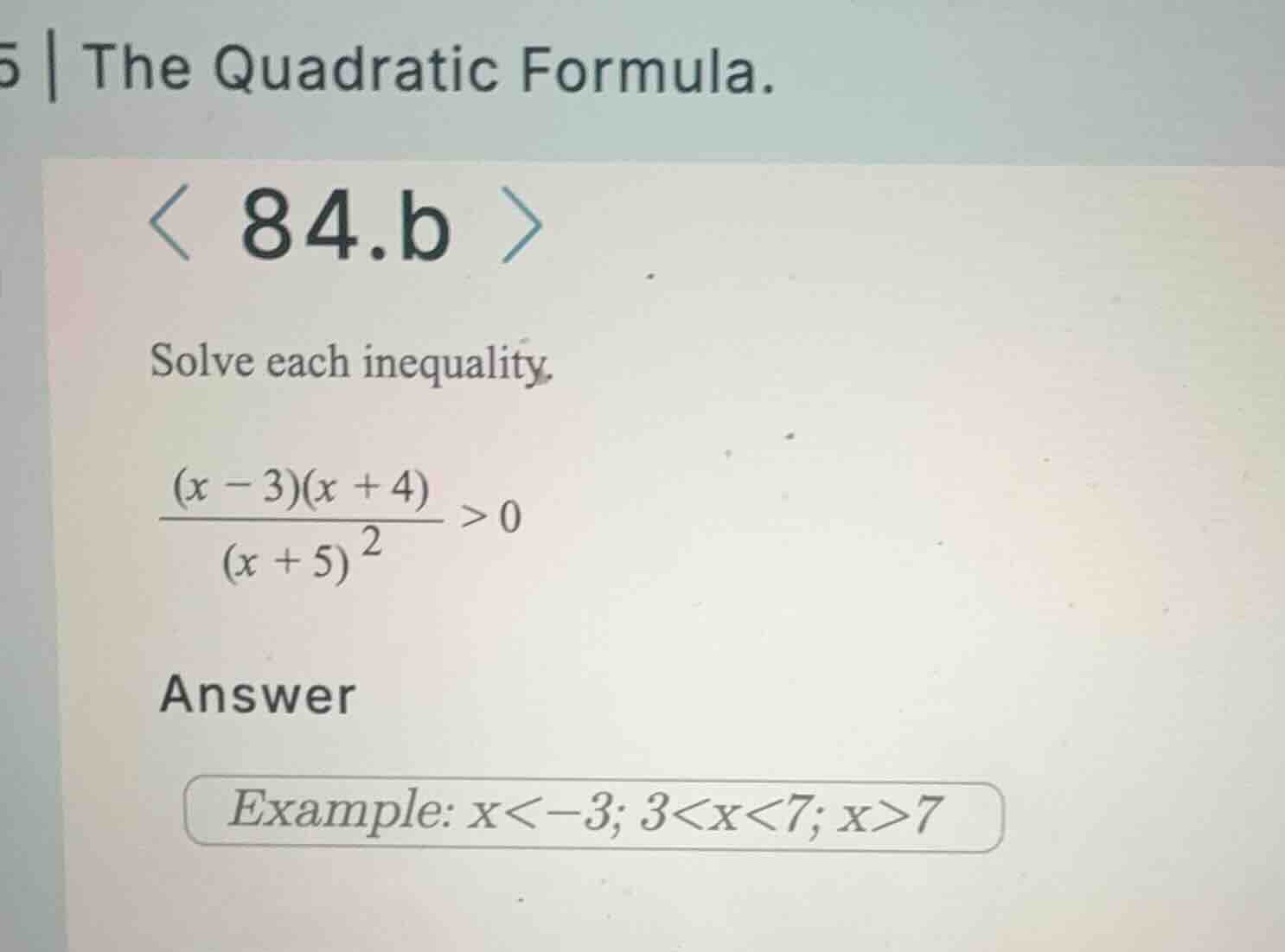
84.b
solve each inequality.
\\(\frac{(x - 3)(x + 4)}{(x + 5)^2} > 0\\)
answer
example: \\(x < -3; 3 < x < 7; x > 7\\)
Step1: Analyze the denominator
The denominator is \((x + 5)^2\). Since a square of a real number is always non - negative, \((x+5)^2\geq0\). But for the fraction \(\frac{(x - 3)(x + 4)}{(x + 5)^2}\) to be defined, the denominator cannot be zero. So \(x
eq - 5\). And \((x + 5)^2>0\) when \(x
eq - 5\).
Step2: Analyze the numerator
Since the denominator \((x + 5)^2>0\) for \(x
eq - 5\), the sign of the fraction \(\frac{(x - 3)(x + 4)}{(x + 5)^2}\) is the same as the sign of the numerator \((x - 3)(x + 4)\). We need to solve \((x - 3)(x + 4)>0\) (because the fraction is greater than 0 and the denominator is positive for \(x
eq - 5\)).
To solve \((x - 3)(x + 4)>0\), we find the critical points by setting each factor equal to zero: \(x-3 = 0\) gives \(x = 3\) and \(x + 4=0\) gives \(x=-4\). These critical points divide the number line into three intervals: \((-\infty,-4)\), \((-4,3)\), and \((3,\infty)\).
- For \(x\in(-\infty,-4)\), let's take a test point, say \(x=-5\) (but \(x=-5\) makes the denominator zero, so we take \(x = - 6\)). Then \((-6 - 3)(-6 + 4)=(-9)\times(-2)=18>0\). So the inequality \((x - 3)(x + 4)>0\) holds in the interval \((-\infty,-4)\).
- For \(x\in(-4,3)\), take a test point \(x = 0\). Then \((0 - 3)(0 + 4)=(-3)\times4=-12<0\). So the inequality \((x - 3)(x + 4)>0\) does not hold in this interval.
- For \(x\in(3,\infty)\), take a test point \(x = 4\). Then \((4 - 3)(4 + 4)=(1)\times(8)=8>0\). So the inequality \((x - 3)(x + 4)>0\) holds in the interval \((3,\infty)\).
We also need to exclude \(x=-5\) from the domain. But \(x = - 5\) is not in the intervals \((-\infty,-4)\) or \((3,\infty)\) (since \(-5\in(-\infty,-4)\) but it makes the denominator zero).

Snap & solve any problem in the app
Get step-by-step solutions on Sovi AI
Photo-based solutions with guided steps
Explore more problems and detailed explanations
\(x < - 4\) or \(x>3\) (in interval notation: \((-\infty,-4)\cup(3,\infty)\))