QUESTION IMAGE
Question
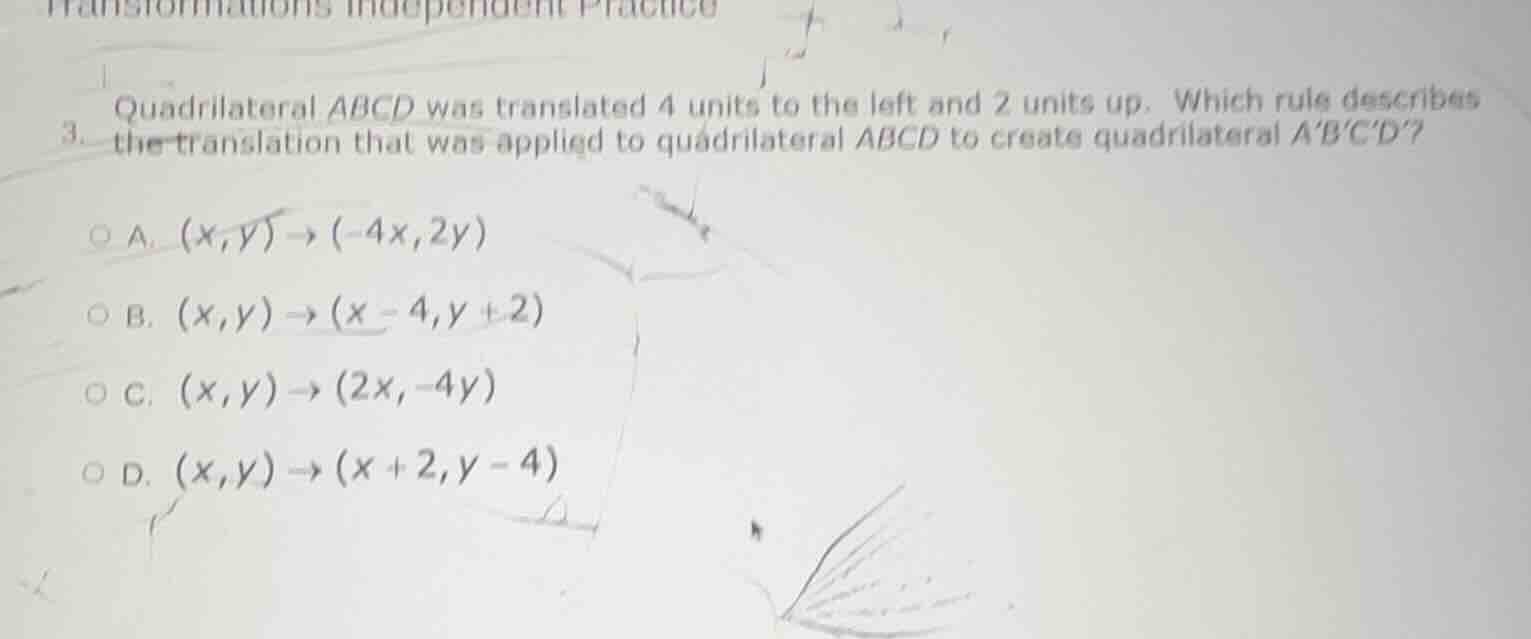
- quadrilateral abcd was translated 4 units to the left and 2 units up. which rule describes the translation that was applied to quadrilateral abcd to create quadrilateral abcd?
a. ((x,y)\to(-4x,2y))
b. ((x,y)\to(x - 4,y + 2))
c. ((x,y)\to(2x,-4y))
d. ((x,y)\to(x + 2,y - 4))
Step1: Recall translation rules
In coordinate geometry, translating a point \((x, y)\) \(h\) units horizontally and \(k\) units vertically uses the rule \((x, y)\to(x + h, y + k)\). Moving left means \(h\) is negative, moving right means \(h\) is positive. Moving up means \(k\) is positive, moving down means \(k\) is negative.
Step2: Apply the given translation
The quadrilateral is translated 4 units left (so \(h=- 4\)) and 2 units up (so \(k = 2\)). Substituting into the translation rule \((x,y)\to(x+h,y + k)\), we get \((x,y)\to(x-4,y + 2)\).

Snap & solve any problem in the app
Get step-by-step solutions on Sovi AI
Photo-based solutions with guided steps
Explore more problems and detailed explanations
B. \((x,y)\to(x - 4,y + 2)\)