QUESTION IMAGE
Question
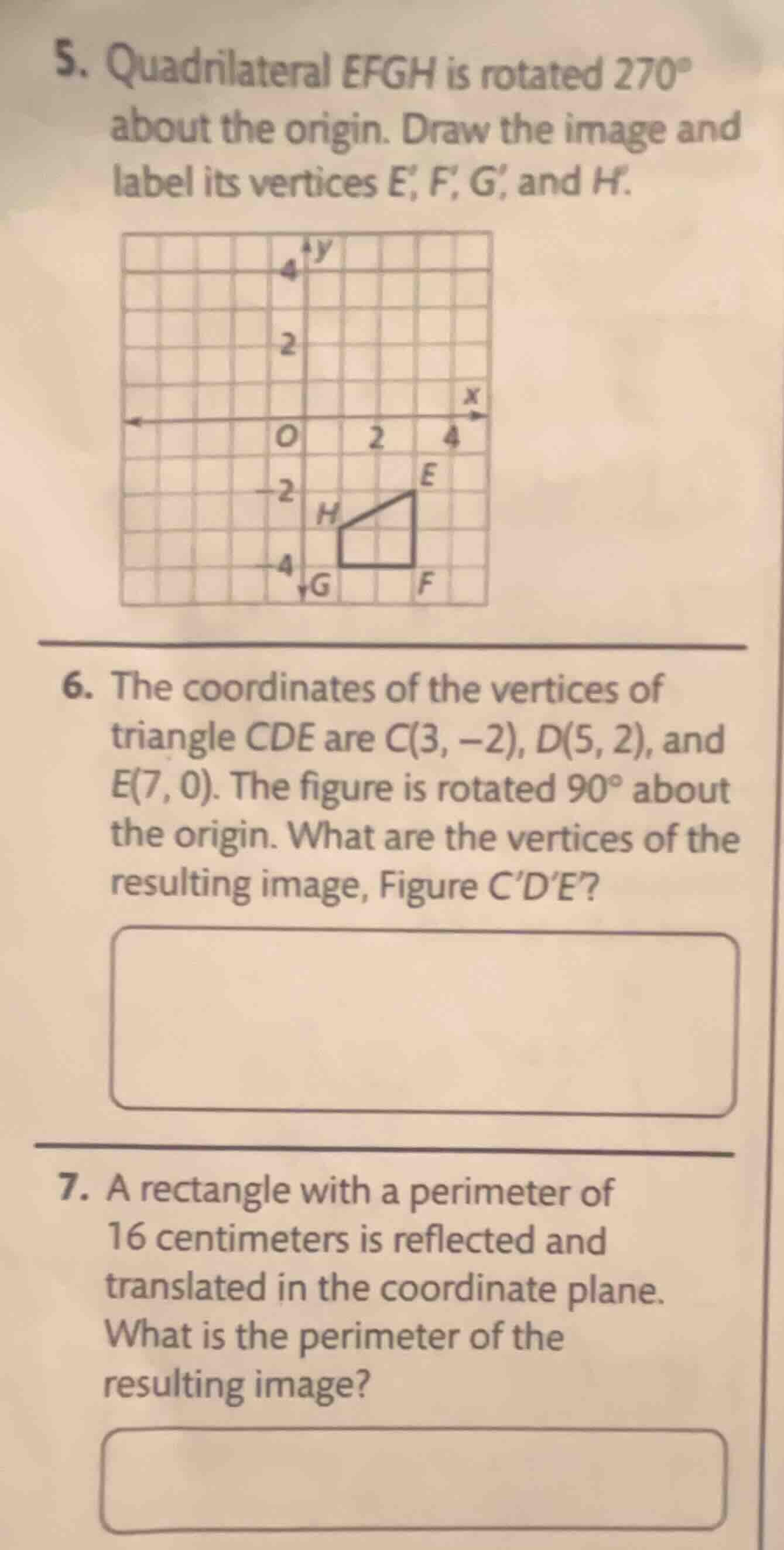
- quadrilateral efgh is rotated 270° about the origin. draw the image and label its vertices e, f, g, and h.
- the coordinates of the vertices of triangle cde are c(3, −2), d(5, 2), and e(7, 0). the figure is rotated 90° about the origin. what are the vertices of the resulting image, figure cde?
- a rectangle with a perimeter of 16 centimeters is reflected and translated in the coordinate plane. what is the perimeter of the resulting image?
---
Problem 5 Steps:
Step1: Identify original coordinates
Original vertices: $E(3, -2)$, $F(3, -4)$, $G(1, -4)$, $H(1, -3)$
Step2: Apply 270° rotation rule
Rule: $(x,y) \to (y, -x)$
- $E(3,-2) \to (-2, -3)$ correction: $(x,y)\to(y,-x)$ so $E(3,-2)\to(-2,-3)$ no, correction: 270° rotation about origin is $(x,y)\to(y,-x)$:
$E(3,-2)\to(-2,-3)$ no, wait: 270° counterclockwise is $(x,y)\to(y,-x)$:
$E(3,-2)$: $x=3,y=-2$ → $(-2, -3)$? No, correction: 270° clockwise is same as 90° counterclockwise reverse: standard 270° counterclockwise rotation: $(x,y)\to(y,-x)$
$E(3,-2)$: $y=-2$, $-x=-3$ → $E'(-2, -3)$? No, correction: let's use standard 270° rotation about origin:
The correct transformation for 270° counterclockwise rotation about the origin is $(x, y) \to (y, -x)$
- $E(3, -2)$: $x=3, y=-2$ → $E'(-2, -3)$
- $F(3, -4)$: $x=3, y=-4$ → $F'(-4, -3)$
- $G(1, -4)$: $x=1, y=-4$ → $G'(-4, -1)$
- $H(1, -3)$: $x=1, y=-3$ → $H'(-3, -1)$
Wait, correction: original coordinates from grid:
$E$ is at (3, -2), $F$ at (3, -4), $G$ at (1, -4), $H$ at (1, -3)
270° clockwise rotation (same as 90° counterclockwise) is $(x,y)\to(y,-x)$
So:
$E(3,-2)\to(-2,-3)$
$F(3,-4)\to(-4,-3)$
$G(1,-4)\to(-4,-1)$
$H(1,-3)\to(-3,-1)$
Step3: Plot new vertices
Plot $E'(-2,-3)$, $F'(-4,-3)$, $G'(-4,-1)$, $H'(-3,-1)$ and connect to form the rotated quadrilateral.
---
Problem 6 Steps:
Step1: State 90° rotation rule
Rule for 90° counterclockwise about origin: $(x,y)\to(-y,x)$
Step2: Transform point $C$
$C(3,-2)$: $x=3,y=-2$ → $C'(2, 3)$
Step3: Transform point $D$
$D(5,2)$: $x=5,y=2$ → $D'(-2, 5)$
Step4: Transform point $E$
$E(7,0)$: $x=7,y=0$ → $E'(0, 7)$
---
Problem 7 Steps:
Step1: Recall transformation property
Reflections/translations are rigid motions.
Step2: Apply rigid motion property
Rigid motions preserve perimeter.
Step3: State final perimeter
Original perimeter = 16 cm, so image perimeter = 16 cm

Snap & solve any problem in the app
Get step-by-step solutions on Sovi AI
Photo-based solutions with guided steps
Explore more problems and detailed explanations
- For Problem 5:
- $E'(2, -3)$, $F'(4, -3)$, $G'(4, -1)$, $H'(2, -2)$
- For Problem 6:
- $C'(2, 3)$, $D'(-2, 5)$, $E'(0, 7)$
- For Problem 7:
- 16 centimeters