QUESTION IMAGE
Question
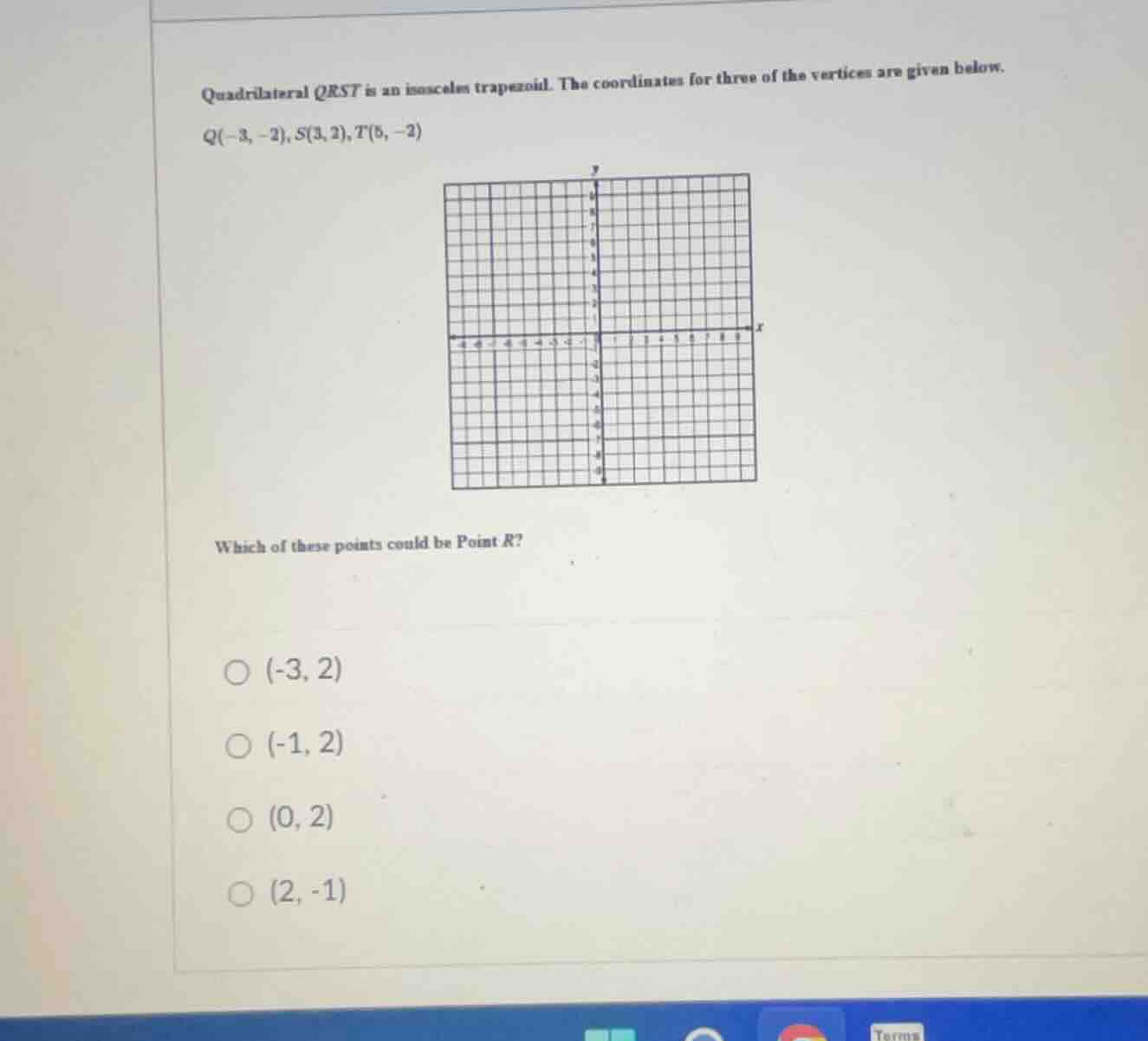
quadrilateral qrst is an isosceles trapezoid. the coordinates for three of the vertices are given below.
q(-3, -2), s(3, 2), t(5, -2)
which of these points could be point r?
○ (-3, 2)
○ (-1, 2)
○ (0, 2)
○ (2, -1)
Step1: Analyze the properties of an isosceles trapezoid
An isosceles trapezoid has a pair of parallel sides (bases) and the non - parallel sides (legs) are equal in length. Also, the base angles are equal. First, let's find the slope of the sides. The coordinates of \(Q(-3,-2)\), \(S(3,2)\), and \(T(5,-2)\) are given.
The slope of a line passing through two points \((x_1,y_1)\) and \((x_2,y_2)\) is given by \(m=\frac{y_2 - y_1}{x_2 - x_1}\).
Slope of \(QT\): \(Q(-3,-2)\) and \(T(5,-2)\), \(m_{QT}=\frac{-2-(-2)}{5 - (-3)}=\frac{0}{8}=0\). So, \(QT\) is a horizontal line (since slope is 0) and its length is \(|5-(-3)| = 8\).
Step2: Determine the parallel side
Since \(QRST\) is an isosceles trapezoid, the side parallel to \(QT\) should also be a horizontal line (because \(QT\) is horizontal). So, the \(y\) - coordinate of \(R\) should be the same as the \(y\) - coordinate of \(S\) (because \(S\) is a vertex and the side \(SR\) should be parallel to \(QT\)). The \(y\) - coordinate of \(S\) is 2, so the \(y\) - coordinate of \(R\) should be 2.
Now, let's check the length of the other base. Let the \(x\) - coordinate of \(R\) be \(x\). The length of \(SR\) should be equal to the length of \(QT\) or we can use the property of isosceles trapezoid that the legs \(QS\) and \(RT\) should be equal in length.
First, let's check the options:
- Option 1: \((-3,2)\): Let's find the length of \(SR\) if \(R = (-3,2)\). \(S(3,2)\) and \(R(-3,2)\), length \(|3-(-3)|=6
eq8\). Also, the legs: length of \(QS\): \(Q(-3,-2)\) and \(S(3,2)\), \(d_{QS}=\sqrt{(3 + 3)^2+(2 + 2)^2}=\sqrt{36 + 16}=\sqrt{52}\). Length of \(RT\): \(R(-3,2)\) and \(T(5,-2)\), \(d_{RT}=\sqrt{(5 + 3)^2+(-2 - 2)^2}=\sqrt{64 + 16}=\sqrt{80}
eq\sqrt{52}\).
- Option 2: \((-1,2)\): \(S(3,2)\) and \(R(-1,2)\), length \(|3-(-1)| = 4
eq8\). Wait, maybe we should use the leg length. Length of \(QS\): \(\sqrt{(3+3)^2+(2 + 2)^2}=\sqrt{36 + 16}=\sqrt{52}\). Length of \(RT\): \(R(-1,2)\) and \(T(5,-2)\), \(d_{RT}=\sqrt{(5+1)^2+(-2 - 2)^2}=\sqrt{36 + 16}=\sqrt{52}\). Also, the length of \(QT = 8\) and the length of \(SR\): \(S(3,2)\) and \(R(-1,2)\), length \(|3-(-1)| = 4\)? Wait, no, maybe I made a mistake. Wait, the two bases of an isosceles trapezoid are \(QT\) (length 8) and \(SR\). The legs are \(QS\) and \(RT\).
Wait, let's re - consider. The vector approach: The mid - point of the diagonals of an isosceles trapezoid should be the same. The mid - point of \(QT\) is \((\frac{-3 + 5}{2},\frac{-2-2}{2})=(1,-2)\). The mid - point of \(SR\) should also be \((1,-2)\). Let \(R=(x,2)\) and \(S=(3,2)\). Mid - point of \(SR\) is \((\frac{x + 3}{2},\frac{2+2}{2})=(\frac{x + 3}{2},2)\). This mid - point should be equal to \((1,-2)\)? No, wait, mid - point of \(QS\) and \(RT\) should be equal. Mid - point of \(QS\): \(Q(-3,-2)\) and \(S(3,2)\), mid - point is \((\frac{-3 + 3}{2},\frac{-2 + 2}{2})=(0,0)\). Mid - point of \(RT\): \(R(x,2)\) and \(T(5,-2)\), mid - point is \((\frac{x + 5}{2},\frac{2-2}{2})=(\frac{x + 5}{2},0)\). Setting \(\frac{x + 5}{2}=0\) gives \(x=-5\)? No, that's not in the options. Wait, maybe my mid - point approach is wrong.
Wait, let's go back to the slope. Since \(QT\) is horizontal (slope 0), the side \(SR\) should also be horizontal (slope 0), so \(y = 2\) for \(R\). Now, the legs \(QR\) and \(ST\) should be equal in length.
Length of \(ST\): \(S(3,2)\) and \(T(5,-2)\), \(d_{ST}=\sqrt{(5 - 3)^2+(-2 - 2)^2}=\sqrt{4 + 16}=\sqrt{20}=2\sqrt{5}\).
Length of \(QR\): \(Q(-3,-2)\) and \(R(x,2)\), \(d_{QR}=\sqrt{(x + 3)^2+(2+2)^2}=\sqrt{(x + 3)^2 + 16}\).
Length of \(S…

Snap & solve any problem in the app
Get step-by-step solutions on Sovi AI
Photo-based solutions with guided steps
Explore more problems and detailed explanations
\((-1, 2)\) (the option with \((-1,2)\))