QUESTION IMAGE
Question
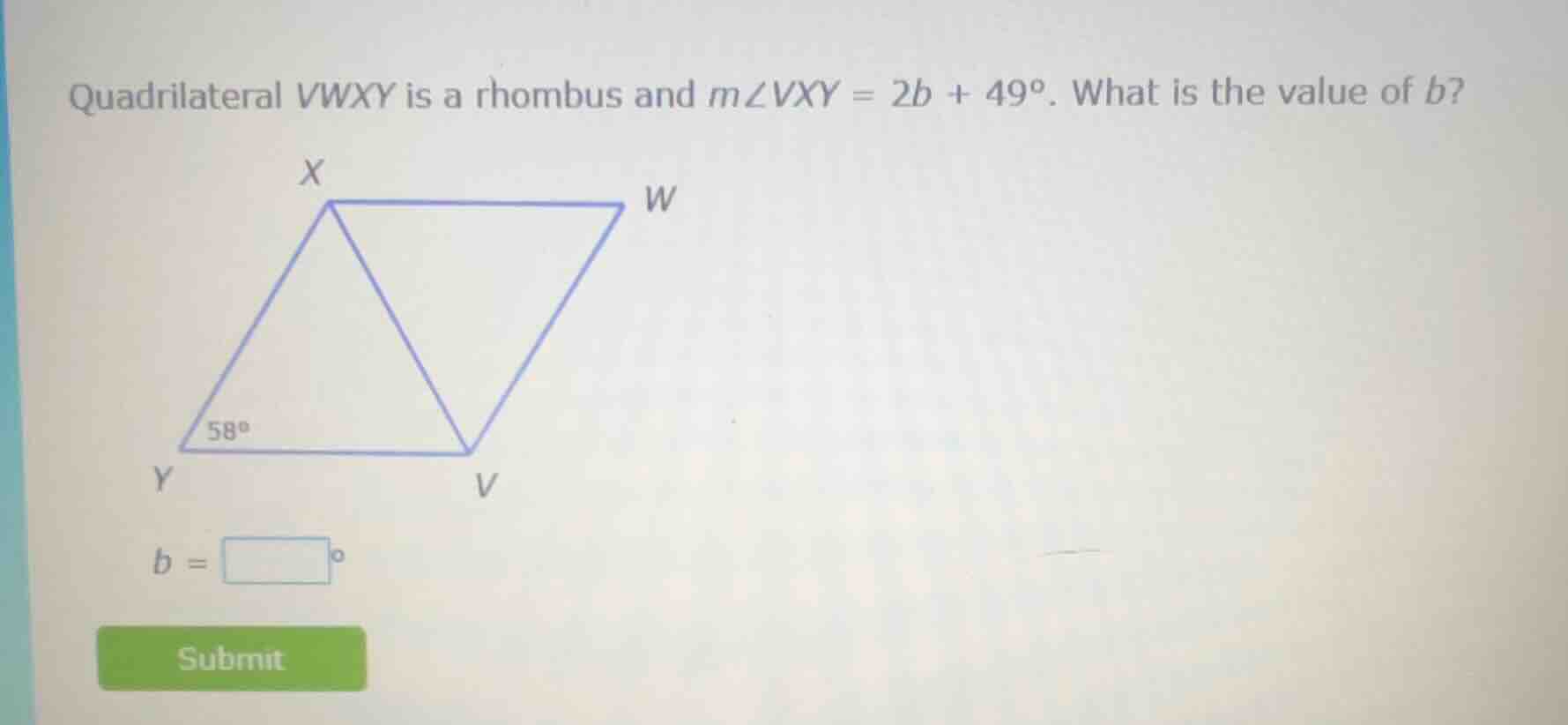
quadrilateral vwxy is a rhombus and ( mangle vxy = 2b + 49^circ ). what is the value of ( b )?
Step1: Recall rhombus property (adjacent angles in rhombus? No, in rhombus, sides are equal, and the diagonal bisects the angles? Wait, in a rhombus, the diagonal divides the angles into two equal parts? Wait, no, in a rhombus, opposite sides are parallel, so consecutive angles are supplementary? Wait, no, in a rhombus, all sides are equal, and opposite angles are equal, consecutive angles are supplementary. Wait, but in triangle VXY, angle at Y is 58 degrees, and in rhombus, XY = XV? Wait, no, in rhombus VWXY, all sides are equal: VW = WX = XY = YV. Wait, so triangle VXY: XY = YV? Wait, no, YV is a side of the rhombus, XY is also a side, so XY = YV. So triangle VXY is isosceles? Wait, no, angle at Y is 58 degrees, and angle at X (angle VXY) is given as 2b + 49. Wait, in a triangle, the sum of angles is 180. Wait, but in rhombus, the diagonal XZ (wait, the diagonal is XV? Wait, the diagonal is XV, connecting X to V. So in rhombus VWXY, diagonal XV divides the rhombus into two triangles: XYW and XVY? Wait, no, the diagonal is XV, so triangle X Y V. Since XY and YV are sides of the rhombus, they are equal (XY = YV). So triangle X Y V is isosceles with XY = YV. Therefore, angles at X and V are equal? Wait, no, angle at Y is 58 degrees, so angles at X (angle VXY) and angle at V (angle XVY) should be equal? Wait, no, in triangle, sum of angles is 180. So angle at Y is 58, angle at X is 2b + 49, angle at V is also... Wait, no, maybe I made a mistake. Wait, in a rhombus, the diagonal bisects the angles. Wait, no, the diagonal of a rhombus bisects the vertex angles. So if angle at Y is 58 degrees, then the diagonal XV bisects angle at X and angle at V? Wait, no, angle at Y is 58, so the adjacent angle at V (angle YVW) would be supplementary? Wait, no, consecutive angles in a rhombus are supplementary. Wait, maybe I should recall that in a rhombus, the diagonal splits the rhombus into two congruent triangles. Wait, in rhombus VWXY, sides XY and YV are equal (since it's a rhombus), so triangle X Y V is isosceles with XY = YV. Therefore, angles opposite those sides: angle at X (angle VXY) and angle at V (angle XVY) are equal? Wait, no, XY and YV are the two equal sides, so the angles opposite them are angle at V (angle XVY) and angle at X (angle VXY), respectively. Wait, no, in triangle X Y V, side XY is opposite angle XVY, side YV is opposite angle VXY. Since XY = YV, then angle XVY = angle VXY. Wait, but angle at Y is 58 degrees, so sum of angles in triangle is 180: angle VXY + angle XVY + angle Y = 180. Since angle VXY = angle XVY (because XY = YV), then 2 * angle VXY + 58 = 180. Wait, but angle VXY is given as 2b + 49. So:
2*(2b + 49) + 58 = 180? Wait, no, that can't be. Wait, maybe I messed up. Wait, in a rhombus, opposite sides are parallel, so XY is parallel to VW, and YV is parallel to XW. So angle at Y (angle XYV) is 58 degrees, and angle at X (angle VXY) – wait, maybe the triangle is such that angle at Y is 58, and angle at X is equal to angle at Y? No, that doesn't make sense. Wait, maybe the rhombus has angle at Y as 58 degrees, so the adjacent angle at X (angle WXY) would be supplementary? Wait, no, consecutive angles in a rhombus are supplementary. So angle at Y (58) and angle at X (angle WXY) are supplementary: 58 + angle WXY = 180, so angle WXY = 122. But the diagonal XV bisects angle WXY, so angle VXY is half of angle WXY? Wait, that makes sense! In a rhombus, the diagonal bisects the vertex angles. So if angle WXY is 122 degrees (since consecutive to 58), then diagonal XV bisects it into two equal angles: angle VXY = 122 /…

Snap & solve any problem in the app
Get step-by-step solutions on Sovi AI
Photo-based solutions with guided steps
Explore more problems and detailed explanations
6