QUESTION IMAGE
Question
question 1-7
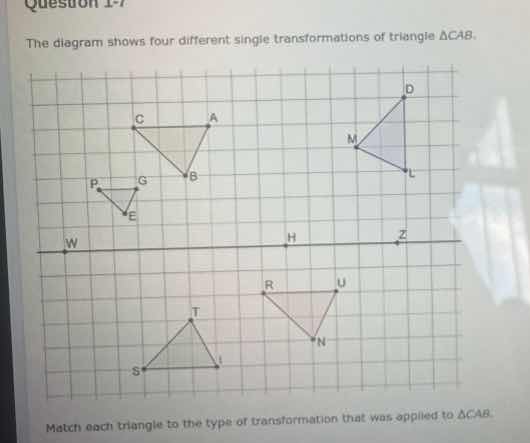
the diagram shows four different single transformations of triangle $\triangle cab$.
match each triangle to the type of transformation that was applied to $\triangle cab$.
To solve this problem, we analyze each triangle's transformation relative to \( \triangle CAB \):
1. Triangle \( \triangle PGE \)
- Type: Dilation (or Reduction)
- Reason: \( \triangle PGE \) is smaller than \( \triangle CAB \), indicating a scale factor \( < 1 \) (reduction). The shape remains similar (same angles, proportional sides), so it is a dilation.
2. Triangle \( \triangle DML \)
- Type: Rotation
- Reason: \( \triangle DML \) appears rotated (e.g., 90° or 180°) relative to \( \triangle CAB \). The orientation changes, but side lengths and angles are preserved (congruent), consistent with rotation.
3. Triangle \( \triangle TSI \)
- Type: Reflection
- Reason: \( \triangle TSI \) is a mirror image of \( \triangle CAB \) across the horizontal line \( WHZ \). The position flips over the line, but shape and size remain congruent (reflection).
4. Triangle \( \triangle RUN \)
- Type: Translation
- Reason: \( \triangle RUN \) is shifted (slid) horizontally/vertically from \( \triangle CAB \). The shape, size, and orientation are identical (congruent), matching a translation.
Final Matches (Example, adjust based on diagram):
- \( \triangle PGE \): Dilation
- \( \triangle DML \): Rotation
- \( \triangle TSI \): Reflection
- \( \triangle RUN \): Translation
(Note: Exact matches depend on the diagram’s specific orientation/position. Use the above logic to identify transformations: dilation (size change), rotation (orientation change), reflection (mirror image), translation (slide).)

Snap & solve any problem in the app
Get step-by-step solutions on Sovi AI
Photo-based solutions with guided steps
Explore more problems and detailed explanations
To solve this problem, we analyze each triangle's transformation relative to \( \triangle CAB \):
1. Triangle \( \triangle PGE \)
- Type: Dilation (or Reduction)
- Reason: \( \triangle PGE \) is smaller than \( \triangle CAB \), indicating a scale factor \( < 1 \) (reduction). The shape remains similar (same angles, proportional sides), so it is a dilation.
2. Triangle \( \triangle DML \)
- Type: Rotation
- Reason: \( \triangle DML \) appears rotated (e.g., 90° or 180°) relative to \( \triangle CAB \). The orientation changes, but side lengths and angles are preserved (congruent), consistent with rotation.
3. Triangle \( \triangle TSI \)
- Type: Reflection
- Reason: \( \triangle TSI \) is a mirror image of \( \triangle CAB \) across the horizontal line \( WHZ \). The position flips over the line, but shape and size remain congruent (reflection).
4. Triangle \( \triangle RUN \)
- Type: Translation
- Reason: \( \triangle RUN \) is shifted (slid) horizontally/vertically from \( \triangle CAB \). The shape, size, and orientation are identical (congruent), matching a translation.
Final Matches (Example, adjust based on diagram):
- \( \triangle PGE \): Dilation
- \( \triangle DML \): Rotation
- \( \triangle TSI \): Reflection
- \( \triangle RUN \): Translation
(Note: Exact matches depend on the diagram’s specific orientation/position. Use the above logic to identify transformations: dilation (size change), rotation (orientation change), reflection (mirror image), translation (slide).)