QUESTION IMAGE
Question
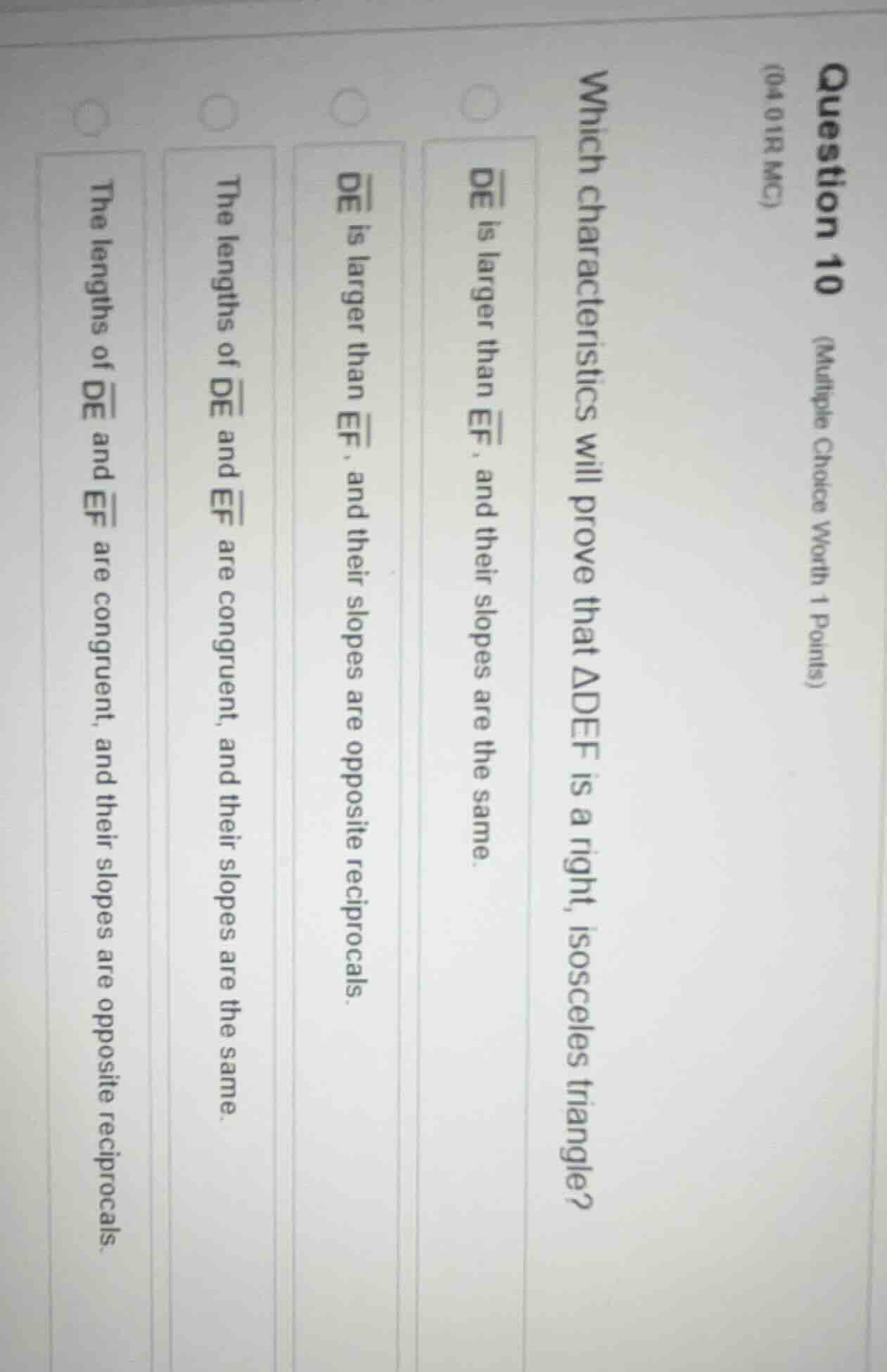
question 10 (multiple choice worth 1 points) (04.01r mc) which characteristics will prove that \\(\triangle def\\) is a right, isosceles triangle? \\(\overline{de}\\) is larger than \\(\overline{ef}\\), and their slopes are the same. \\(\overline{de}\\) is larger than \\(\overline{ef}\\), and their slopes are opposite reciprocals. the lengths of \\(\overline{de}\\) and \\(\overline{ef}\\) are congruent, and their slopes are the same. the lengths of \\(\overline{de}\\) and \\(\overline{ef}\\) are congruent, and their slopes are opposite reciprocals.
To prove \(\triangle DEF\) is a right isosceles triangle, we need two conditions: (1) Two sides are congruent (for isosceles), and (2) The two sides are perpendicular (for right, which means their slopes are opposite reciprocals, since perpendicular lines have slopes that are negative reciprocals).
- Analyzing the options:
- For a right isosceles triangle, two sides must be congruent (so \(DE = EF\) or \(DE = DF\) or \(EF = DF\)) and the angle between them must be \(90^\circ\) (so the slopes of the two congruent sides are opposite reciprocals).
- Option 1: "The lengths of \(\overline{DE}\) and \(\overline{EF}\) are congruent, and their slopes are opposite reciprocals." This satisfies both: congruent sides (isosceles) and perpendicular sides (right angle, since opposite reciprocals slopes mean perpendicular lines).
- Other options:
- If slopes are the same, lines are parallel, not perpendicular (so not a right angle).
- If one side is larger than the other, it's not isosceles.
So the correct option is the one where \(DE\) and \(EF\) are congruent (lengths equal) and their slopes are opposite reciprocals (perpendicular, right angle).

Snap & solve any problem in the app
Get step-by-step solutions on Sovi AI
Photo-based solutions with guided steps
Explore more problems and detailed explanations
The option: "The lengths of \(\overline{DE}\) and \(\overline{EF}\) are congruent, and their slopes are opposite reciprocals." (Assuming this is the fourth option in the list, but based on the description, it's the one with congruent lengths and opposite reciprocal slopes)