QUESTION IMAGE
Question
question 6 of 10
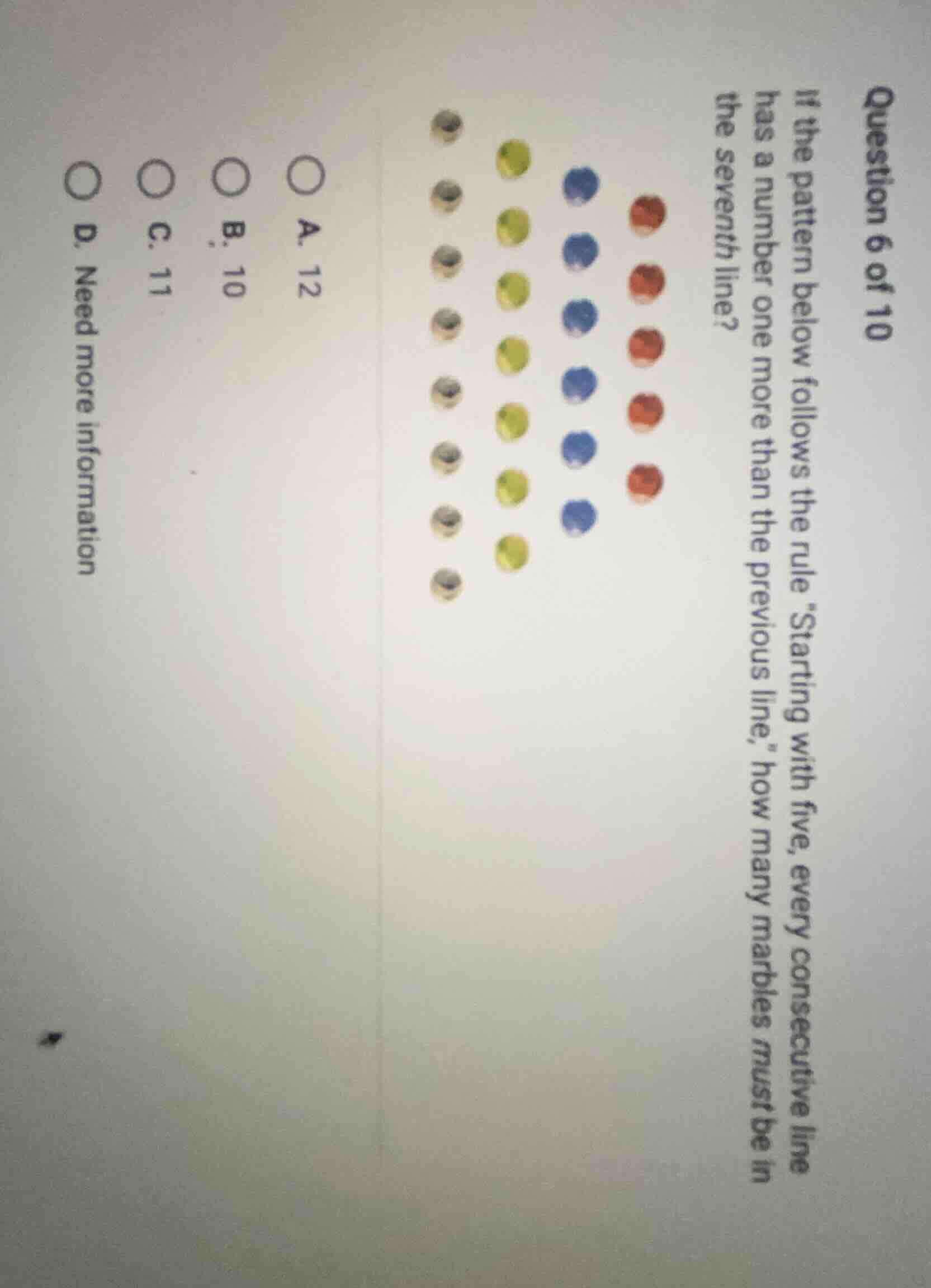
if the pattern below follows the rule \starting with five, every consecutive line has a number one more than the previous line\, how many marbles must be in the seventh line?
a. 12
b. 10
c. 11
d. need more information
Step1: Identify the pattern
The first line has 5 marbles. Each subsequent line has 1 more marble than the previous one. So this is an arithmetic sequence with first term \(a_1 = 5\) and common difference \(d = 1\).
Step2: Use the arithmetic sequence formula
The formula for the \(n\)-th term of an arithmetic sequence is \(a_n=a_1+(n - 1)d\). We need to find the 7th term, so \(n = 7\), \(a_1=5\), \(d = 1\).
Substitute the values into the formula: \(a_7=5+(7 - 1)\times1\)
Step3: Calculate the value
First, calculate \(7-1 = 6\). Then, \(5+6\times1=5 + 6=11\). Wait, but wait, maybe I misread the starting term. Wait, let's check again. Wait, maybe the first line is considered as line 1 with 5, line 2 with 6, line 3 with 7, line 4 with 8, line 5 with 9, line 6 with 10, line 7 with 11? Wait no, wait the problem says "starting with five, every consecutive line has a number one more than the previous line". So line 1: 5, line 2: 6, line 3: 7, line 4: 8, line 5: 9, line 6: 10, line 7: 11? But wait the options have 11 as option C. Wait but let's re - evaluate. Wait maybe the first line in the diagram? Wait the diagram shows some marbles. Wait maybe the first line (the top - most) has, let's count the red marbles: 5 red? No, the red marbles: first red line (top) has 1? Wait no, the problem says "starting with five". Wait maybe my initial assumption is wrong. Wait the problem says "starting with five, every consecutive line has a number one more than the previous line". So the formula is \(a_n=5+(n - 1)\times1\). For \(n = 7\), \(a_7=5 + 6=11\). But wait the options: A.12, B.10, C.11, D. Need more info. So the answer should be C.11. Wait but let's check again. Wait maybe the first line is line 0? No, the problem says "starting with five, every consecutive line...". So line 1: 5, line 2: 6, line 3: 7, line 4: 8, line 5: 9, line 6: 10, line 7: 11. So the 7th line has 11 marbles.

Snap & solve any problem in the app
Get step-by-step solutions on Sovi AI
Photo-based solutions with guided steps
Explore more problems and detailed explanations
C. 11