QUESTION IMAGE
Question
question 3/10
select the correct answers for the question. when finished, select submit.
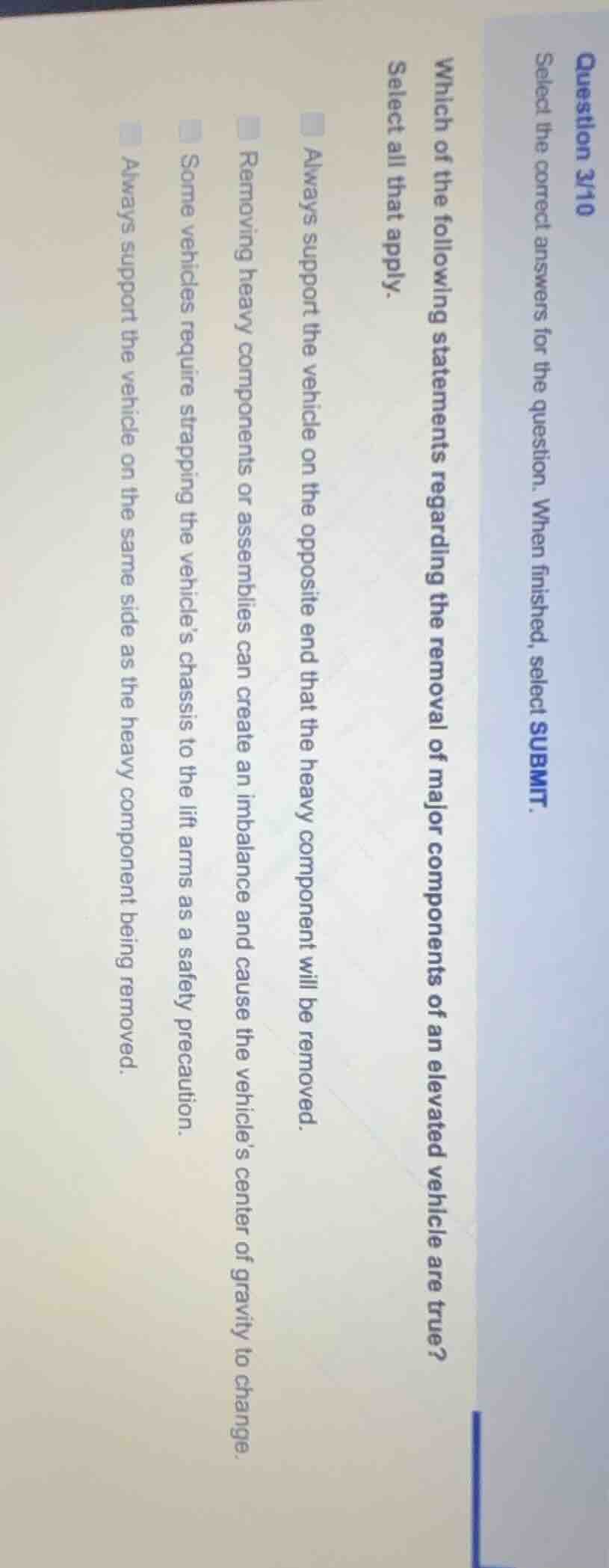
which of the following statements regarding the removal of major components of an elevated vehicle are true?
select all that apply.
always support the vehicle on the opposite end that the heavy component will be removed.
removing heavy components or assemblies can create an imbalance and cause the vehicle’s center of gravity to change.
some vehicles require strapping the vehicle’s chassis to the lift arms as a safety precaution.
always support the vehicle on the same side as the heavy component being removed.
- For "Always support the vehicle on the opposite end that the heavy component will be removed": When a heavy component is removed from one end, supporting the opposite end helps maintain balance, so this is correct.
- For "Removing heavy components or assemblies can create an imbalance and cause the vehicle’s center of gravity to change": Removing a heavy part changes the weight distribution, thus altering the center of gravity and potentially causing imbalance, so this is correct.
- For "Some vehicles require strapping the vehicle’s chassis to the lift arms as a safety precaution": Certain vehicles, especially those with high centers of gravity or specific designs, need this strapping to prevent movement during component removal, so this is correct.
- For "Always support the vehicle on the same side as the heavy component being removed": Supporting on the same side as the heavy component being removed would likely increase imbalance, so this is incorrect.

Snap & solve any problem in the app
Get step-by-step solutions on Sovi AI
Photo-based solutions with guided steps
Explore more problems and detailed explanations
A. Always support the vehicle on the opposite end that the heavy component will be removed.
B. Removing heavy components or assemblies can create an imbalance and cause the vehicle’s center of gravity to change.
C. Some vehicles require strapping the vehicle’s chassis to the lift arms as a safety precaution.