QUESTION IMAGE
Question
question 10
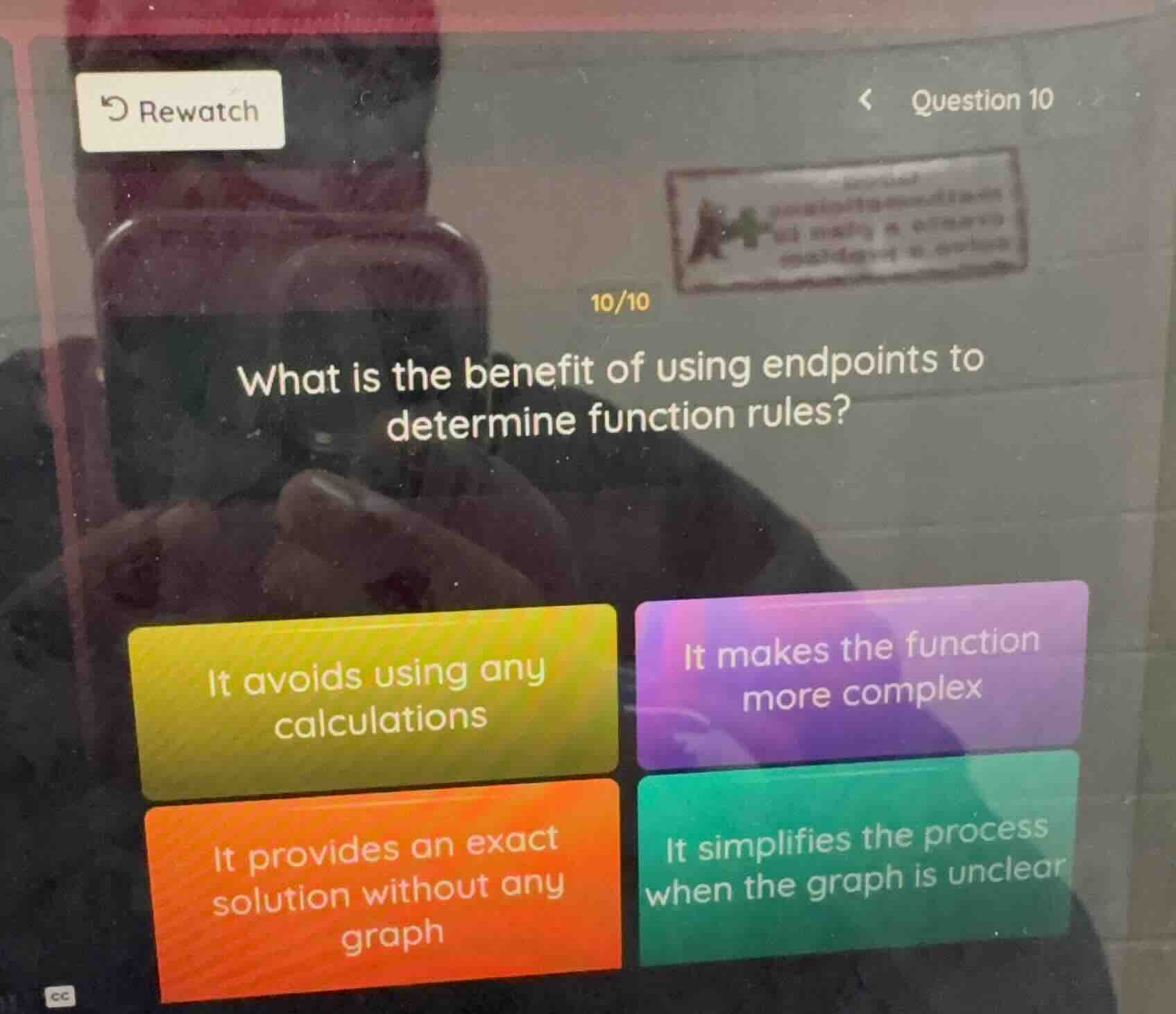
what is the benefit of using endpoints to determine function rules?
it avoids using any calculations
it makes the function more complex
it provides an exact solution without any graph
it simplifies the process when the graph is unclear
Brief Explanations
- Analyzing the first option: Using endpoints still requires some calculations (like finding slope, intercept), so it doesn't avoid all calculations. Eliminate this.
- Analyzing the second option: Using endpoints should simplify, not complicate, the function - determination process. Eliminate this.
- Analyzing the third option: Endpoints are part of the graph (or related to the function's domain/range), and you still need information (like the graph's shape or other points) or the function's context. It doesn't provide an exact solution "without any graph" as it's tied to the function's graphical or numerical representation. Eliminate this.
- Analyzing the fourth option: When a graph is unclear (e.g., messy, hard to read points), using endpoints (which are distinct and often easier to identify) can simplify finding the function rule (e.g., for a linear function, two endpoints give slope and help find the equation). This makes sense.

Snap & solve any problem in the app
Get step-by-step solutions on Sovi AI
Photo-based solutions with guided steps
Explore more problems and detailed explanations
D. It simplifies the process when the graph is unclear (assuming the options are labeled A - D as: A. It avoids using any calculations, B. It makes the function more complex, C. It provides an exact solution without any graph, D. It simplifies the process when the graph is unclear)