QUESTION IMAGE
Question
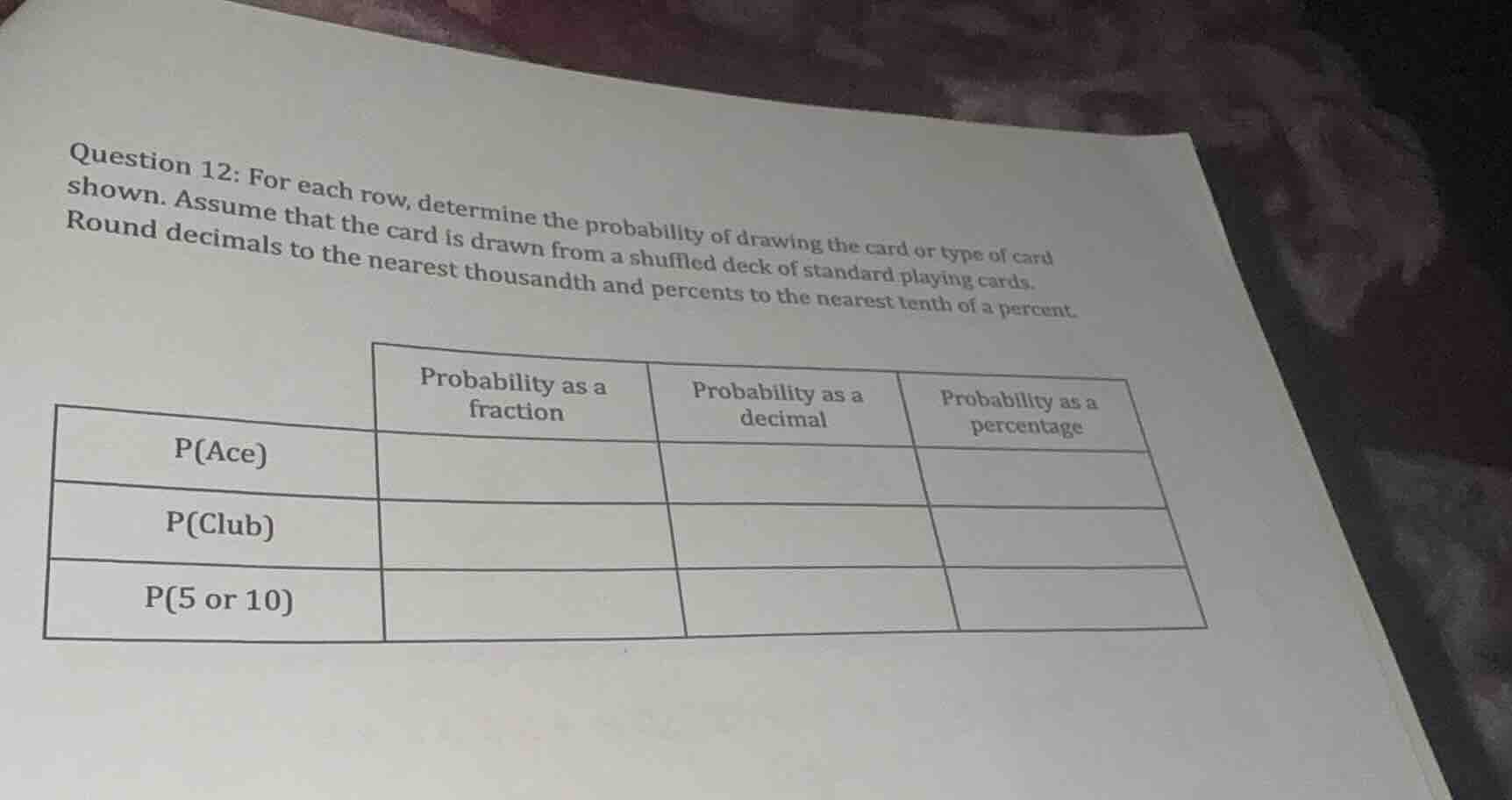
question 12: for each row, determine the probability of drawing the card or type of card shown. assume that the card is drawn from a shuffled deck of standard playing cards. round decimals to the nearest thousandth and percents to the nearest tenth of a percent.
| probability as a fraction | probability as a decimal | probability as a percentage | |
|---|---|---|---|
| p(club) | |||
| p(5 or 10) |
Part 1: \( P(\text{Ace}) \)
Step 1: Determine number of Aces and total cards
A standard deck has 4 Aces and 52 total cards. Probability formula: \( P = \frac{\text{Number of favorable outcomes}}{\text{Total number of outcomes}} \)
So, \( P(\text{Ace}) = \frac{4}{52} = \frac{1}{13} \)
Step 2: Convert to decimal
\( \frac{1}{13} \approx 0.077 \) (rounded to nearest thousandth)
Step 3: Convert to percentage
\( 0.077 \times 100 = 7.7\% \) (rounded to nearest tenth of a percent)
Part 2: \( P(\text{Club}) \)
Step 1: Determine number of Clubs and total cards
A standard deck has 13 Clubs and 52 total cards.
So, \( P(\text{Club}) = \frac{13}{52} = \frac{1}{4} \)
Step 2: Convert to decimal
\( \frac{1}{4} = 0.250 \)
Step 3: Convert to percentage
\( 0.250 \times 100 = 25.0\% \)
Part 3: \( P(5 \text{ or } 10) \)
Step 1: Determine number of 5s, 10s, and total cards
There are 4 fives and 4 tens, so total favorable outcomes: \( 4 + 4 = 8 \). Total cards: 52.
Thus, \( P(5 \text{ or } 10) = \frac{8}{52} = \frac{2}{13} \)
Step 2: Convert to decimal
\( \frac{2}{13} \approx 0.154 \) (rounded to nearest thousandth)
Step 3: Convert to percentage
\( 0.154 \times 100 = 15.4\% \) (rounded to nearest tenth of a percent)
Final Table (Filled):
| Probability as a fraction | Probability as a decimal | Probability as a percentage | |
|---|---|---|---|
| \( P(\text{Club}) \) | \( \frac{1}{4} \) | \( 0.250 \) | \( 25.0\% \) |
| \( P(5 \text{ or } 10) \) | \( \frac{2}{13} \) | \( 0.154 \) | \( 15.4\% \) |

Snap & solve any problem in the app
Get step-by-step solutions on Sovi AI
Photo-based solutions with guided steps
Explore more problems and detailed explanations
Part 1: \( P(\text{Ace}) \)
Step 1: Determine number of Aces and total cards
A standard deck has 4 Aces and 52 total cards. Probability formula: \( P = \frac{\text{Number of favorable outcomes}}{\text{Total number of outcomes}} \)
So, \( P(\text{Ace}) = \frac{4}{52} = \frac{1}{13} \)
Step 2: Convert to decimal
\( \frac{1}{13} \approx 0.077 \) (rounded to nearest thousandth)
Step 3: Convert to percentage
\( 0.077 \times 100 = 7.7\% \) (rounded to nearest tenth of a percent)
Part 2: \( P(\text{Club}) \)
Step 1: Determine number of Clubs and total cards
A standard deck has 13 Clubs and 52 total cards.
So, \( P(\text{Club}) = \frac{13}{52} = \frac{1}{4} \)
Step 2: Convert to decimal
\( \frac{1}{4} = 0.250 \)
Step 3: Convert to percentage
\( 0.250 \times 100 = 25.0\% \)
Part 3: \( P(5 \text{ or } 10) \)
Step 1: Determine number of 5s, 10s, and total cards
There are 4 fives and 4 tens, so total favorable outcomes: \( 4 + 4 = 8 \). Total cards: 52.
Thus, \( P(5 \text{ or } 10) = \frac{8}{52} = \frac{2}{13} \)
Step 2: Convert to decimal
\( \frac{2}{13} \approx 0.154 \) (rounded to nearest thousandth)
Step 3: Convert to percentage
\( 0.154 \times 100 = 15.4\% \) (rounded to nearest tenth of a percent)
Final Table (Filled):
| Probability as a fraction | Probability as a decimal | Probability as a percentage | |
|---|---|---|---|
| \( P(\text{Club}) \) | \( \frac{1}{4} \) | \( 0.250 \) | \( 25.0\% \) |
| \( P(5 \text{ or } 10) \) | \( \frac{2}{13} \) | \( 0.154 \) | \( 15.4\% \) |