QUESTION IMAGE
Question
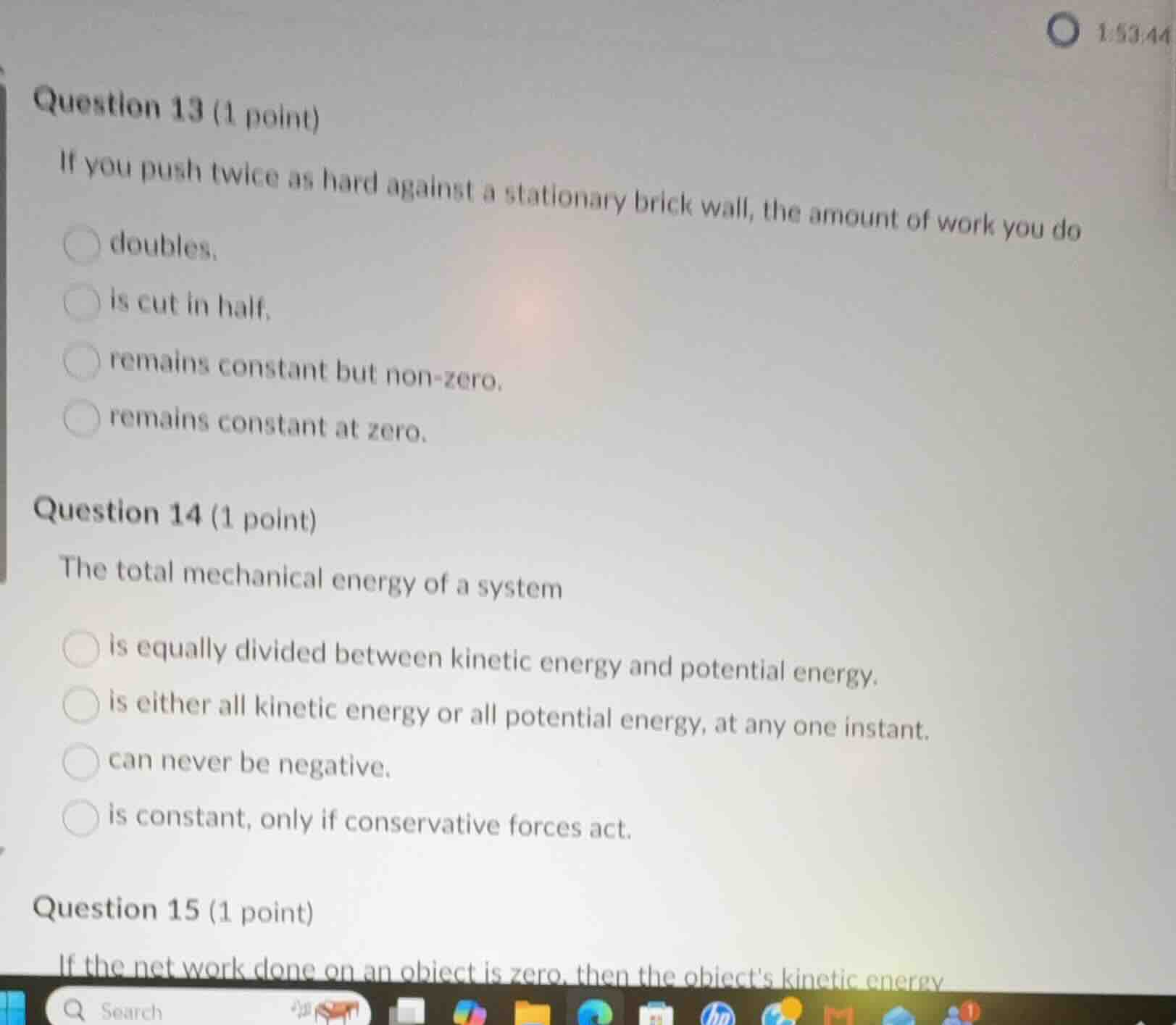
question 13 (1 point)
if you push twice as hard against a stationary brick wall, the amount of work you do
doubles.
is cut in half.
remains constant but non - zero.
remains constant at zero.
question 14 (1 point)
the total mechanical energy of a system
is equally divided between kinetic energy and potential energy.
is either all kinetic energy or all potential energy, at any one instant.
can never be negative.
is constant, only if conservative forces act.
question 15 (1 point)
if the net work done on an object is zero, then the objects kinetic energy
Question 13
Work is defined as \( W = F \cdot d \cdot \cos(\theta) \), where \( F \) is force, \( d \) is displacement, and \( \theta \) is the angle between force and displacement. For a stationary brick wall, displacement \( d = 0 \). Even if force \( F \) doubles, \( W = F \cdot 0 \cdot \cos(\theta)=0 \), so work remains zero.
Mechanical energy \( E_{mech}=E_k + E_p \) (kinetic + potential). Conservative forces (e.g., gravity, spring force) conserve mechanical energy (no non - conservative forces like friction). Non - conservative forces change mechanical energy. Option 1: Not necessarily equal (e.g., a moving object has more \( E_k \), less \( E_p \)). Option 2: A system can have both (e.g., a pendulum has both at most points). Option 3: Potential energy can be negative (e.g., gravitational potential energy with negative reference), so \( E_{mech} \) can be negative. Option 4: Correct, as conservative forces conserve mechanical energy.
By the Work - Energy Theorem, \( W_{net}=\Delta E_k=E_{kf}-E_{ki} \). If \( W_{net} = 0 \), then \( E_{kf}-E_{ki}=0\), so \( E_{kf}=E_{ki} \), meaning kinetic energy remains constant.

Snap & solve any problem in the app
Get step-by-step solutions on Sovi AI
Photo-based solutions with guided steps
Explore more problems and detailed explanations
remains constant at zero.