QUESTION IMAGE
Question
question 13
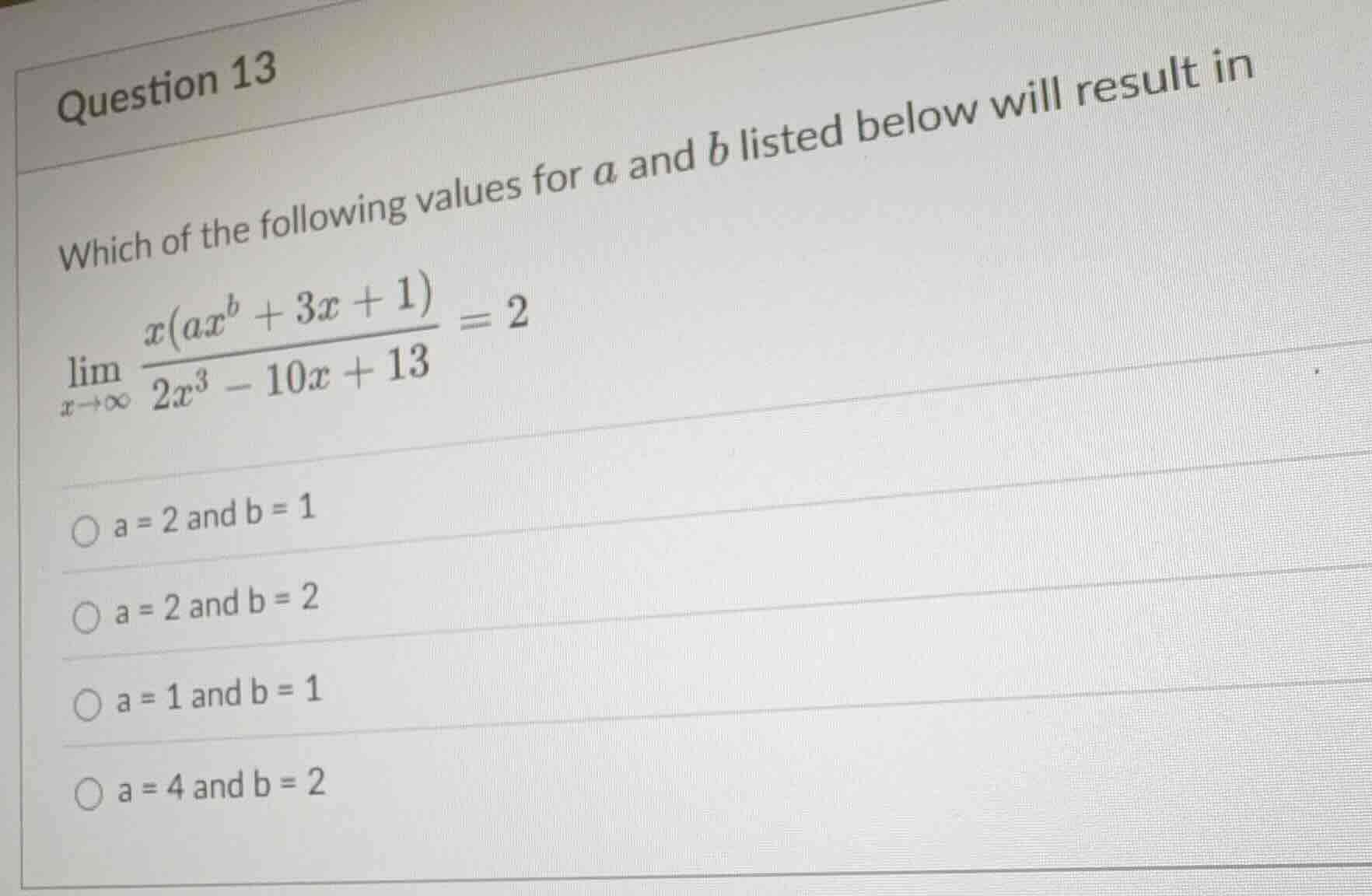
which of the following values for a and b listed below will result in
\\(\lim_{x\to\infty} \frac{x(ax^b + 3x + 1)}{2x^3 - 10x + 13} = 2\\)
\\(\bigcirc\\) a = 2 and b = 1
\\(\bigcirc\\) a = 2 and b = 2
\\(\bigcirc\\) a = 1 and b = 1
\\(\bigcirc\\) a = 4 and b = 2
Step1: Simplify the numerator
First, expand the numerator \( x(ax^b + 3x + 1) \). Using the distributive property (also known as the distributive law of multiplication over addition), we multiply \( x \) by each term inside the parentheses:
\( x \cdot ax^b = ax^{b + 1} \), \( x \cdot 3x = 3x^2 \), and \( x \cdot 1 = x \). So the numerator becomes \( ax^{b + 1}+3x^2 + x \).
Step2: Analyze the degrees of numerator and denominator
For a limit as \( x \to \infty \) of a rational function (a ratio of two polynomials), the limit depends on the degrees of the numerator and the denominator. The denominator is \( 2x^3 - 10x + 13 \), which is a polynomial of degree 3 (the highest power of \( x \) is 3).
For the limit to exist and be a non - zero finite number (in this case, 2), the degree of the numerator must be equal to the degree of the denominator. The degree of the numerator \( ax^{b + 1}+3x^2 + x \) is determined by the term with the highest power of \( x \), which is \( ax^{b + 1} \). So we need the degree of the numerator, \( b + 1 \), to be equal to the degree of the denominator, 3.
Set up the equation: \( b + 1=3 \). Solving for \( b \), we subtract 1 from both sides: \( b=3 - 1 = 2 \).
Step3: Find the value of \( a \)
When the degrees of the numerator and denominator are equal, the limit of the rational function as \( x\to\infty \) is the ratio of the leading coefficients. The leading coefficient of the numerator (the coefficient of the highest - degree term) is \( a \), and the leading coefficient of the denominator is 2.
We know that \( \lim_{x\to\infty}\frac{ax^{b + 1}+3x^2 + x}{2x^3 - 10x + 13}=\frac{a}{2} \) (since \( b + 1 = 3 \), the numerator's leading term is \( ax^3 \) and the denominator's leading term is \( 2x^3 \)). And we are given that this limit is equal to 2. So we set up the equation \( \frac{a}{2}=2 \).
To solve for \( a \), multiply both sides of the equation by 2: \( a = 2\times2=4 \)? Wait, no, wait. Wait, let's re - check. Wait, when \( b + 1 = 3 \), the numerator is \( ax^3+3x^2 + x \) and the denominator is \( 2x^3-10x + 13 \). Then the limit as \( x\to\infty \) is \( \frac{a}{2} \). We want this limit to be 2, so \( \frac{a}{2}=2 \), which gives \( a = 4 \)? Wait, but let's check the options. Wait, maybe I made a mistake. Wait, no, wait the original numerator after expansion: \( x(ax^b+3x + 1)=ax^{b + 1}+3x^2+x \). The denominator is \( 2x^3-10x + 13 \). For the limit as \( x\to\infty \) to be a non - zero finite number, the degrees must be equal. So degree of numerator (highest power of \( x \)) must equal degree of denominator (3). So \( b + 1=3\Rightarrow b = 2 \). Then the leading term of numerator is \( ax^3 \), leading term of denominator is \( 2x^3 \). So the limit is \( \frac{a}{2} \). We want this limit to be 2, so \( \frac{a}{2}=2\Rightarrow a = 4 \)? But wait, let's check the options. Wait, the options are:
- \( a = 2 \) and \( b = 1 \)
- \( a = 2 \) and \( b = 2 \)
- \( a = 1 \) and \( b = 1 \)
- \( a = 4 \) and \( b = 2 \)
Wait, when \( b = 2 \), then the degree of numerator is \( b + 1=3 \), which matches the degree of denominator (3). Then the limit is \( \frac{a}{2} \). If the limit is 2, then \( \frac{a}{2}=2\Rightarrow a = 4 \). So \( a = 4 \) and \( b = 2 \). Wait, but let's check option 2: \( a = 2 \), \( b = 2 \). Then the numerator is \( x(2x^2+3x + 1)=2x^3+3x^2+x \). The denominator is \( 2x^3-10x + 13 \). Then the limit as \( x\to\infty \) is \( \frac{2x^3}{2x^3}=1 \), which is not 2. Wait, I think I made a mistake. Wait, let's re - do the leading coefficient cal…

Snap & solve any problem in the app
Get step-by-step solutions on Sovi AI
Photo-based solutions with guided steps
Explore more problems and detailed explanations
D. \( a = 4 \) and \( b = 2 \) (assuming the options are labeled as A: \( a = 2 \) and \( b = 1 \), B: \( a = 2 \) and \( b = 2 \), C: \( a = 1 \) and \( b = 1 \), D: \( a = 4 \) and \( b = 2 \))