QUESTION IMAGE
Question
question 14
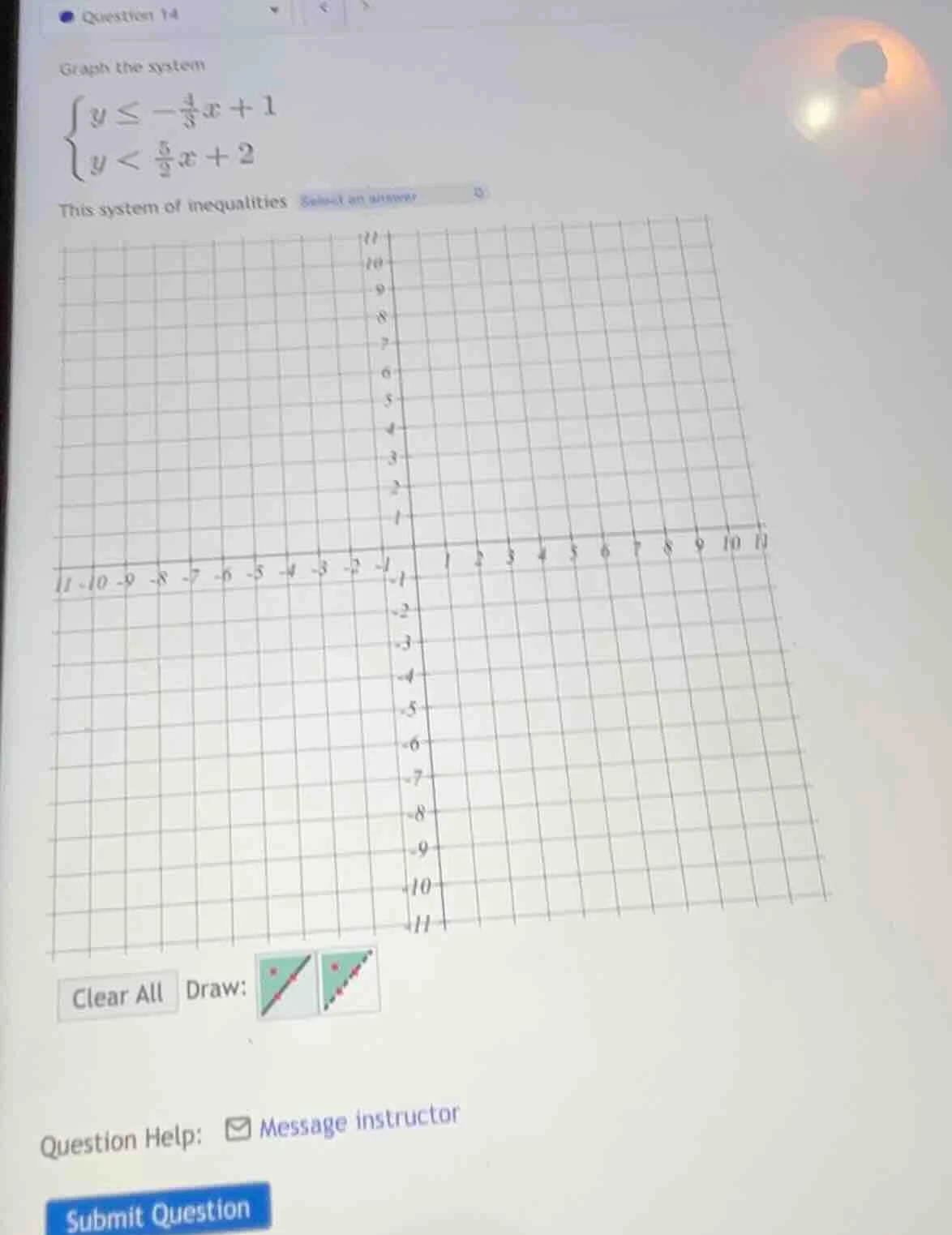
graph the system
$\
$
this system of inequalities select an answer
clear all draw:
question help: message instructor
submit question
Step1: Graph boundary of first inequality
First, identify the boundary line $y = -\frac{4}{3}x + 1$. This is a solid line because the inequality is $\leq$ (includes the boundary).
- Find intercepts:
- When $x=0$, $y=1$ (y-intercept: $(0,1)$)
- When $y=0$, $0 = -\frac{4}{3}x +1 \implies x = \frac{3}{4}$ (x-intercept: $(\frac{3}{4},0)$)
Shade the region below this line, since $y$ is less than or equal to the expression.
Step2: Graph boundary of second inequality
Next, identify the boundary line $y = \frac{5}{2}x + 2$. This is a dashed line because the inequality is $<$ (does not include the boundary).
- Find intercepts:
- When $x=0$, $y=2$ (y-intercept: $(0,2)$)
- When $y=0$, $0 = \frac{5}{2}x +2 \implies x = -\frac{4}{5}$ (x-intercept: $(-\frac{4}{5},0)$)
Shade the region below this dashed line, since $y$ is less than the expression.
Step3: Identify overlapping region
The solution to the system is the area where the two shaded regions overlap.

Snap & solve any problem in the app
Get step-by-step solutions on Sovi AI
Photo-based solutions with guided steps
Explore more problems and detailed explanations
- Draw a solid line through $(0,1)$ and $(\frac{3}{4}, 0)$, shade below it.
- Draw a dashed line through $(0,2)$ and $(-\frac{4}{5}, 0)$, shade below it.
- The overlapping shaded area is the solution set.