QUESTION IMAGE
Question
question 14 (1 point)
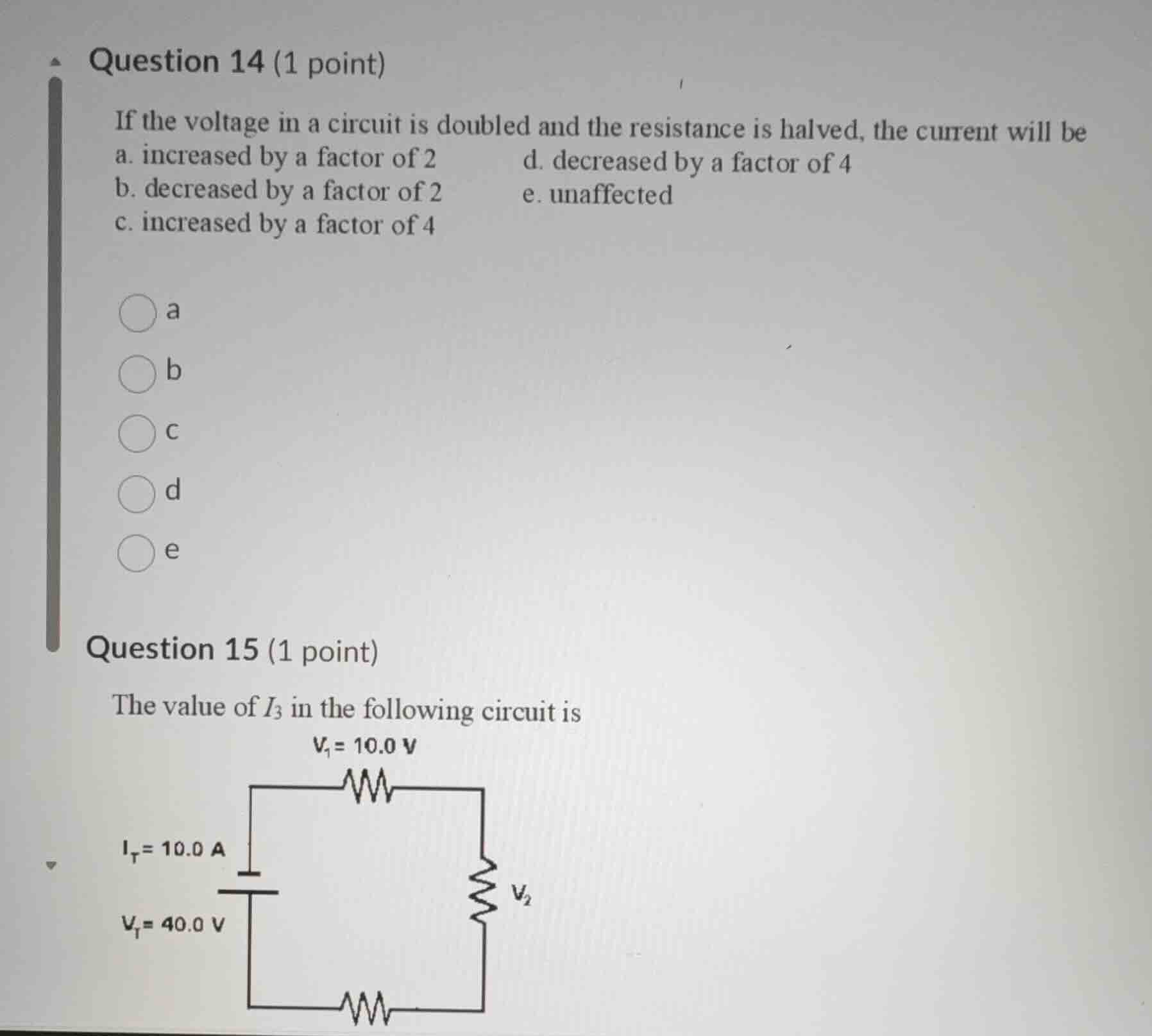
if the voltage in a circuit is doubled and the resistance is halved, the current will be
a. increased by a factor of 2 d. decreased by a factor of 4
b. decreased by a factor of 2 e. unaffected
c. increased by a factor of 4
question 15 (1 point)
the value of ( i_3 ) in the following circuit is
( v_1 = 10.0 , \text{v} )
( i_t = 10.0 , \text{a} )
( v_t = 40.0 , \text{v} )
(image of a circuit with a battery, resistors, and labeled voltages/current)
Question 14
Step1: Recall Ohm's Law
Ohm's Law is given by \( I = \frac{V}{R} \), where \( I \) is current, \( V \) is voltage, and \( R \) is resistance.
Step2: Analyze new voltage and resistance
Let the original voltage be \( V \) and original resistance be \( R \). The new voltage \( V' = 2V \) and new resistance \( R' = \frac{R}{2} \).
Step3: Calculate new current
Substitute into Ohm's Law: \( I' = \frac{V'}{R'} = \frac{2V}{\frac{R}{2}} \). Simplify: \( \frac{2V}{\frac{R}{2}} = 2V\times\frac{2}{R}=\frac{4V}{R} \). Since original \( I = \frac{V}{R} \), \( I' = 4I \). So current increases by factor of 4.
Step1: Recall Kirchhoff's Current Law (KCL) for series circuits
In a series circuit, the current is the same through all components. So \( I_T = I_3 \) (since it's a series circuit, current doesn't change through components). Given \( I_T = 10.0 \, A \), so \( I_3 = 10.0 \, A \). (Note: If we check voltage, using Kirchhoff's Voltage Law (KVL), total voltage \( V_T = 40.0 \, V \), voltage across one resistor \( V_1 = 10.0 \, V \), so \( V_2 = 40 - 10 = 30 \, V \), but for current, series circuit has same current throughout.)
Step2: Determine \( I_3 \)
Since it's a series circuit, \( I_3 = I_T = 10.0 \, A \).

Snap & solve any problem in the app
Get step-by-step solutions on Sovi AI
Photo-based solutions with guided steps
Explore more problems and detailed explanations
c. increased by a factor of 4