QUESTION IMAGE
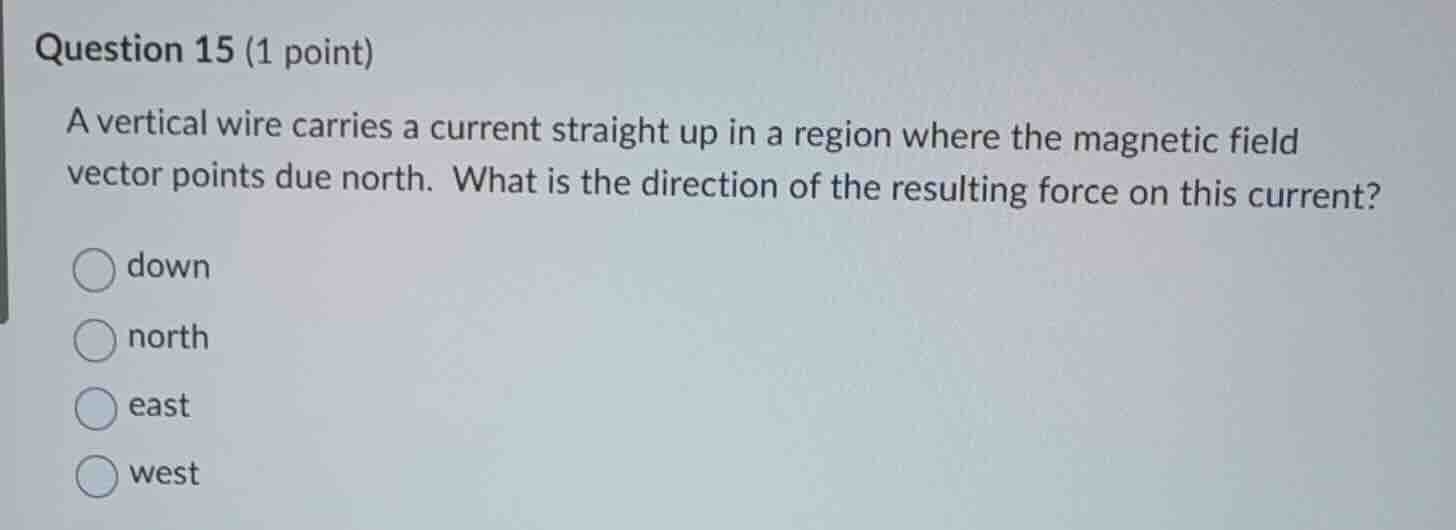
Question
question 15 (1 point)
a vertical wire carries a current straight up in a region where the magnetic field vector points due north. what is the direction of the resulting force on this current?
down
north
east
west
Step1: Recall the Right-Hand Rule
To determine the direction of the magnetic force on a current - carrying wire, we use the right - hand rule for the cross product \(\vec{F}=I\vec{L}\times\vec{B}\) (where \(\vec{F}\) is the force, \(I\) is the current, \(\vec{L}\) is the length vector of the wire in the direction of the current, and \(\vec{B}\) is the magnetic field). The right - hand rule states that if we point the fingers of our right hand in the direction of \(\vec{L}\) (current direction) and then curl them towards \(\vec{B}\) (magnetic field direction), our thumb points in the direction of \(\vec{F}\).
The current is straight up, so the direction of \(\vec{L}\) (current direction) is upward (let's consider the upward direction as the positive \(z\) - axis for simplicity). The magnetic field \(\vec{B}\) points due north (let's consider the north direction as the positive \(y\) - axis).
Step2: Apply the Right - Hand Rule
Using the right - hand rule for the cross product \(\vec{L}\times\vec{B}\):
- Point your right hand fingers in the direction of the current (upward, along the \(z\) - axis).
- Then, curl your fingers towards the direction of the magnetic field (north, along the \(y\) - axis).
- When we do this, our thumb will point in the direction of the east (along the positive \(x\) - axis). Another way to think about it is using the formula for the cross product in terms of unit vectors: \(\hat{z}\times\hat{y}=-\hat{x}\)? Wait, no, wait. Wait, the standard cross - product of unit vectors: \(\hat{i}\times\hat{j}=\hat{k}\), \(\hat{j}\times\hat{k}=\hat{i}\), \(\hat{k}\times\hat{i}=\hat{j}\) and the anti - commutative property \(\vec{A}\times\vec{B}=-\vec{B}\times\vec{A}\). If the current is in the \(+\hat{z}\) direction (\(\vec{L}\) is in \(+\hat{z}\)) and the magnetic field \(\vec{B}\) is in \(+\hat{y}\) (north), then \(\vec{F}=I\vec{L}\times\vec{B}\), so \(\hat{z}\times\hat{y}=-\hat{x}\)? Wait, no, I think I mixed up the axes. Let's re - define the axes properly. Let's take:
- Let the positive \(y\) - axis be north.
- Let the positive \(x\) - axis be east.
- Let the positive \(z\) - axis be up (current direction).
The cross product \(\vec{L}\times\vec{B}\) (where \(\vec{L}\) is in \(+\hat{z}\) and \(\vec{B}\) is in \(+\hat{y}\)): \(\hat{z}\times\hat{y}=-\hat{x}\)? No, wait, the cross - product formula: \(\hat{z}\times\hat{y}=\hat{z}\times\hat{y}\). Using the right - hand rule: hold your right hand so that your fingers point in the direction of \(\vec{L}\) (up, \(\hat{z}\)) and then bend your fingers towards \(\vec{B}\) (north, \(\hat{y}\)). The direction your thumb points is west? Wait, no, I think I made a mistake in the axis definition. Let's use the right - hand rule correctly:
The right - hand rule for the force on a current - carrying conductor: \(F = ILB\sin\theta\), and the direction is given by the right - hand rule where:
- Point your right hand's index finger in the direction of the current (\(I\)).
- Point your middle finger in the direction of the magnetic field (\(B\)).
- Your thumb will point in the direction of the force (\(F\)).
So current (index finger) is up, magnetic field (middle finger) is north. So when index is up and middle is north, the thumb points to the west? Wait, no, let's do it physically. If the current is going up (out of the page, if we consider the page as the \(xy\) - plane, with north as up on the page, east as right). Wait, maybe a better way:
Imagine the wire is vertical, current going up (towards the sky). The magnetic field is pointing north (towards the north po…

Snap & solve any problem in the app
Get step-by-step solutions on Sovi AI
Photo-based solutions with guided steps
Explore more problems and detailed explanations
west (the option: west)