QUESTION IMAGE
Question
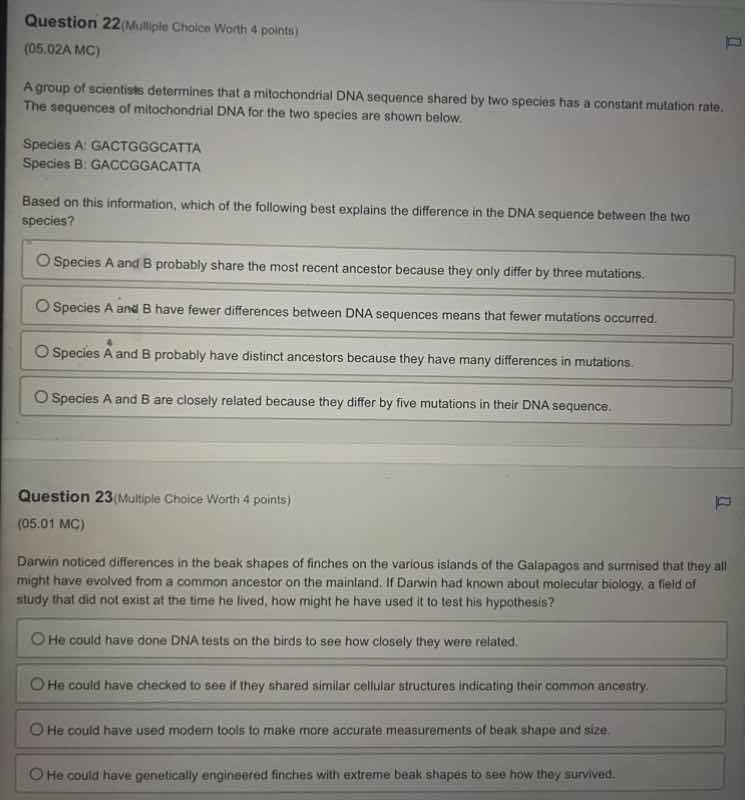
question 22 (multiple choice worth 4 points)
(05.02a mc)
a group of scientists determines that a mitochondrial dna sequence shared by two species has a constant mutation rate.
the sequences of mitochondrial dna for the two species are shown below.
species a: gactggggcatta
species b: gaccgggacatta
based on this information, which of the following best explains the difference in the dna sequence between the two
species?
○ species a and b probably share the most recent ancestor because they only differ by three mutations.
○ species a and b have fewer differences between dna sequences means that fewer mutations occurred.
○ species a and b probably have distinct ancestors because they have many differences in mutations.
○ species a and b are closely related because they differ by five mutations in their dna sequence.
question 23 (multiple choice worth 4 points)
(05.01 mc)
darwin noticed differences in the beak shapes of finches on the various islands of the galapagos and surmised that they all
might have evolved from a common ancestor on the mainland. if darwin had known about molecular biology, a field of
study that did not exist at the time he lived, how might he have used it to test his hypothesis?
○ he could have done dna tests on the birds to see how closely they were related.
○ he could have checked to see if they shared similar cellular structures indicating their common ancestry.
○ he could have used modern tools to make more accurate measurements of beak shape and size.
○ he could have genetically engineered finches with extreme beak shapes to see how they survived.
Question 22
- First, count the mutations between the two DNA sequences (Species A: GACTGGGGCATTA; Species B: GACCGGACATTA). By comparing each position:
- Position 4: T (A) vs C (B) – mutation.
- Position 5: G (A) vs C (B) – mutation.
- Position 6: G (A) vs G (B) – no mutation.
- Position 7: G (A) vs G (B) – no mutation.
- Position 8: G (A) vs A (B) – mutation.
So total mutations are 3.
- Analyze each option:
- Option 1: Says they differ by three mutations, and sharing a recent ancestor makes sense as fewer mutations (shorter time since divergence).
- Option 2: “Fewer differences means fewer mutations” is a tautology and not an explanation of the difference’s significance.
- Option 3: They only have 3 mutations, not “many”, so this is wrong.
- Option 4: They differ by 3, not 5, so this is incorrect.
- Darwin’s hypothesis is common ancestry. Molecular biology (like DNA analysis) can show genetic relatedness.
- Analyze options:
- Option 1: DNA tests show genetic relatedness, which tests common ancestry.
- Option 2: Cellular structures are more about cell biology, not direct molecular evidence for ancestry.
- Option 3: Measuring beak shape is morphological, not molecular biology.
- Option 4: Genetic engineering wasn’t possible then, and it’s not a test of common ancestry from the past.

Snap & solve any problem in the app
Get step-by-step solutions on Sovi AI
Photo-based solutions with guided steps
Explore more problems and detailed explanations
A. Species A and B probably share the most recent ancestor because they only differ by three mutations.