QUESTION IMAGE
Question
question 32
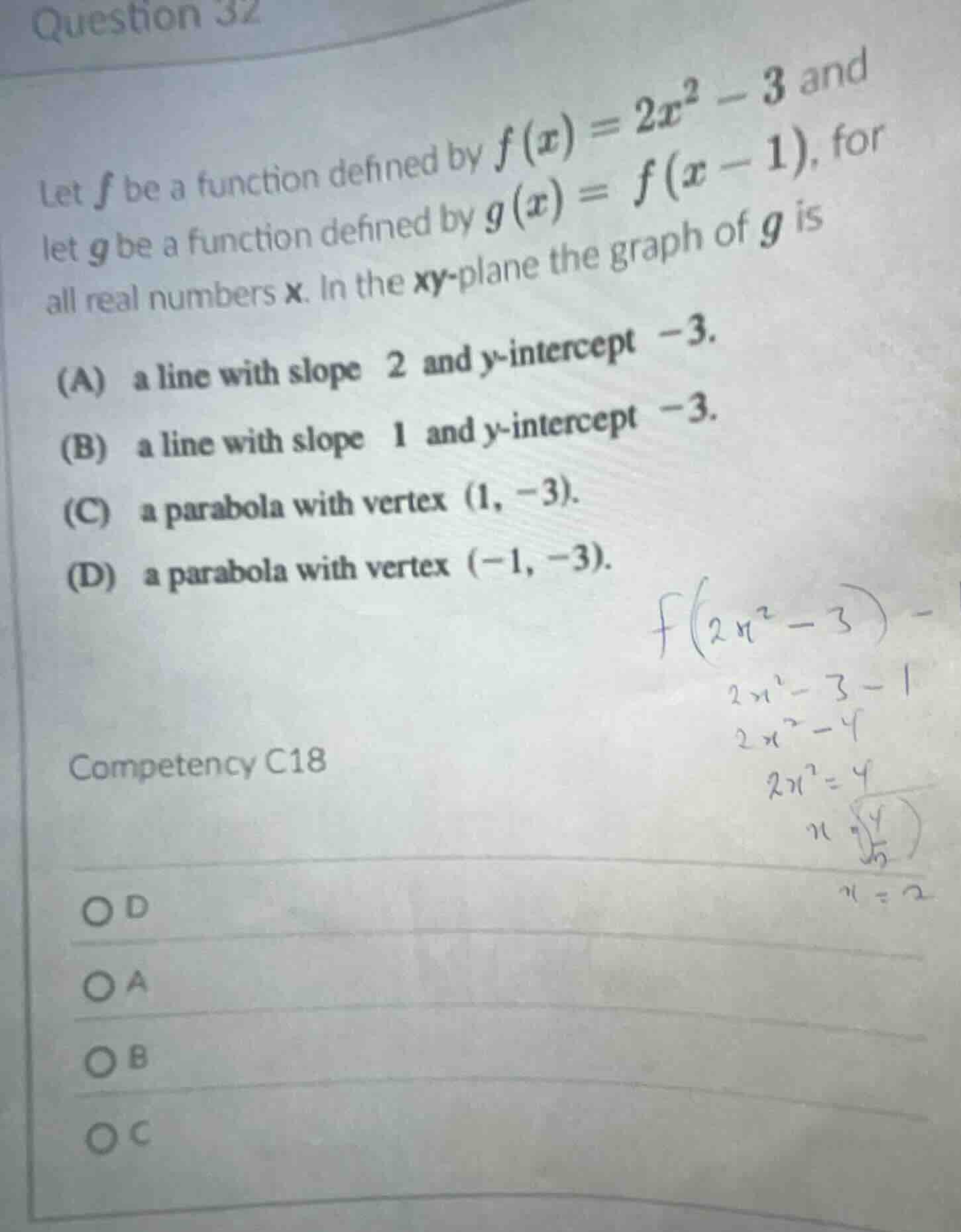
let ( f ) be a function defined by ( f(x) = 2x^2 - 3 ) and let ( g ) be a function defined by ( g(x) = f(x - 1) ), for all real numbers ( x ). in the ( xy )-plane the graph of ( g ) is
(a) a line with slope 2 and ( y )-intercept ( -3 ).
(b) a line with slope 1 and ( y )-intercept ( -3 ).
(c) a parabola with vertex ( (1, -3) ).
(d) a parabola with vertex ( (-1, -3) ).
competency c18
Step1: Substitute \( f(x) \) into \( g(x) \)
Given \( f(x) = 2x^2 - 3 \) and \( g(x) = f(x - 1) \), substitute \( x - 1 \) into \( f(x) \):
\( g(x) = 2(x - 1)^2 - 3 \)
Step2: Expand the expression
Expand \( (x - 1)^2 \):
\( (x - 1)^2 = x^2 - 2x + 1 \)
So, \( g(x) = 2(x^2 - 2x + 1) - 3 = 2x^2 - 4x + 2 - 3 = 2x^2 - 4x - 1 \)
Step3: Analyze the function type and vertex
The function \( g(x) = 2x^2 - 4x - 1 \) is a quadratic function (since the highest power of \( x \) is 2), so its graph is a parabola. For a quadratic function in the form \( y = a(x - h)^2 + k \), the vertex is \( (h, k) \). We can also find the vertex using the formula \( x = -\frac{b}{2a} \) for \( y = ax^2 + bx + c \).
For \( g(x) = 2x^2 - 4x - 1 \), \( a = 2 \), \( b = -4 \).
\( x = -\frac{-4}{2 \times 2} = \frac{4}{4} = 1 \)
Substitute \( x = 1 \) into \( g(x) \):
\( g(1) = 2(1)^2 - 4(1) - 1 = 2 - 4 - 1 = -3 \)
So the vertex is \( (1, -3) \).

Snap & solve any problem in the app
Get step-by-step solutions on Sovi AI
Photo-based solutions with guided steps
Explore more problems and detailed explanations
C. a parabola with vertex \( (1, -3) \)