QUESTION IMAGE
Question
question 9 of 40
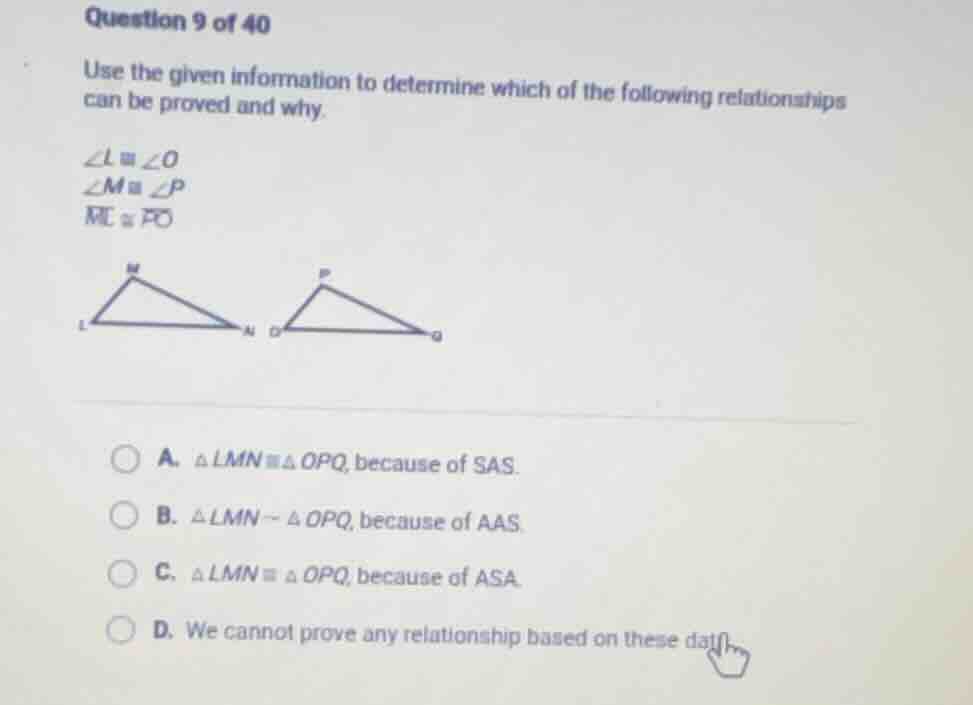
use the given information to determine which of the following relationships can be proved and why.
$\angle l \cong \angle o$
$\angle m \cong \angle p$
$ml \cong po$
a. $\triangle lmn \cong \triangle opq$, because of sas.
b. $\triangle lmn \sim \triangle opq$, because of aas.
c. $\triangle lmn \cong \triangle opq$, because of asa.
d. we cannot prove any relationship based on these data
First, analyze the given congruent/equal elements: $\angle L \cong \angle O$, $\angle M \cong \angle P$, and $\overline{ML} \cong \overline{PO}$. For triangle congruence or similarity:
- SAS requires two sides and the included angle, which is not satisfied here.
- ASA requires two angles and the included side; the side $\overline{ML}$ is not the included side between $\angle L$ and $\angle M$, so ASA does not apply.
- AAS applies to congruence (not just similarity) when two angles and a non-included side are congruent. However, the given congruent side $\overline{ML}$ corresponds to $\overline{PO}$, but to confirm full triangle congruence, we need to verify the correspondence of the third pair of angles and the remaining sides. Wait, no—actually, with two pairs of congruent angles, the triangles are similar by AA similarity, but the given congruent side is not between the corresponding angles, and for congruence, AAS requires the side to be a corresponding non-included side. But here, $\overline{ML}$ is a side of $\triangle LMN$ opposite $\angle N$, and $\overline{PO}$ is a side of $\triangle OPQ$ opposite $\angle Q$. Since $\angle L \cong \angle O$ and $\angle M \cong \angle P$, $\angle N \cong \angle Q$ by the triangle angle sum theorem. However, the given congruent side is not a corresponding side that links the angle pairs for AAS congruence correctly (AAS needs a side adjacent to one of the congruent angles, not the one opposite the unstated angle). So we cannot prove the triangles are congruent, and while AA would prove similarity, option B incorrectly cites AAS for similarity (AAS is for congruence, not similarity). None of the congruence/similarity justifications in options A, B, C are valid.

Snap & solve any problem in the app
Get step-by-step solutions on Sovi AI
Photo-based solutions with guided steps
Explore more problems and detailed explanations
D. We cannot prove any relationship based on these data