QUESTION IMAGE
Question
question 4 of 8
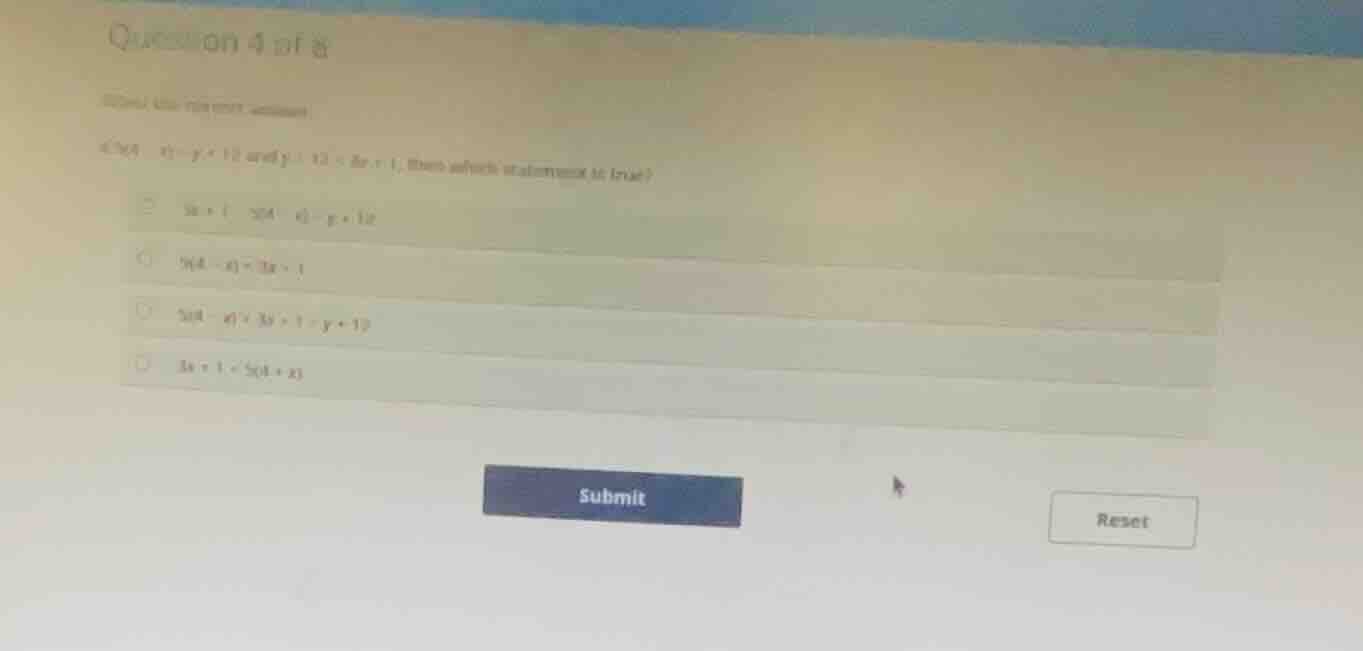
choose the correct answer.
let ( 5(1 - x) = y + 12 ) and ( y + 12 = 3x + 1 ), then which statement is true?
( 3x + 1 = 5(1 - x) + y + 12 )
( 5(1 - x) = 3x + 1 )
( 5(1 - x) = 3x + 1 = y + 12 )
( 3x + 1 < 5(1 + x) )
Step1: Analyze the given inequalities
We have two inequalities: \( 5(1 - x)>y + 12 \) and \( y+12>3x + 1 \). By the transitive property of inequalities (if \( a > b \) and \( b > c \), then \( a > c \)), we can combine these two inequalities.
Step2: Apply the transitive property
Since \( 5(1 - x)>y + 12 \) and \( y + 12>3x + 1 \), we can substitute the middle term (\( y + 12 \)) to get \( 5(1 - x)>3x + 1 \). Rearranging this inequality (or just looking at the transitive relation), we can also see the reverse relation in terms of the last option. Let's check each option:
- Option 1: \( 3x + 1>5(1 - x)+y + 12 \) - This would require \( 3x + 1>5(1 - x)+(>3x + 1) \), which is not possible.
- Option 2: \( 5(1 - x)>3x + 1 \) - We know \( 5(1 - x)>y + 12 \) and \( y + 12>3x + 1 \), but we can't be sure \( 5(1 - x)>3x + 1 \) directly (transitive gives \( 5(1 - x)>3x + 1 \) only if we consider the two inequalities, wait no: Wait, \( a>b \) and \( b>c \) implies \( a>c \), so \( 5(1 - x)>y + 12>3x + 1 \) implies \( 5(1 - x)>3x + 1 \)? Wait no, \( 5(1 - x)>y + 12 \) and \( y + 12>3x + 1 \) means \( 5(1 - x)>3x + 1 \) by transitivity. But let's check the last option: \( 3x + 1<5(1 - x) \) which is the same as \( 5(1 - x)>3x + 1 \), which is exactly what we get from transitivity. Wait, maybe I made a mistake earlier. Wait, the last option is \( 3x + 1<5(1 - x) \), which is equivalent to \( 5(1 - x)>3x + 1 \), which is true because \( 5(1 - x)>y + 12 \) and \( y + 12>3x + 1 \), so by transitivity, \( 5(1 - x)>3x + 1 \), so \( 3x + 1<5(1 - x) \) is true. Let's verify other options:
- Option 3: \( 5(1 - x)>3x + 1 + y + 12 \) - \( y + 12>3x + 1 \), so \( 3x + 1 + y + 12>3x + 1+3x + 1=6x + 2 \), but we can't say \( 5(1 - x)>6x + 2 \) from given info.
- Option 4: \( 3x + 1<5(1 - x) \) - As per transitivity, since \( 5(1 - x)>y + 12 \) and \( y + 12>3x + 1 \), then \( 5(1 - x)>3x + 1 \), which is equivalent to \( 3x + 1<5(1 - x) \).
So the correct option is the last one (assuming the last option is \( 3x + 1<5(1 - x) \)).

Snap & solve any problem in the app
Get step-by-step solutions on Sovi AI
Photo-based solutions with guided steps
Explore more problems and detailed explanations
The correct option is the one with \( 3x + 1 < 5(1 - x) \) (the last option in the list, likely labeled as the fourth option in the original problem's choices).