QUESTION IMAGE
Question
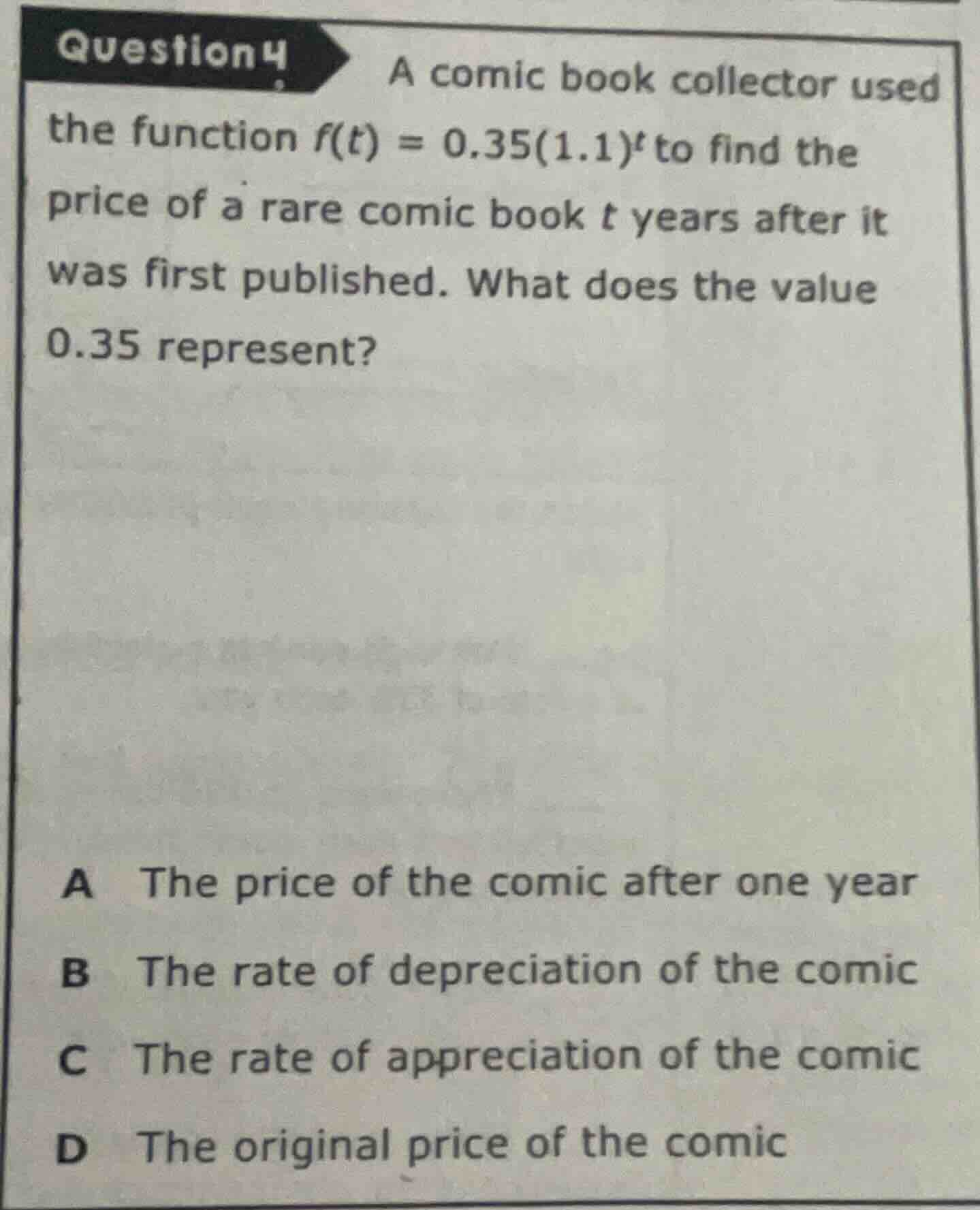
question 4 a comic book collector used the function $f(t) = 0.35(1.1)^t$ to find the price of a rare comic book $t$ years after it was first published. what does the value 0.35 represent? a the price of the comic after one year b the rate of depreciation of the comic c the rate of appreciation of the comic d the original price of the comic
Step1: Recall the exponential growth formula
The general form of an exponential growth function is \( f(t)=a(1 + r)^{t} \), where \( a \) is the initial amount, \( r \) is the growth rate, and \( t \) is the time.
Step2: Compare with the given function
The given function is \( f(t)=0.35(1.1)^{t} \). Comparing it with the general form \( f(t)=a(1 + r)^{t} \), we can see that when \( t = 0 \) (the time when the comic was first published, \( t = 0 \) years after publication), \( f(0)=0.35(1.1)^{0}=0.35\times1 = 0.35 \). So \( 0.35 \) is the value of the function when \( t = 0 \), which represents the initial price (original price) of the comic.
Step3: Analyze other options
- Option A: The price after one year would be \( f(1)=0.35(1.1)^{1}=0.385 \), not \( 0.35 \), so A is wrong.
- Option B: The base of the exponential is \( 1.1 \), so the growth rate \( r=0.1 \) (10% growth), not depreciation (depreciation would have a base less than 1), so B is wrong.
- Option C: The rate of appreciation is \( 0.1 \) (from \( 1.1=1 + 0.1 \)), not \( 0.35 \), so C is wrong.

Snap & solve any problem in the app
Get step-by-step solutions on Sovi AI
Photo-based solutions with guided steps
Explore more problems and detailed explanations
D. The original price of the comic