QUESTION IMAGE
Question
question 3
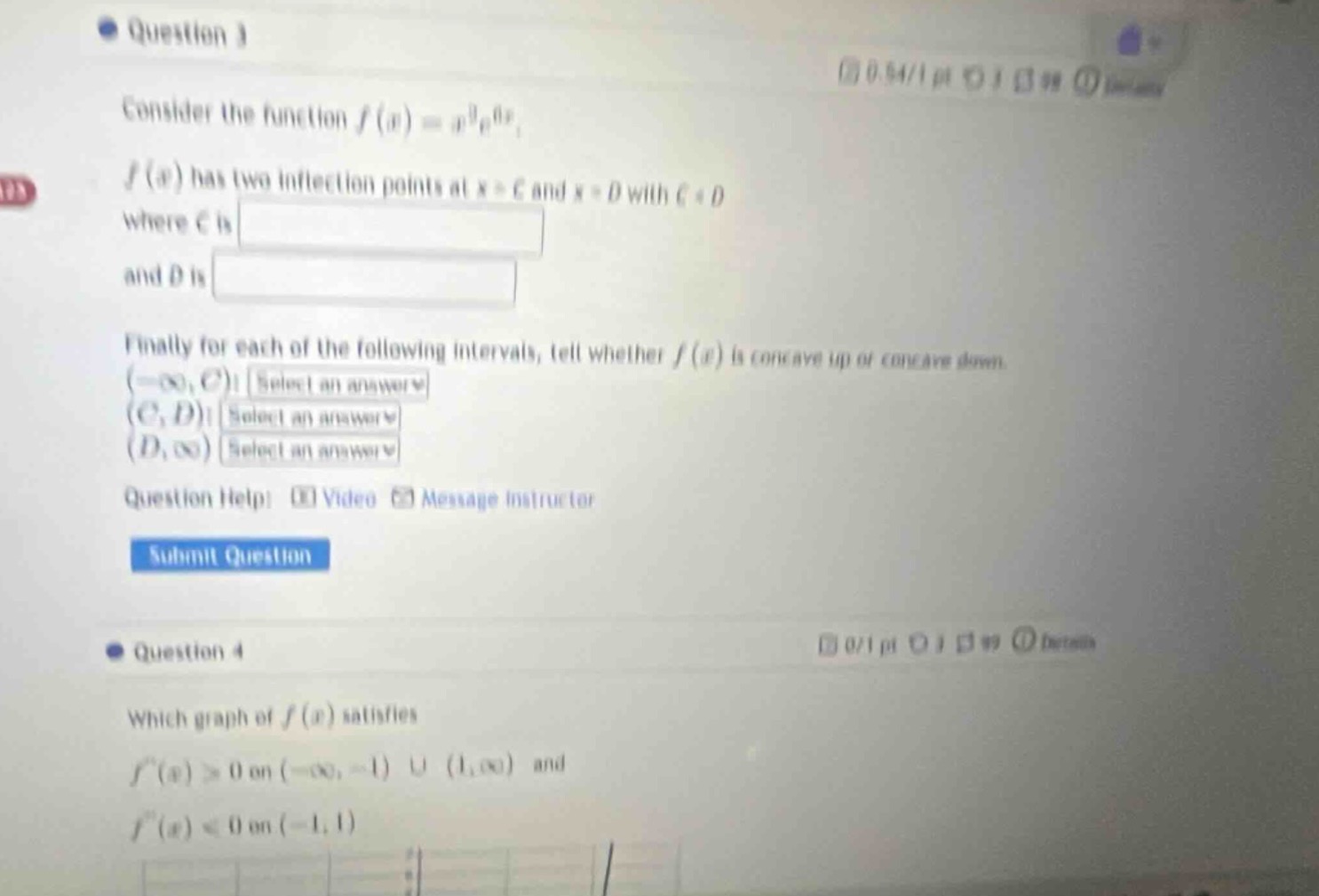
consider the function $f(x) = x^3 e^{0x}$
$f(x)$ has two inflection points at $x = c$ and $x = d$ with $c < d$
where $c$ is
and $d$ is
finally for each of the following intervals, tell whether $f(x)$ is concave up or concave down.
$(-infty, c)$: select an answer
$(c, d)$: select an answer
$(d, infty)$ select an answer
question help: video message instructor
question 4
which graph of $f(x)$ satisfies
$f(x) > 0$ on $(-infty, -1) \cup (1, infty)$ and
$f(x) < 0$ on $(-1, 1)$
Step1: Find first derivative
Use product rule: $(uv)'=u'v+uv'$, where $u=x^3$, $v=e^{6x}$.
$f'(x) = 3x^2e^{6x} + x^3\cdot 6e^{6x} = e^{6x}(3x^2 + 6x^3)$
Step2: Find second derivative
Differentiate $f'(x)$ with product rule.
$f''(x) = 6e^{6x}(3x^2+6x^3) + e^{6x}(6x+18x^2)$
Factor out $6e^{6x}x$:
$f''(x) = 6xe^{6x}(3x^2+6x + 1 + 3x) = 6xe^{6x}(6x^2+9x+1)$
Step3: Solve $f''(x)=0$
$e^{6x}
eq0$, so solve $6x^2+9x+1=0$ with quadratic formula $x=\frac{-b\pm\sqrt{b^2-4ac}}{2a}$, $a=6,b=9,c=1$.
$x=\frac{-9\pm\sqrt{81-24}}{12}=\frac{-9\pm\sqrt{57}}{12}=\frac{-3\pm\sqrt{57}}{4}$
Step4: Order the inflection points
$C=\frac{-3-\sqrt{57}}{4}$, $D=\frac{-3+\sqrt{57}}{4}$ (since $C Pick $x=-3$: $f''(-3)>0$, so concave up. Pick $x=-0.1$: $f''(-0.1)<0$, so concave down. Pick $x=1$: $f''(1)>0$, so concave up.Step5: Test concavity for $(-\infty,C)$
Step6: Test concavity for $(C,D)$
Step7: Test concavity for $(D,\infty)$
The second derivative sign tells concavity: $f''(x)\geq0$ means concave up, $f''(x)\leq0$ means concave down. So the graph is concave up on $(-\infty,-1)\cup(1,\infty)$ and concave down on $(-1,1)$. This describes a graph that curves upward outside $[-1,1]$ and curves downward between $-1$ and $1$.

Snap & solve any problem in the app
Get step-by-step solutions on Sovi AI
Photo-based solutions with guided steps
Explore more problems and detailed explanations
$C = \frac{-3-\sqrt{57}}{4}$, $D = \frac{-3+\sqrt{57}}{4}$
$(-\infty,C)$: concave up
$(C,D)$: concave down
$(D,\infty)$: concave up
---
For Question 4: