QUESTION IMAGE
Question
- question content not fully visible
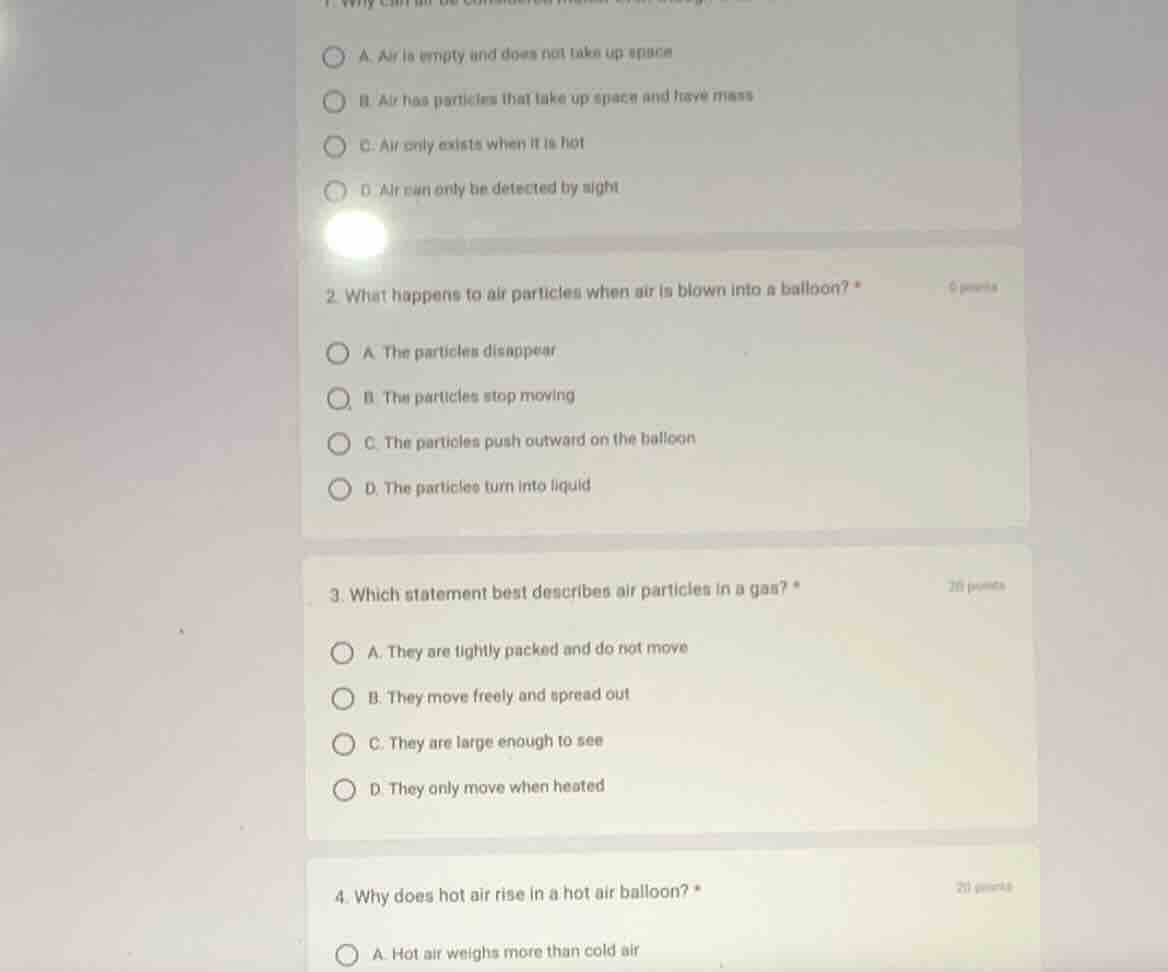
a. air is empty and does not take up space
b. air has particles that take up space and have mass
c. air only exists when it is hot
d. air can only be detected by sight
- what happens to air particles when air is blown into a balloon? *
a. the particles disappear
b. the particles stop moving
c. the particles push outward on the balloon
d. the particles turn into liquid
- which statement best describes air particles in a gas? *
a. they are tightly packed and do not move
b. they move freely and spread out
c. they are large enough to see
d. they only move when heated
- why does hot air rise in a hot air balloon? *
a. hot air weighs more than cold air
Brief Explanations
- For question 1: Matter is defined as anything that has mass and takes up space. Air is matter because it is made of particles with mass and volume.
- For question 2: When air is blown into a balloon, the added air particles increase pressure inside, pushing outward on the balloon's walls.
- For question 3: Gas particles (like air) have high kinetic energy, move freely, and spread out to fill their container.
- For question 4 (partial): Hot air rises because it is less dense than cold air; when air is heated, its particles spread out, lowering its density compared to surrounding cooler air.

Snap & solve any problem in the app
Get step-by-step solutions on Sovi AI
Photo-based solutions with guided steps
Explore more problems and detailed explanations
- B. Air has particles that take up space and have mass
- C. The particles push outward on the balloon
- B. They move freely and spread out
- (Note: The full options for question 4 are cut off, but the correct reasoning is that hot air is less dense than cold air, so the intended correct option would state this principle)