QUESTION IMAGE
Question
question
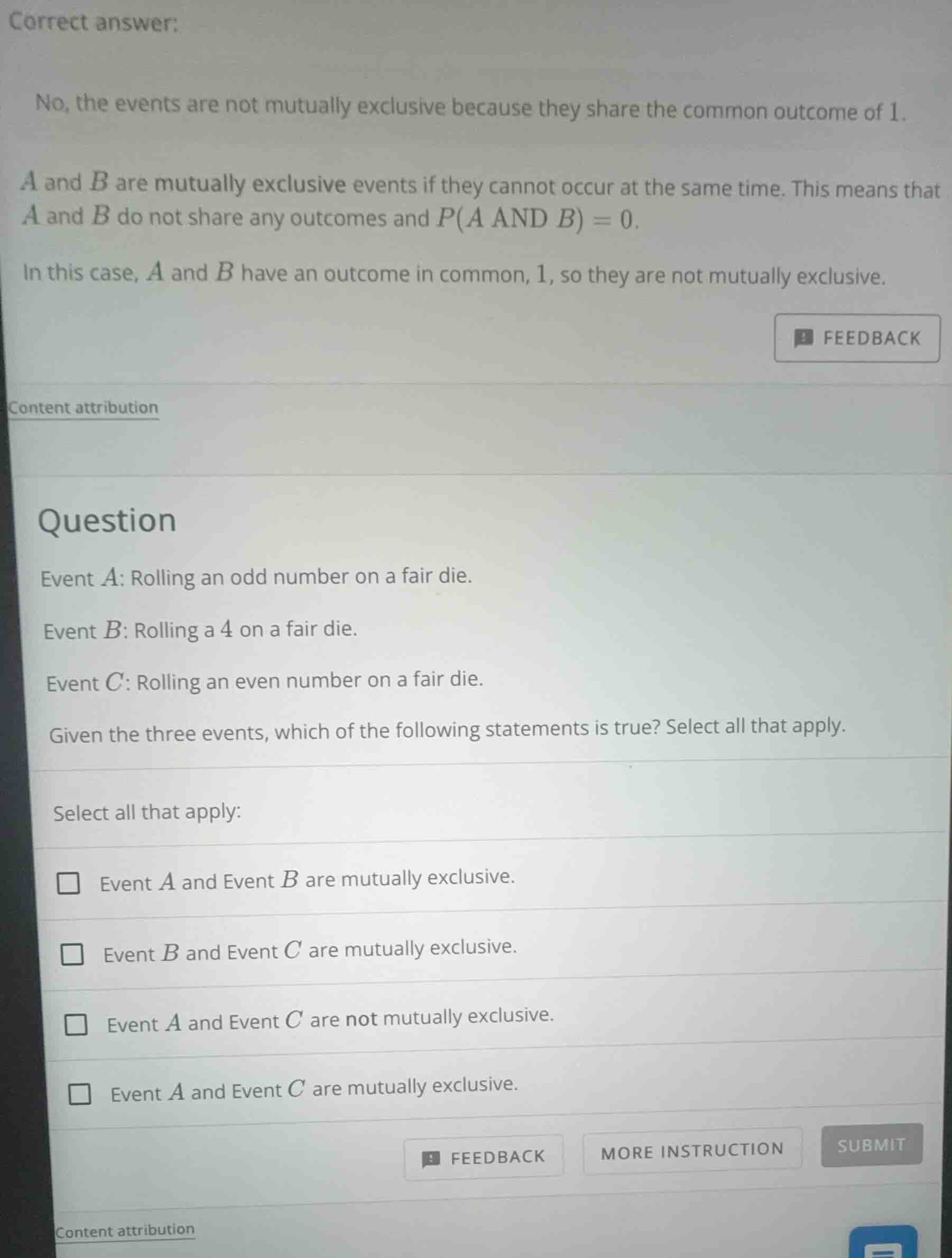
event a: rolling an odd number on a fair die.
event b: rolling a 4 on a fair die.
event c: rolling an even number on a fair die.
given the three events, which of the following statements is true? select all that apply.
select all that apply:
□ event a and event b are mutually exclusive.
□ event b and event c are mutually exclusive.
□ event a and event c are not mutually exclusive.
□ event a and event c are mutually exclusive.
Brief Explanations
- Event A and Event B: Event A (odd numbers: 1, 3, 5) and Event B (rolling a 4). 4 is even, so no common outcomes. Thus, they are mutually exclusive.
- Event B and Event C: Event B (rolling a 4) and Event C (even numbers: 2, 4, 6). 4 is in both, so they are not mutually exclusive. Wait, no—wait, mutually exclusive means no common outcomes. But 4 is in both B and C, so they can occur at the same time (rolling a 4 is both B and C). Wait, no, that's a mistake. Wait, Event B is rolling a 4, Event C is rolling an even number. So if you roll a 4, both B and C occur. So they are not mutually exclusive? Wait, no, wait the definition: mutually exclusive if they cannot occur at the same time. So if B and C can occur at the same time (rolling a 4), then they are not mutually exclusive. Wait, but let's re - check:
- Event A: {1, 3, 5} (odd numbers on a die)
- Event B: {4} (rolling a 4)
- Event C: {2, 4, 6} (even numbers on a die)
- For Event A and B: The intersection of A and B is $\varnothing$ (no common elements), so $P(A\cap B)=0$. So they are mutually exclusive.
- For Event B and C: The intersection of B and C is {4}, so $P(B\cap C)=\frac{1}{6}
eq0$. So they are not mutually exclusive.
- For Event A and C: The intersection of A and C is $\varnothing$ (odd and even numbers have no overlap), so $P(A\cap C) = 0$. So they are mutually exclusive. Wait, the option "Event A and Event C are mutually exclusive" is correct, and "Event A and Event C are not mutually exclusive" is wrong. And "Event B and Event C are mutually exclusive" is wrong. And "Event A and Event B are mutually exclusive" is correct. Also, let's re - evaluate:
- Event A (odd: 1,3,5) and Event B (4): no overlap, so mutually exclusive (correct option).
- Event B (4) and Event C (even: 2,4,6): overlap (4), so not mutually exclusive (so the option "Event B and Event C are mutually exclusive" is wrong).
- Event A (odd) and Event C (even): no overlap, so mutually exclusive (so "Event A and Event C are mutually exclusive" is correct, and "Event A and Event C are not mutually exclusive" is wrong).
- Wait, I made a mistake earlier. Let's do it properly:
- Mutually exclusive: $A\cap B=\varnothing$ (no common outcomes).
- Event A: {1, 3, 5}, Event B: {4}. $A\cap B=\varnothing$, so A and B are mutually exclusive.
- Event B: {4}, Event C: {2, 4, 6}. $A\cap B = \{4\}
eq\varnothing$, so B and C are not mutually exclusive.
- Event A: {1, 3, 5}, Event C: {2, 4, 6}. $A\cap C=\varnothing$, so A and C are mutually exclusive.

Snap & solve any problem in the app
Get step-by-step solutions on Sovi AI
Photo-based solutions with guided steps
Explore more problems and detailed explanations
- Event A and Event B are mutually exclusive. (This option is correct as $A\cap B = \varnothing$)
- Event A and Event C are mutually exclusive. (This option is correct as $A\cap C=\varnothing$)
So the correct options are:
- Event A and Event B are mutually exclusive.
- Event A and Event C are mutually exclusive.