QUESTION IMAGE
Question
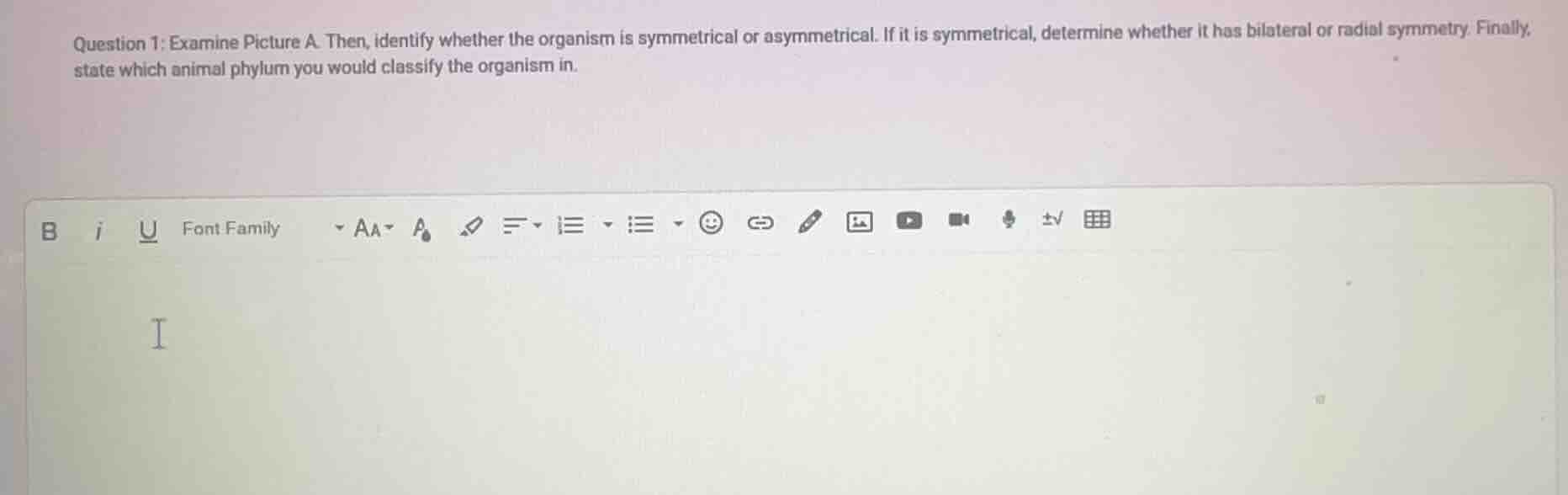
question 1: examine picture a. then, identify whether the organism is symmetrical or asymmetrical. if it is symmetrical, determine whether it has bilateral or radial symmetry. finally, state which animal phylum you would classify the organism in.
To answer this question, we would need to see Picture A (the organism in question). However, here's a general approach:
Step 1: Analyze Symmetry
- Asymmetrical: No consistent plane of symmetry (e.g., sponges, Porifera).
- Symmetrical:
- Radial symmetry: Symmetry around a central axis (e.g., jellyfish, Cnidaria; starfish, Echinodermata).
- Bilateral symmetry: Symmetry across one plane (e.g., insects, Arthropoda; humans, Chordata).
Step 2: Classify Phylum
Once symmetry is identified, match it to known phyla:
- Asymmetrical → Likely Porifera (sponges).
- Radial → Cnidaria (jellyfish, corals), Echinodermata (starfish, sea urchins) (note: echinoderms are radially symmetrical as adults but bilaterally as larvae).
- Bilateral → Most complex phyla (e.g., Arthropoda, Annelida, Chordata).
Since the image is missing, please share Picture A (or describe the organism) to provide a specific answer. For example, if Picture A is a sponge:
The organism (sponge) is asymmetrical, with no consistent symmetry plane. It belongs to Phylum Porifera.

Snap & solve any problem in the app
Get step-by-step solutions on Sovi AI
Photo-based solutions with guided steps
Explore more problems and detailed explanations
Symmetry: Asymmetrical; Phylum: Porifera (or adjust based on the actual organism in Picture A).