QUESTION IMAGE
Question
question
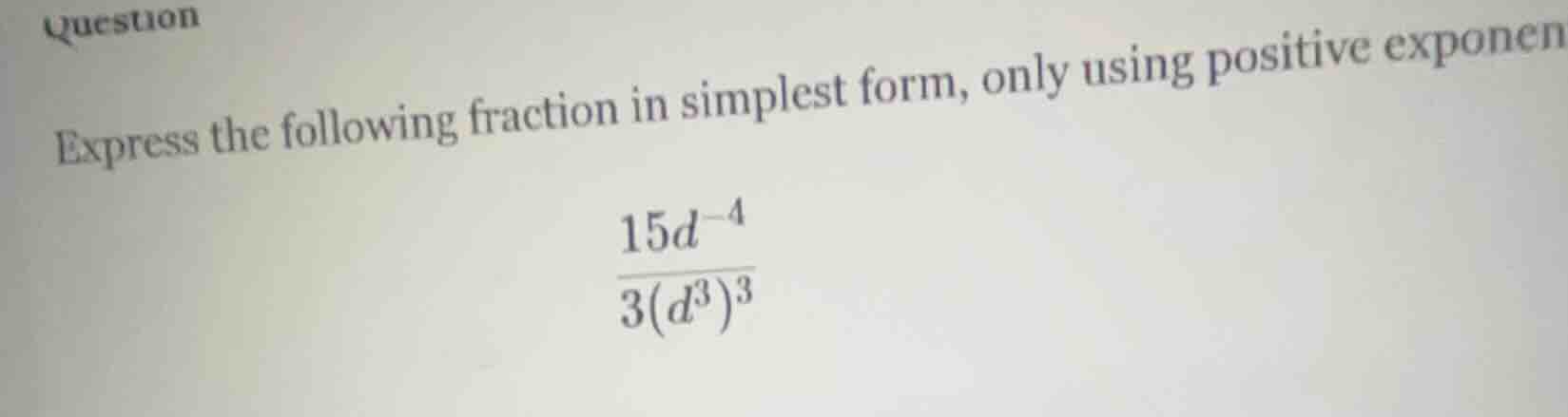
express the following fraction in simplest form, only using positive exponen
\\(\frac{15d^{-4}}{3(d^3)^3}\\)
Step1: Simplify the coefficient and the exponent of \(d\) in the denominator
First, simplify the coefficient: \(\frac{15}{3} = 5\). Then, simplify \((d^{3})^{3}\) using the power - of - a - power rule \((a^{m})^{n}=a^{mn}\). So, \((d^{3})^{3}=d^{3\times3}=d^{9}\). The expression becomes \(\frac{5d^{-4}}{d^{9}}\).
Step2: Use the negative exponent rule and the quotient rule for exponents
The negative exponent rule states that \(a^{-n}=\frac{1}{a^{n}}\), so \(d^{-4}=\frac{1}{d^{4}}\). Then, using the quotient rule for exponents \(\frac{a^{m}}{a^{n}}=a^{m - n}\) (or in the case of \(\frac{1}{a^{n}}\times a^{m}=a^{m - n}\) when we have a fraction), we have \(\frac{5d^{-4}}{d^{9}}=5\times d^{-4-9}\) (because \(\frac{d^{-4}}{d^{9}}=d^{-4}\times d^{-9}=d^{-4+( - 9)}\) by the rule \(\frac{1}{a^{n}}=a^{-n}\) and \(a^{m}\times a^{n}=a^{m + n}\)).
Step3: Simplify the exponent
Calculate \(-4-9=-13\), so the expression is \(5d^{-13}\). Then, using the negative exponent rule again, \(d^{-13}=\frac{1}{d^{13}}\), so the expression in simplest form with positive exponents is \(\frac{5}{d^{13}}\).

Snap & solve any problem in the app
Get step-by-step solutions on Sovi AI
Photo-based solutions with guided steps
Explore more problems and detailed explanations
\(\frac{5}{d^{13}}\)