QUESTION IMAGE
Question
question
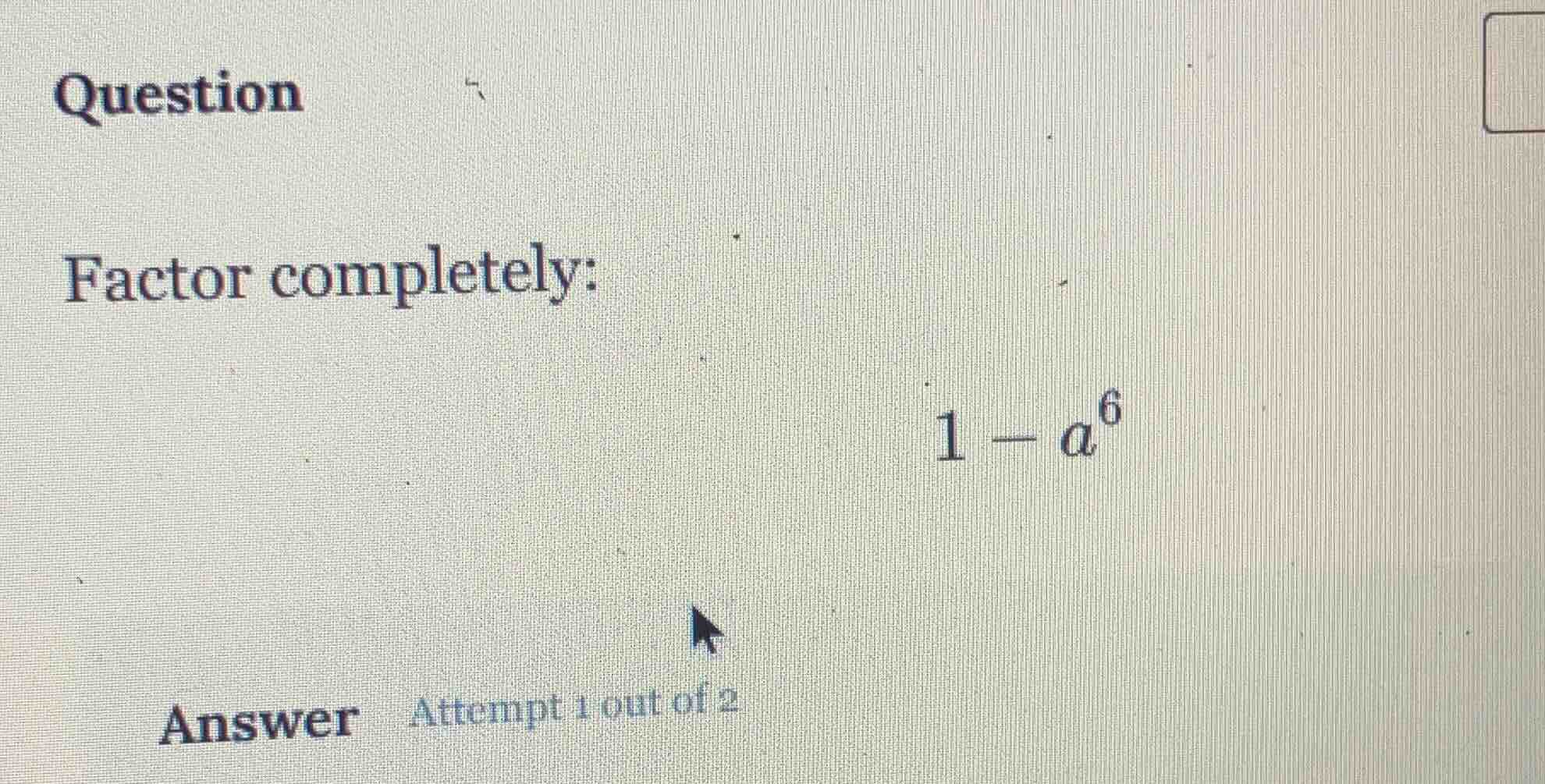
factor completely:
$1 - a^6$
answer attempt 1 out of 2
Step1: Recognize as difference of squares
The expression \(1 - a^6\) can be written as \(1^2 - (a^3)^2\), which is a difference of squares. The formula for factoring a difference of squares is \(x^2 - y^2=(x + y)(x - y)\). So, \(1^2 - (a^3)^2=(1 + a^3)(1 - a^3)\).
Step2: Factor sum and difference of cubes
Now, \(1 + a^3\) is a sum of cubes, and the formula for factoring a sum of cubes is \(x^3 + y^3=(x + y)(x^2 - xy + y^2)\). Here, \(x = 1\) and \(y = a\), so \(1 + a^3=(1 + a)(1^2 - 1\times a + a^2)=(1 + a)(1 - a + a^2)\).
Also, \(1 - a^3\) is a difference of cubes, and the formula for factoring a difference of cubes is \(x^3 - y^3=(x - y)(x^2 + xy + y^2)\). Here, \(x = 1\) and \(y = a\), so \(1 - a^3=(1 - a)(1^2 + 1\times a + a^2)=(1 - a)(1 + a + a^2)\).
Step3: Combine the factors
Putting it all together, \(1 - a^6=(1 + a^3)(1 - a^3)=(1 + a)(1 - a + a^2)(1 - a)(1 + a + a^2)\). We can re - arrange the factors as \((1 + a)(1 - a)(1 + a^2 + a)(1 + a^2 - a)\) or \((1 - a^2)(1 + a^2 + a)(1 + a^2 - a)\), but factoring \(1 - a^2\) further (since it is also a difference of squares) gives \((1 + a)(1 - a)\), so the completely factored form is \((1 + a)(1 - a)(1 + a + a^2)(1 - a + a^2)\).

Snap & solve any problem in the app
Get step-by-step solutions on Sovi AI
Photo-based solutions with guided steps
Explore more problems and detailed explanations
\((1 + a)(1 - a)(1 + a + a^2)(1 - a + a^2)\)