QUESTION IMAGE
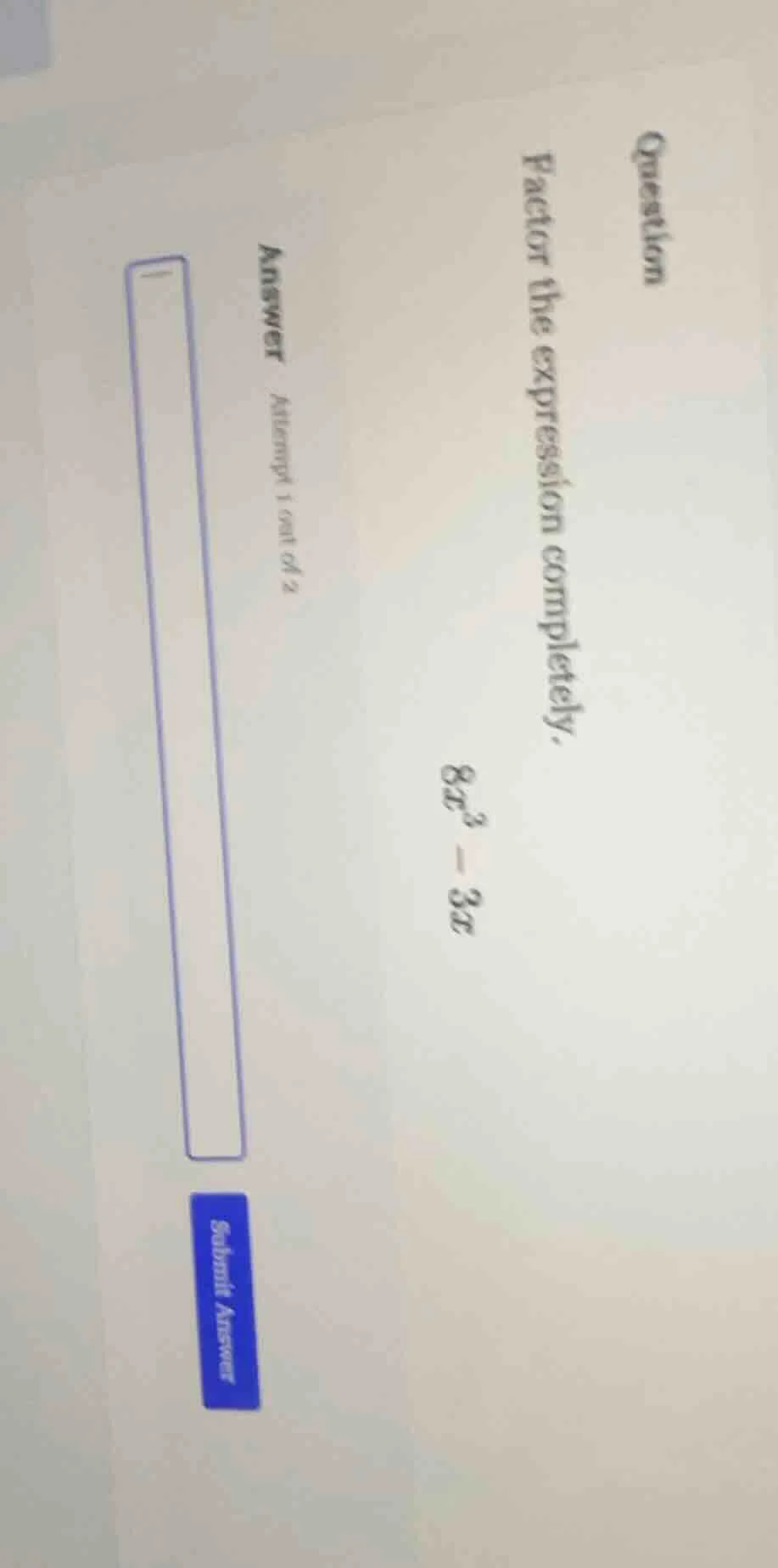
Question
question
factor the expression completely.
8x³ - 3x
answer attempt 1 out of 2
submit answer
Step1: Identify the GCF
The greatest common factor (GCF) of \(8x^3\) and \(3x\) is \(x\) (since \(x\) is the highest power of \(x\) that divides both terms, and there is no common numerical factor other than 1? Wait, no, wait: \(8x^3 - 3x\), let's check again. Wait, \(8x^3\) is \(x \times 8x^2\) and \(3x\) is \(x \times 3\). So the GCF is \(x\). Wait, but also, is there a difference of squares or something? Wait, no, first factor out the GCF. Wait, no, wait: \(8x^3 - 3x\). Wait, maybe I made a mistake. Wait, \(8x^3 - 3x\) can be factored by taking out the GCF first, which is \(x\), so:
\(8x^3 - 3x = x(8x^2 - 3)\)
Wait, but \(8x^2 - 3\) is a difference of squares? Let's see: \(8x^2 = (\sqrt{8}x)^2 = (2\sqrt{2}x)^2\) and \(3 = (\sqrt{3})^2\). So yes, \(8x^2 - 3 = (2\sqrt{2}x - \sqrt{3})(2\sqrt{2}x + \sqrt{3})\). But maybe the problem expects factoring over integers? Wait, the original expression is \(8x^3 - 3x\). Let's check again. Wait, maybe a typo? If it's \(8x^3 - 27\), that's a difference of cubes, but here it's \(8x^3 - 3x\). So first, factor out \(x\):
\(8x^3 - 3x = x(8x^2 - 3)\)
Then, \(8x^2 - 3\) can be factored as a difference of squares with irrational coefficients:
\(8x^2 - 3 = (2\sqrt{2}x - \sqrt{3})(2\sqrt{2}x + \sqrt{3})\)
So putting it together:
\(8x^3 - 3x = x(2\sqrt{2}x - \sqrt{3})(2\sqrt{2}x + \sqrt{3})\)
But maybe the problem is written incorrectly? Wait, the user provided \(8x^3 - 3x\). Let's confirm. Alternatively, maybe it's \(8x^3 - 2x\)? Then GCF is \(2x\), and \(8x^3 - 2x = 2x(4x^2 - 1) = 2x(2x - 1)(2x + 1)\). But the problem says \(8x^3 - 3x\). So assuming the problem is correct, the factorization is \(x(8x^2 - 3)\) or further into \(x(2\sqrt{2}x - \sqrt{3})(2\sqrt{2}x + \sqrt{3})\).
But maybe the problem is \(8x^3 - 3x\) as given. So first, factor out \(x\):
Step1: Factor out GCF
The GCF of \(8x^3\) and \(3x\) is \(x\). So:
\(8x^3 - 3x = x(8x^2 - 3)\)
Step2: Factor \(8x^2 - 3\) as difference of squares
Since \(8x^2 = (2\sqrt{2}x)^2\) and \(3 = (\sqrt{3})^2\), we can write:
\(8x^2 - 3 = (2\sqrt{2}x - \sqrt{3})(2\sqrt{2}x + \sqrt{3})\)
Thus, the completely factored form is:
\(8x^3 - 3x = x(2\sqrt{2}x - \sqrt{3})(2\sqrt{2}x + \sqrt{3})\)
But if we consider factoring over integers, then \(8x^2 - 3\) doesn't factor, so the answer is \(x(8x^2 - 3)\). Maybe the problem expects that. Let's check the original problem again. The user wrote "Factor the expression completely. \(8x^3 - 3x\)". So first, factor out \(x\):
\(8x^3 - 3x = x(8x^2 - 3)\)
Since \(8x^2 - 3\) can't be factored over the integers, this is the complete factorization over integers. If we allow irrational numbers, then we can factor further as above.

Snap & solve any problem in the app
Get step-by-step solutions on Sovi AI
Photo-based solutions with guided steps
Explore more problems and detailed explanations
\(x(8x^2 - 3)\) (or \(x(2\sqrt{2}x - \sqrt{3})(2\sqrt{2}x + \sqrt{3})\) if factoring over reals)