QUESTION IMAGE
Question
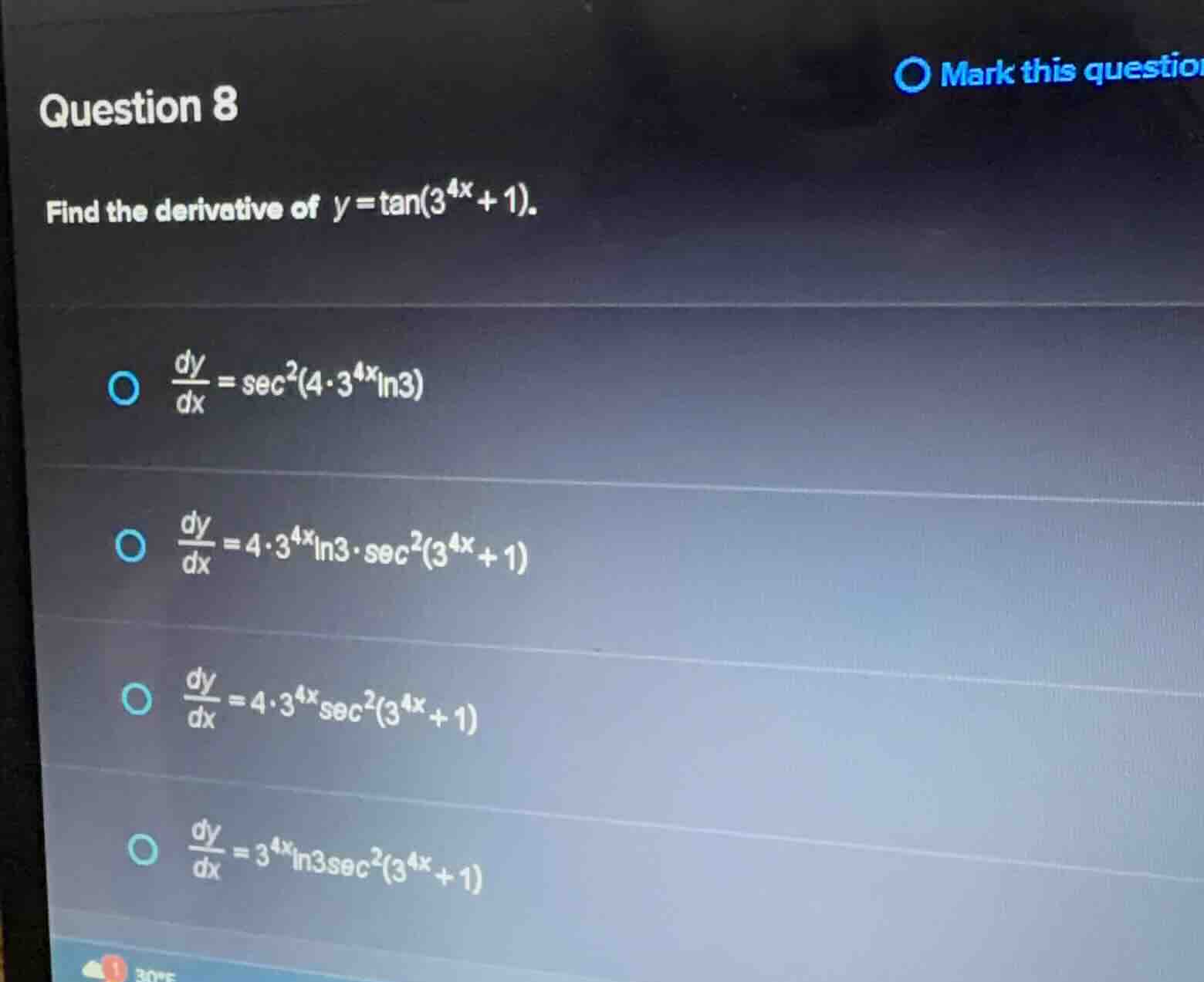
question 8 find the derivative of $y = \tan(3^{4x}+1)$. $\frac{dy}{dx}=\sec^{2}(4\cdot 3^{4x}\ln 3)$ $\frac{dy}{dx}=4\cdot 3^{4x}\ln 3\cdot \sec^{2}(3^{4x}+1)$ $\frac{dy}{dx}=4\cdot 3^{4x}\sec^{2}(3^{4x}+1)$ $\frac{dy}{dx}=3^{4x}\ln 3\sec^{2}(3^{4x}+1)$
Step1: Apply chain rule (outer function)
Let $u = 3^{4x}+1$, so $y = \tan(u)$. The derivative of $\tan(u)$ is $\sec^2(u)\cdot u'$, so:
$\frac{dy}{dx} = \sec^2(3^{4x}+1) \cdot \frac{d}{dx}(3^{4x}+1)$
Step2: Differentiate $3^{4x}+1$
The derivative of a constant is 0, so focus on $\frac{d}{dx}(3^{4x})$. Use $a^{f(x)}$ rule: $\frac{d}{dx}(a^{f(x)}) = a^{f(x)}\ln(a)\cdot f'(x)$. Here $a=3$, $f(x)=4x$, $f'(x)=4$:
$\frac{d}{dx}(3^{4x}) = 3^{4x}\ln(3)\cdot 4$
Step3: Combine results
Substitute back into the chain rule expression:
$\frac{dy}{dx} = 4\cdot 3^{4x}\ln3\cdot \sec^2(3^{4x}+1)$

Snap & solve any problem in the app
Get step-by-step solutions on Sovi AI
Photo-based solutions with guided steps
Explore more problems and detailed explanations
$\boldsymbol{\frac{dy}{dx} = 4\cdot 3^{4x}\ln3\cdot \sec^2(3^{4x}+1)}$ (the second option)