QUESTION IMAGE
Question
question 1
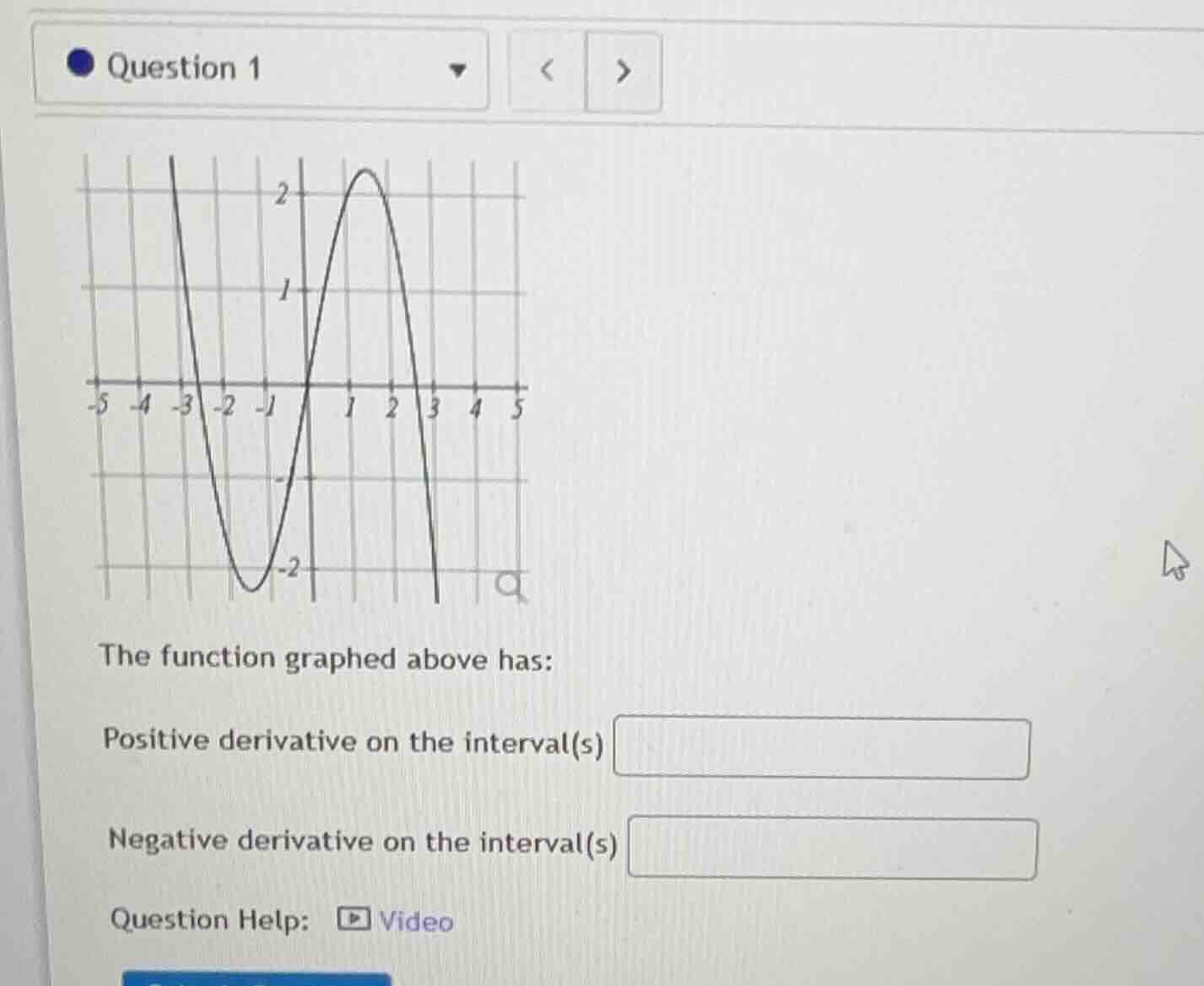
the function graphed above has:
positive derivative on the interval(s)
negative derivative on the interval(s)
question help: video
Step1: Understand derivative sign from graph
A positive derivative means the function is increasing (graph rises as \( x \) increases), a negative derivative means the function is decreasing (graph falls as \( x \) increases).
Step2: Analyze increasing intervals
From the graph, the function increases from \( x = -2 \) to \( x = 2 \) (since it rises from the minimum at \( x=-2 \) to the maximum at \( x = 2 \)). So the interval with positive derivative is \( (-2, 2) \).
Step3: Analyze decreasing intervals
The function decreases when \( x < -2 \) (from left to \( x=-2 \)) and when \( x > 2 \) (from \( x = 2 \) to the right). So the intervals with negative derivative are \( (-\infty, -2) \) and \( (2, \infty) \).

Snap & solve any problem in the app
Get step-by-step solutions on Sovi AI
Photo-based solutions with guided steps
Explore more problems and detailed explanations
Positive derivative on the interval(s): \(\boldsymbol{(-2, 2)}\)
Negative derivative on the interval(s): \(\boldsymbol{(-\infty, -2) \cup (2, \infty)}\)