QUESTION IMAGE
Question
question
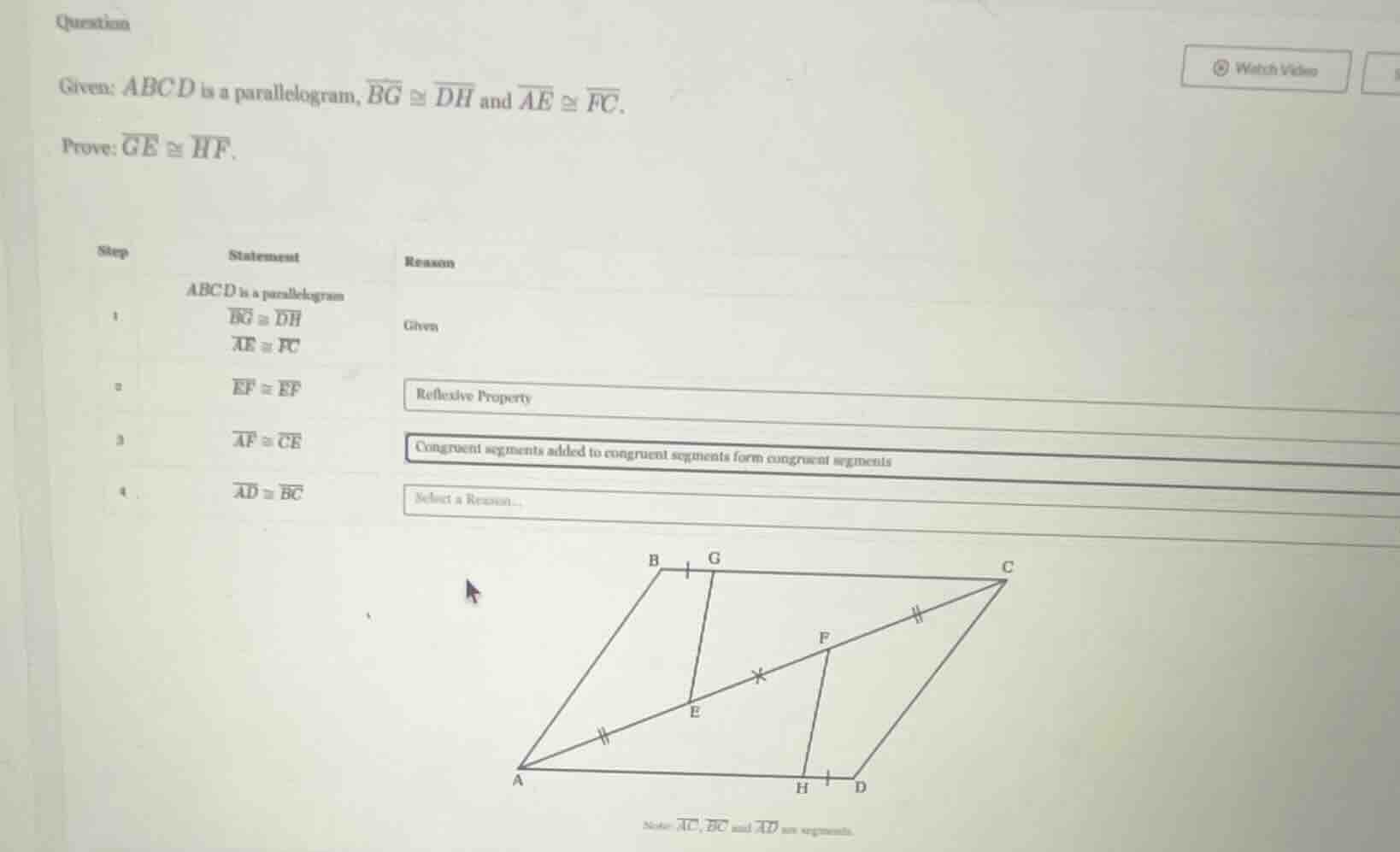
given: abcd is a parallelogram, \\(\overline{bg} \cong \overline{dh}\\) and \\(\overline{ae} \cong \overline{fc}\\).
prove: \\(\overline{ge} \cong \overline{hf}\\).
step | statement | reason
--- | --- | ---
1 | abcd is a parallelogram<br>\\(\overline{bg} \cong \overline{dh}\\)<br>\\(\overline{ae} \cong \overline{fc}\\) | given
2 | \\(\overline{ef} \cong \overline{ef}\\) | reflexive property
3 | \\(\overline{af} \cong \overline{ce}\\) | congruent segments added to congruent segments form congruent segments
4 | \\(\overline{ad} \cong \overline{bc}\\) | select a reason...
(image of parallelogram abcd with points g on bc, h on ad, e and f on ac. note: ac, bc and ad are segments.)
Step1: Recall properties of parallelograms
In a parallelogram, opposite sides are congruent. Since \(ABCD\) is a parallelogram, by the definition of a parallelogram (or the property of parallelograms: opposite sides of a parallelogram are congruent), we have \(\overline{AD} \cong \overline{BC}\).
Step2: Use given congruences and segment addition
We know \(\overline{BG} \cong \overline{DH}\) (given) and \(\overline{AD} \cong \overline{BC}\) (from step 1). Let's look at the segments related to \(GE\) and \(HF\). Also, \(\overline{AE} \cong \overline{FC}\) (given). We can show that the triangles or the quadrilateral formed have congruent sides. But for step 4, the reason for \(\overline{AD} \cong \overline{BC}\) is "Opposite sides of a parallelogram are congruent".
To prove \(\overline{GE} \cong \overline{HF}\), we can show that \(\triangle GCE\) and \(\triangle HAF\) (or other relevant triangles/quadrilaterals) are congruent. But focusing on step 4 first:
Step3: Complete the proof steps (summary)
After establishing \(\overline{AD} \cong \overline{BC}\), we can use the other given congruences (\(\overline{BG} \cong \overline{DH}\), \(\overline{AE} \cong \overline{FC}\)) and segment addition or triangle congruence (like SAS, SSS) to show \(\overline{GE} \cong \overline{HF}\). But for the specific step 4, the reason is the property of parallelograms.

Snap & solve any problem in the app
Get step-by-step solutions on Sovi AI
Photo-based solutions with guided steps
Explore more problems and detailed explanations
For step 4, the reason is "Opposite sides of a parallelogram are congruent". To fully prove \(\overline{GE} \cong \overline{HF}\), we can continue:
- Since \(\overline{AD} \cong \overline{BC}\) and \(\overline{BG} \cong \overline{DH}\), then \(\overline{AD}-\overline{DH} \cong \overline{BC}-\overline{BG}\) (subtraction of congruent segments), so \(\overline{AH} \cong \overline{CG}\).
- We also have \(\overline{AE} \cong \overline{FC}\) (given) and \(\angle EAH \cong \angle FCG\) (since \(ABCD\) is a parallelogram, \(AD \parallel BC\), so alternate interior angles are congruent).
- By SAS (Side - Angle - Side) congruence criterion, \(\triangle EAH \cong \triangle FCG\).
- Then, by CPCTC (Corresponding Parts of Congruent Triangles are Congruent), \(\overline{GE} \cong \overline{HF}\) (after showing the relevant sides from the congruent triangles).
But for the specific step 4, the reason is "Opposite sides of a parallelogram are congruent".