QUESTION IMAGE
Question
question
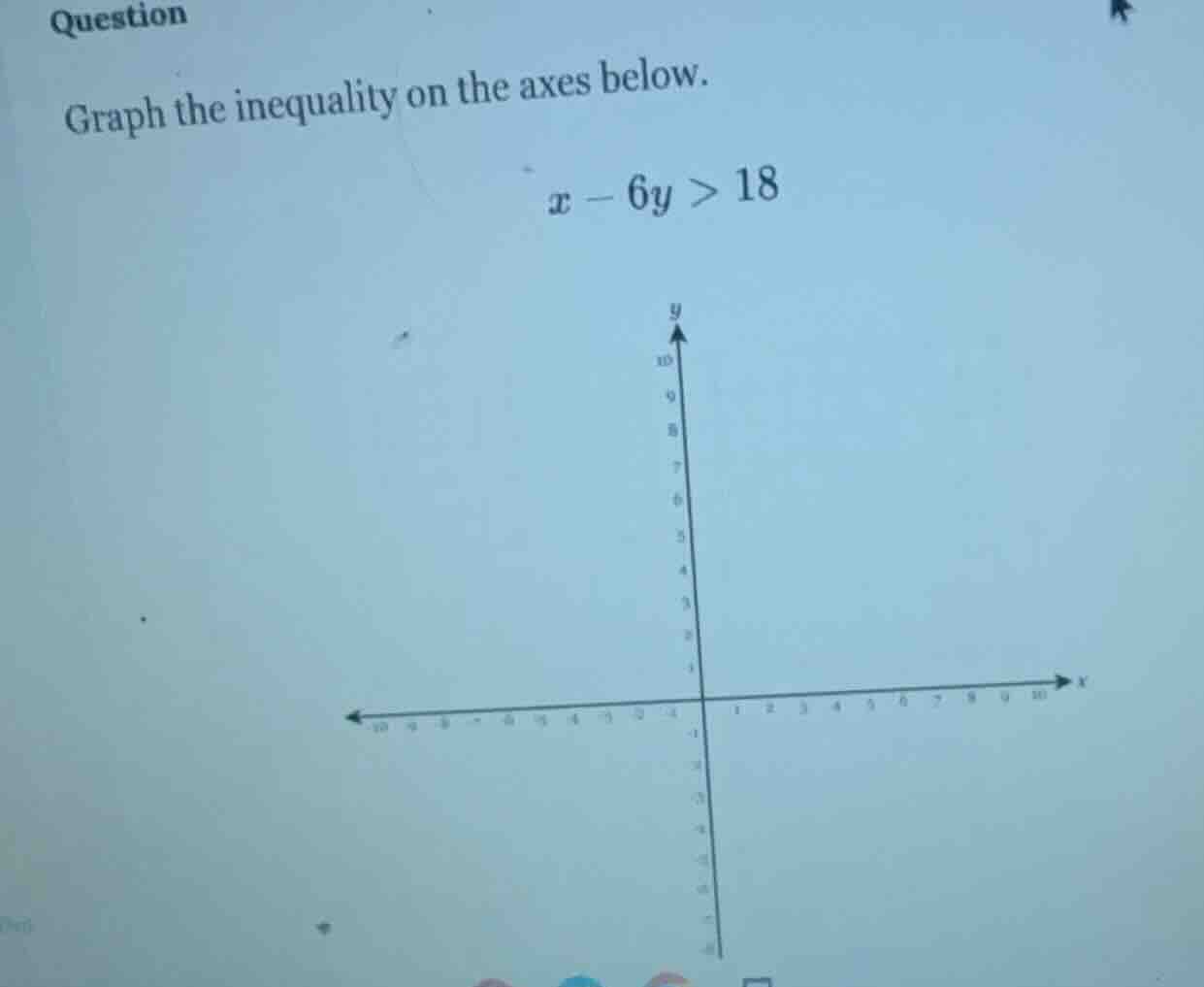
graph the inequality on the axes below.
$x - 6y > 18$
Step1: Rewrite the inequality in slope - intercept form
We start with the inequality \(x - 6y>18\). We want to solve for \(y\) to get it in the form \(y = mx + b\) (slope - intercept form) to make graphing easier.
Subtract \(x\) from both sides: \(- 6y>-x + 18\).
Then divide each term by \(-6\). Remember that when we divide or multiply an inequality by a negative number, the direction of the inequality sign changes. So we have \(y<\frac{1}{6}x - 3\).
Step2: Graph the boundary line
The boundary line for the inequality \(y<\frac{1}{6}x - 3\) is the line \(y=\frac{1}{6}x - 3\). Since the inequality is strict (\(<\), not \(\leq\)), the boundary line should be a dashed line.
To find two points on the line \(y=\frac{1}{6}x - 3\):
- When \(x = 0\), \(y=\frac{1}{6}(0)-3=-3\). So one point is \((0,-3)\).
- When \(x = 6\), \(y=\frac{1}{6}(6)-3=1 - 3=-2\). So another point is \((6,-2)\). Plot these two points and draw a dashed line through them.
Step3: Determine the region to shade
We need to determine which side of the line \(y=\frac{1}{6}x - 3\) satisfies the inequality \(y<\frac{1}{6}x - 3\). We can use a test point. A common test point is \((0,0)\) (as long as it is not on the boundary line).
Substitute \(x = 0\) and \(y = 0\) into the inequality \(y<\frac{1}{6}x - 3\):
\(0<\frac{1}{6}(0)-3\) simplifies to \(0 < - 3\), which is false. So we shade the region that does not contain the test point \((0,0)\). In other words, we shade the region below the dashed line \(y=\frac{1}{6}x - 3\).
(Note: Since the problem asks to graph the inequality, the final answer is the graph with a dashed line \(y = \frac{1}{6}x-3\) and the region below the line shaded. If we were to describe the steps for graphing, the above steps are the key parts of the process.)

Snap & solve any problem in the app
Get step-by-step solutions on Sovi AI
Photo-based solutions with guided steps
Explore more problems and detailed explanations
The graph of the inequality \(x - 6y>18\) (or \(y<\frac{1}{6}x - 3\)) has a dashed boundary line \(y=\frac{1}{6}x - 3\) (passing through \((0,-3)\) and \((6,-2)\)) and the region below this dashed line is shaded.