QUESTION IMAGE
Question
question:
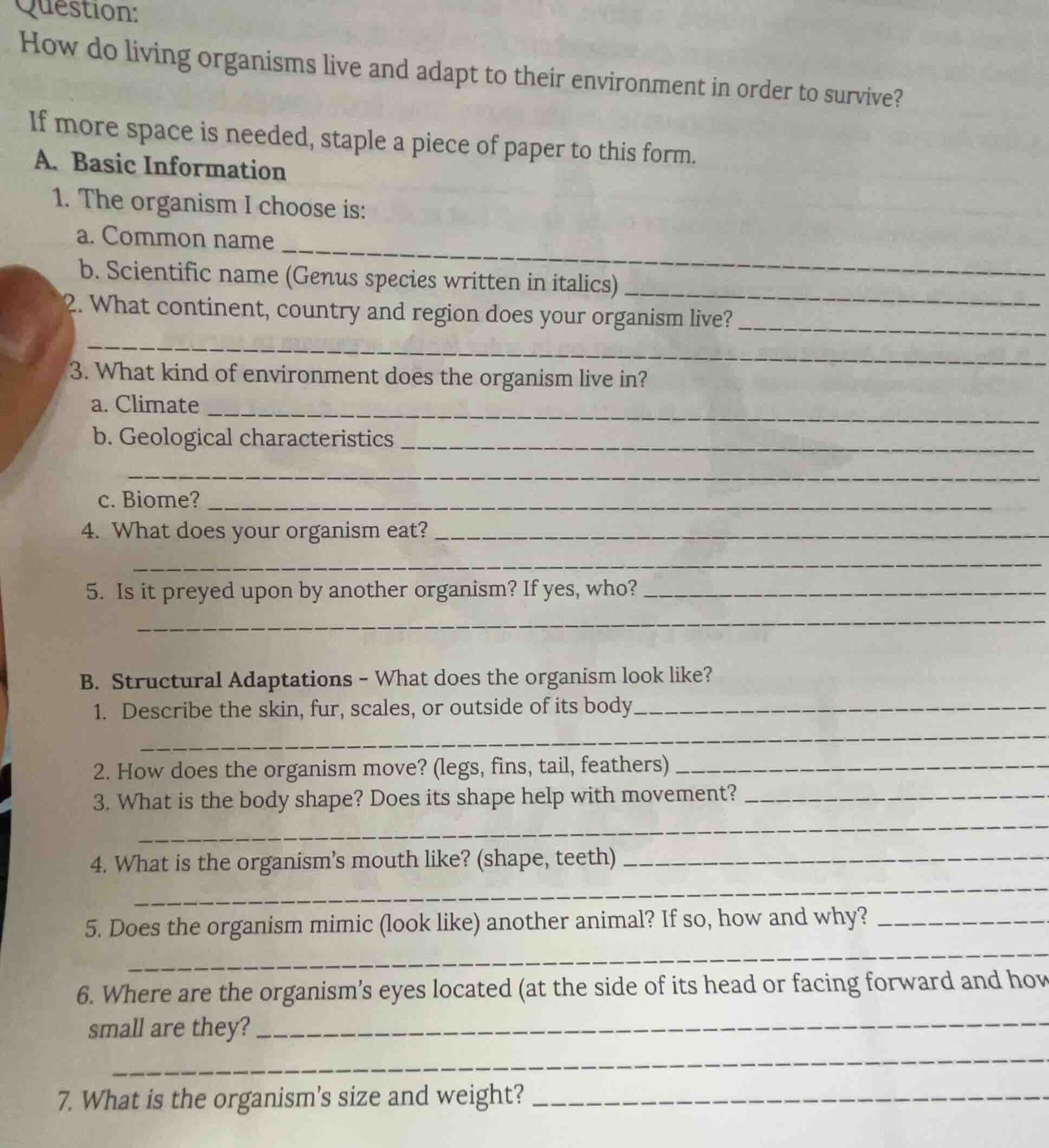
how do living organisms live and adapt to their environment in order to survive?
if more space is needed, staple a piece of paper to this form.
a. basic information
- the organism i choose is:
a. common name
b. scientific name (genus species written in italics)
- what continent, country and region does your organism live?
- what kind of environment does the organism live in?
a. climate
b. geological characteristics
c. biome?
- what does your organism eat?
- is it preyed upon by another organism? if yes, who?
b. structural adaptations - what does the organism look like?
- describe the skin, fur, scales, or outside of its body
- how does the organism move? (legs, fins, tail, feathers)
- what is the body shape? does its shape help with movement?
- what is the organisms mouth like? (shape, teeth)
- does the organism mimic (look like) another animal? if so, how and why?
- where are the organisms eyes located (at the side of its head or facing forward and how small are they?
- what is the organisms size and weight?
This response uses the African lion as a representative organism to address all sections, covering its basic ecological details, survival needs, and structural adaptations that support its survival in its native habitat.

Snap & solve any problem in the app
Get step-by-step solutions on Sovi AI
Photo-based solutions with guided steps
Explore more problems and detailed explanations
A. Basic Information
- a. Common name: African Lion
b. Scientific name: Panthera leo
- Continent, country, region: Africa; countries like Tanzania, Kenya, South Africa; savanna and grassland regions
- a. Climate: Warm to hot, seasonal wet/dry cycles
b. Geological characteristics: Flat to gently rolling grasslands, scattered acacia trees, compacted soil
c. Biome: Tropical savanna
- What it eats: Large herbivores (zebras, wildebeest, buffalo), small mammals
- Is it preyed upon? No (adults are apex predators; cubs may be preyed on by hyenas, leopards, wild dogs)
B. Structural Adaptations
- Body covering: Short, tawny fur (camouflages in savanna); males have thick manes (protects neck during fights)
- Movement: Uses muscular legs to run, walk, and pounce; retractable claws for traction
- Body shape: Streamlined, muscular build; yes, the compact, strong torso and long legs enable short bursts of high speed (up to 80 km/h) for chasing prey
- Mouth: Strong, jaw with large, sharp canine teeth (for piercing and gripping prey) and molars for shearing meat
- Mimicry? No, it does not mimic other animals
- Eyes: Located forward on the head (binocular vision for depth perception to hunt prey); medium-sized, with a reflective layer to see in low light
- Size and weight: Males: 1.8-2.1 m body length (plus 0.9-1.1 m tail), 190-260 kg; Females: 1.5-1.8 m body length (plus 0.7-1 m tail), 120-182 kg