QUESTION IMAGE
Question
question
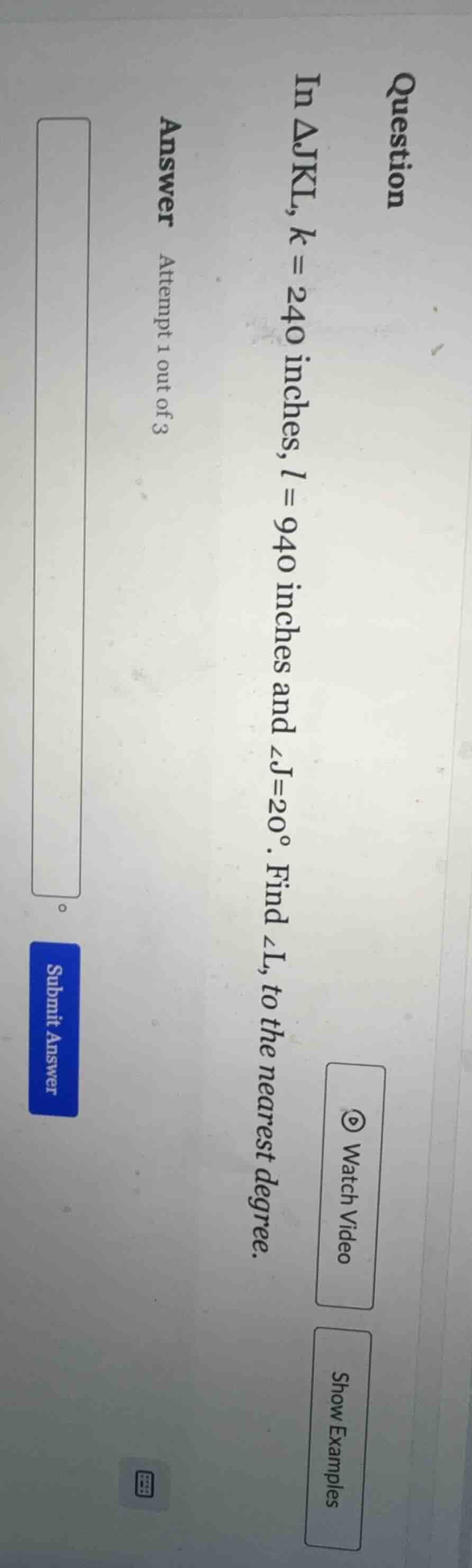
in \\(\triangle jkl\\), \\(k = 240\\) inches, \\(l = 940\\) inches and \\(\angle j = 20^\circ\\). find \\(\angle l\\), to the nearest degree.
answer
attempt 1 out of 3
\\(\circ\\)
submit answer
\\(\circledcirc\\) watch video
show examples
Step1: Recall the Law of Sines
The Law of Sines states that in any triangle, $\frac{a}{\sin A}=\frac{b}{\sin B}=\frac{c}{\sin C}$, where $a, b, c$ are the lengths of the sides opposite angles $A, B, C$ respectively. In $\triangle JKL$, we have side $k = 240$ (opposite $\angle K$), side $l=940$ (opposite $\angle L$), and $\angle J = 20^{\circ}$. First, we can find $\angle K$ or $\angle L$ using the Law of Sines. Let's write the ratio for $\angle L$ and $\angle J$ (wait, no, side $k$ is opposite $\angle K$, side $l$ opposite $\angle L$, side $j$ opposite $\angle J$. Wait, actually, in standard notation, side $a$ is opposite angle $A$, side $b$ opposite angle $B$, side $c$ opposite angle $C$. So in $\triangle JKL$, angle $J$ is opposite side $j$, angle $K$ opposite side $k$, angle $L$ opposite side $l$. So Law of Sines: $\frac{j}{\sin J}=\frac{k}{\sin K}=\frac{l}{\sin L}$. But we know $k = 240$, $l=940$, $\angle J = 20^{\circ}$. Wait, maybe we can first find angle $K$ or angle $L$. Wait, let's correct: Let's denote: angle $J = 20^{\circ}$, side opposite $J$ is $j$; angle $K$, side opposite $K$ is $k = 240$; angle $L$, side opposite $L$ is $l = 940$. So by Law of Sines: $\frac{l}{\sin L}=\frac{k}{\sin K}=\frac{j}{\sin J}$. But we don't know $j$. Alternatively, we can use the Law of Sines to relate $\angle L$ and $\angle K$? Wait, no, we know angle $J$, so the sum of angles in a triangle is $180^{\circ}$, so $\angle J+\angle K+\angle L=180^{\circ}$, so $\angle K+\angle L = 160^{\circ}$. But maybe better to use Law of Sines: $\frac{l}{\sin L}=\frac{k}{\sin K}$, but also $\angle K=180^{\circ}-\angle J - \angle L=160^{\circ}-\angle L$. So substitute into Law of Sines: $\frac{940}{\sin L}=\frac{240}{\sin(160^{\circ}-\angle L)}$. But that might be complicated. Wait, no, wait: Wait, maybe I made a mistake. Wait, side $k$ is opposite angle $K$, side $l$ opposite angle $L$, angle $J$ is given. So actually, the Law of Sines is $\frac{l}{\sin L}=\frac{k}{\sin K}=\frac{j}{\sin J}$. But we can also use $\frac{l}{\sin L}=\frac{k}{\sin K}$ and $\angle K = 180 - 20 - \angle L=160 - \angle L$. So:
$\frac{940}{\sin L}=\frac{240}{\sin(160^{\circ}-\angle L)}$
But $\sin(160^{\circ}-\angle L)=\sin(180^{\circ}-20^{\circ}-\angle L)=\sin(20^{\circ}+\angle L)$? No, wait, $160^{\circ}-\angle L=180^{\circ}-(20^{\circ}+\angle L)$, so $\sin(160^{\circ}-\angle L)=\sin(20^{\circ}+\angle L)$? No, $\sin(180 - x)=\sin x$, so $\sin(160 - L)=\sin(20 + (140 - L))$? No, better to use $\sin(160 - L)=\sin(180 - (20 + L))=\sin(20 + L)$? Wait, no, $160 - L = 180 - (20 + L)$, so $\sin(160 - L)=\sin(20 + L)$? Wait, no, $\sin(180 - \theta)=\sin \theta$, so $\sin(160 - L)=\sin(180 - (20 + L))=\sin(20 + L)$. Wait, maybe not. Alternatively, let's use the Law of Sines with angle $J$. Wait, maybe I messed up the notation. Let's start over.
In $\triangle JKL$:
- Angle $J = 20^{\circ}$
- Side $k = 240$ (length of side opposite angle $K$)
- Side $l = 940$ (length of side opposite angle $L$)
We need to find angle $L$.
By Law of Sines: $\frac{l}{\sin L}=\frac{k}{\sin K}$
But also, in a triangle, $J + K + L = 180^{\circ}$, so $K = 180^{\circ}-20^{\circ}-L = 160^{\circ}-L$
So substitute $K = 160^{\circ}-L$ into Law of Sines:
$\frac{940}{\sin L}=\frac{240}{\sin(160^{\circ}-L)}$
Now, $\sin(160^{\circ}-L)=\sin(180^{\circ}-20^{\circ}-L)=\sin(20^{\circ}+L)$? Wait, no, $160 - L = 180 - (20 + L)$, so $\sin(160 - L)=\sin(20 + L)$? Wait, $\sin(180 - x)=\sin x$, so $\sin(160 - L)=\sin(180 - (20 + L))=\sin(20 + L)$. Wait, no, $180 - (20 + L)=160 - L$, yes. So $\sin(160 - L)=\sin(20 + L)$. Wai…

Snap & solve any problem in the app
Get step-by-step solutions on Sovi AI
Photo-based solutions with guided steps
Explore more problems and detailed explanations
Step1: Recall the Law of Sines
The Law of Sines states that in any triangle, $\frac{a}{\sin A}=\frac{b}{\sin B}=\frac{c}{\sin C}$, where $a, b, c$ are the lengths of the sides opposite angles $A, B, C$ respectively. In $\triangle JKL$, we have side $k = 240$ (opposite $\angle K$), side $l=940$ (opposite $\angle L$), and $\angle J = 20^{\circ}$. First, we can find $\angle K$ or $\angle L$ using the Law of Sines. Let's write the ratio for $\angle L$ and $\angle J$ (wait, no, side $k$ is opposite $\angle K$, side $l$ opposite $\angle L$, side $j$ opposite $\angle J$. Wait, actually, in standard notation, side $a$ is opposite angle $A$, side $b$ opposite angle $B$, side $c$ opposite angle $C$. So in $\triangle JKL$, angle $J$ is opposite side $j$, angle $K$ opposite side $k$, angle $L$ opposite side $l$. So Law of Sines: $\frac{j}{\sin J}=\frac{k}{\sin K}=\frac{l}{\sin L}$. But we know $k = 240$, $l=940$, $\angle J = 20^{\circ}$. Wait, maybe we can first find angle $K$ or angle $L$. Wait, let's correct: Let's denote: angle $J = 20^{\circ}$, side opposite $J$ is $j$; angle $K$, side opposite $K$ is $k = 240$; angle $L$, side opposite $L$ is $l = 940$. So by Law of Sines: $\frac{l}{\sin L}=\frac{k}{\sin K}=\frac{j}{\sin J}$. But we don't know $j$. Alternatively, we can use the Law of Sines to relate $\angle L$ and $\angle K$? Wait, no, we know angle $J$, so the sum of angles in a triangle is $180^{\circ}$, so $\angle J+\angle K+\angle L=180^{\circ}$, so $\angle K+\angle L = 160^{\circ}$. But maybe better to use Law of Sines: $\frac{l}{\sin L}=\frac{k}{\sin K}$, but also $\angle K=180^{\circ}-\angle J - \angle L=160^{\circ}-\angle L$. So substitute into Law of Sines: $\frac{940}{\sin L}=\frac{240}{\sin(160^{\circ}-\angle L)}$. But that might be complicated. Wait, no, wait: Wait, maybe I made a mistake. Wait, side $k$ is opposite angle $K$, side $l$ opposite angle $L$, angle $J$ is given. So actually, the Law of Sines is $\frac{l}{\sin L}=\frac{k}{\sin K}=\frac{j}{\sin J}$. But we can also use $\frac{l}{\sin L}=\frac{k}{\sin K}$ and $\angle K = 180 - 20 - \angle L=160 - \angle L$. So:
$\frac{940}{\sin L}=\frac{240}{\sin(160^{\circ}-\angle L)}$
But $\sin(160^{\circ}-\angle L)=\sin(180^{\circ}-20^{\circ}-\angle L)=\sin(20^{\circ}+\angle L)$? No, wait, $160^{\circ}-\angle L=180^{\circ}-(20^{\circ}+\angle L)$, so $\sin(160^{\circ}-\angle L)=\sin(20^{\circ}+\angle L)$? No, $\sin(180 - x)=\sin x$, so $\sin(160 - L)=\sin(20 + (140 - L))$? No, better to use $\sin(160 - L)=\sin(180 - (20 + L))=\sin(20 + L)$? Wait, no, $160 - L = 180 - (20 + L)$, so $\sin(160 - L)=\sin(20 + L)$? Wait, no, $\sin(180 - \theta)=\sin \theta$, so $\sin(160 - L)=\sin(180 - (20 + L))=\sin(20 + L)$. Wait, maybe not. Alternatively, let's use the Law of Sines with angle $J$. Wait, maybe I messed up the notation. Let's start over.
In $\triangle JKL$:
- Angle $J = 20^{\circ}$
- Side $k = 240$ (length of side opposite angle $K$)
- Side $l = 940$ (length of side opposite angle $L$)
We need to find angle $L$.
By Law of Sines: $\frac{l}{\sin L}=\frac{k}{\sin K}$
But also, in a triangle, $J + K + L = 180^{\circ}$, so $K = 180^{\circ}-20^{\circ}-L = 160^{\circ}-L$
So substitute $K = 160^{\circ}-L$ into Law of Sines:
$\frac{940}{\sin L}=\frac{240}{\sin(160^{\circ}-L)}$
Now, $\sin(160^{\circ}-L)=\sin(180^{\circ}-20^{\circ}-L)=\sin(20^{\circ}+L)$? Wait, no, $160 - L = 180 - (20 + L)$, so $\sin(160 - L)=\sin(20 + L)$? Wait, $\sin(180 - x)=\sin x$, so $\sin(160 - L)=\sin(180 - (20 + L))=\sin(20 + L)$. Wait, no, $180 - (20 + L)=160 - L$, yes. So $\sin(160 - L)=\sin(20 + L)$. Wait, is that correct? Let's check with $L = 80^{\circ}$, then $160 - 80 = 80$, $\sin 80=\sin(20 + 60)=\sin 80$, yes. So $\sin(160 - L)=\sin(20 + L)$. Wait, no, $20 + L$ when $L=80$ is 100, $\sin 100=\sin 80$, yes, because $\sin(180 - x)=\sin x$. So $\sin(160 - L)=\sin(20 + L)$? Wait, no, $160 - L = 180 - (20 + L)$, so $\sin(160 - L)=\sin(20 + L)$. Yes, because $\sin(180 - \theta)=\sin \theta$, so $\theta = 20 + L$, so $\sin(180 - (20 + L))=\sin(20 + L)$. So:
$\frac{940}{\sin L}=\frac{240}{\sin(20^{\circ}+L)}$
Cross-multiplying: $940\sin(20^{\circ}+L)=240\sin L$
Using the sine addition formula: $\sin(A + B)=\sin A\cos B+\cos A\sin B$, so $\sin(20^{\circ}+L)=\sin 20^{\circ}\cos L+\cos 20^{\circ}\sin L$
So:
$940(\sin 20^{\circ}\cos L+\cos 20^{\circ}\sin L)=240\sin L$
Expand:
$940\sin 20^{\circ}\cos L+940\cos 20^{\circ}\sin L=240\sin L$
Subtract $240\sin L$ from both sides:
$940\sin 20^{\circ}\cos L+(940\cos 20^{\circ}-240)\sin L=0$
Divide both sides by $\cos L$ (assuming $\cos L
eq0$, which it isn't because $L$ is an angle in a triangle, so between $0$ and $160^{\circ}$, so $\cos L$ is not zero):
$940\sin 20^{\circ}+(940\cos 20^{\circ}-240)\tan L=0$
Solve for $\tan L$:
$(940\cos 20^{\circ}-240)\tan L=-940\sin 20^{\circ}$
$\tan L=\frac{-940\sin 20^{\circ}}{940\cos 20^{\circ}-240}$
Calculate the values:
First, $\sin 20^{\circ}\approx0.3420$, $\cos 20^{\circ}\approx0.9397$
Numerator: $-940\times0.3420\approx -940\times0.3420\approx -321.48$
Denominator: $940\times0.9397 - 240\approx 940\times0.9397\approx 883.318 - 240 = 643.318$
So $\tan L\approx\frac{-321.48}{643.318}\approx -0.50$
Wait, but tangent of an angle in a triangle (which is between $0$ and $160^{\circ}$) can be negative only if the angle is greater than $90^{\circ}$, because tangent is positive in first and third quadrants, negative in second and fourth. Since the triangle angle is between $0$ and $180$, so if $\tan L$ is negative, $L$ is in second quadrant (between $90^{\circ}$ and $180^{\circ}$). But let's check the calculation again, maybe I made a mistake in the Law of Sines setup.
Wait, maybe I mixed up the sides. Wait, side $k = 240$ is opposite angle $K$, side $l = 940$ opposite angle $L$, angle $J = 20^{\circ}$. Wait, maybe the correct ratio is $\frac{l}{\sin L}=\frac{k}{\sin K}$, but angle $K = 180 - 20 - L = 160 - L$. But maybe I should use $\frac{l}{\sin L}=\frac{j}{\sin J}$? No, we don't know $j$. Wait, no, perhaps the initial mistake is in the notation. Let's use the correct Law of Sines: in triangle $ABC$, $a/\sin A = b/\sin B = c/\sin C$. So in triangle $JKL$, let's let:
- Angle $J = 20^{\circ}$, side opposite $J$ is $j$ (so $j$ is the length of $KL$)
- Angle $K$, side opposite $K$ is $k = JL = 240$ (wait, maybe the notation is different: maybe side $k$ is $JL$, side $l$ is $JK$? Wait, the problem says "In $\triangle JKL$", so the vertices are $J$, $K$, $L$. So the sides: $JK$ is between $J$ and $K$, $KL$ between $K$ and $L$, $JL$ between $J$ and $L$. So angle at $J$ is between sides $JK$ and $JL$. So side opposite angle $J$ is $KL$, let's call that $j$; side opposite angle $K$ is $JL$, call that $k = 240$; side opposite angle $L$ is $JK$, call that $l = 940$. Ah! That's the mistake! I had the sides opposite the angles wrong. So angle $J$ is between sides $JK$ and $JL$, so the side opposite angle $J$ is $KL$ (length $j$), side opposite angle $K$ is $JL$ (length $k = 240$), side opposite angle $L$ is $JK$ (length $l = 940$). So now, Law of Sines: $j/\sin J = k/\sin K = l/\sin L$. So we have $k = 240$ (opposite angle $K$), $l = 940$ (opposite angle $L$), angle $J = 20^{\circ}$ (opposite side $j$). Now, we can use $k/\sin K = l/\sin L$, and angle $K = 180 - 20 - L = 160 - L$. So:
$240/\sin(160 - L) = 940/\sin L$
Cross-multiplying: $240\sin L = 940\sin(160 - L)$
Now, $\sin(160 - L) = \sin(180 - 20 - L) = \sin(20 + L)$? No, $\sin(160 - L) = \sin(180 - (20 + L)) = \sin(20 + L)$? Wait, no, $160 - L = 180 - (20 + L)$, so $\sin(160 - L) = \sin(20 + L)$ because $\sin(180 - x) = \sin x$. So:
$240\sin L = 940\sin(20 + L)$
Now, expand $\sin(20 + L)$ using sine addition: $\sin(20 + L) = \sin 20 \cos L + \cos 20 \sin L$
So:
$240\sin L = 940(\sin 20 \cos L + \cos 20 \sin L)$
Expand right side:
$240\sin L = 940\sin 20 \cos L + 940\cos 20 \sin L$
Bring all terms to left side:
$240\sin L - 940\cos 20 \sin L - 940\sin 20 \cos L = 0$
Factor $\sin L$ from first two terms:
$\sin L(240 - 940\cos 20) - 940\sin 20 \cos L = 0$
Now, divide both sides by $\cos L$ (assuming $\cos L
eq 0$):
$\tan L(240 - 940\cos 20) - 940\sin 20 = 0$
Solve for $\tan L$:
$\tan L(240 - 940\cos 20) = 940\sin 20$
$\tan L = \frac{940\sin 20}{240 - 940\cos 20}$
Now, calculate the values:
$\sin 20 \approx 0.3420$, $\cos 20 \approx 0.9397$
Numerator: $940 \times 0.3420 \approx 940 \times 0.3420 \approx 321.48$
Denominator: $240 - 940 \times 0.9397 \approx 240 - 883.318 \approx -643.318$
So $\tan L \approx \frac{321.48}{-643.318} \approx -0.50$
Wait, that's the same as before, but now the numerator is positive and denominator negative, so $\tan L$ is negative, meaning $L$ is in the second quadrant (between $90^{\circ}$ and $180^{\circ}$). Now, $\tan L \approx -0.50$, so $L \approx 180^{\circ} - \arctan(0.50)$. $\arctan(0.50) \approx 26.565^{\circ}$, so $L \approx 180 - 26.565 \approx 153.435^{\circ}$. But wait, let's check if this makes sense. The sum of angles: $J = 20^{\circ}$, $L \approx 153.435^{\circ}$, so $K = 180 - 20 - 153.435 \approx 6.565^{\circ}$. Now, check the Law of Sines: $k/\sin K = 240/\sin(6.565^{\circ}) \approx 240 / 0.1145 \approx 2096.07$; $l/\sin L = 940/\sin(153.435^{\circ})$. $\sin(153.435^{\circ}) = \sin(180 - 26.565) = \sin(26.565^{\circ}) \approx 0.4472$, so $940 / 0.4472 \approx 2096.07$. So that checks out. But wait, is there a mistake in the side opposite? Because if side $l = 940$ is opposite angle $L$, and side $k = 240$ opposite angle $K$, and angle $J = 20^{\circ}$, then angle $L$ is obtuse (greater than $90^{\circ}$), which is possible. But let's