QUESTION IMAGE
Question
question 1
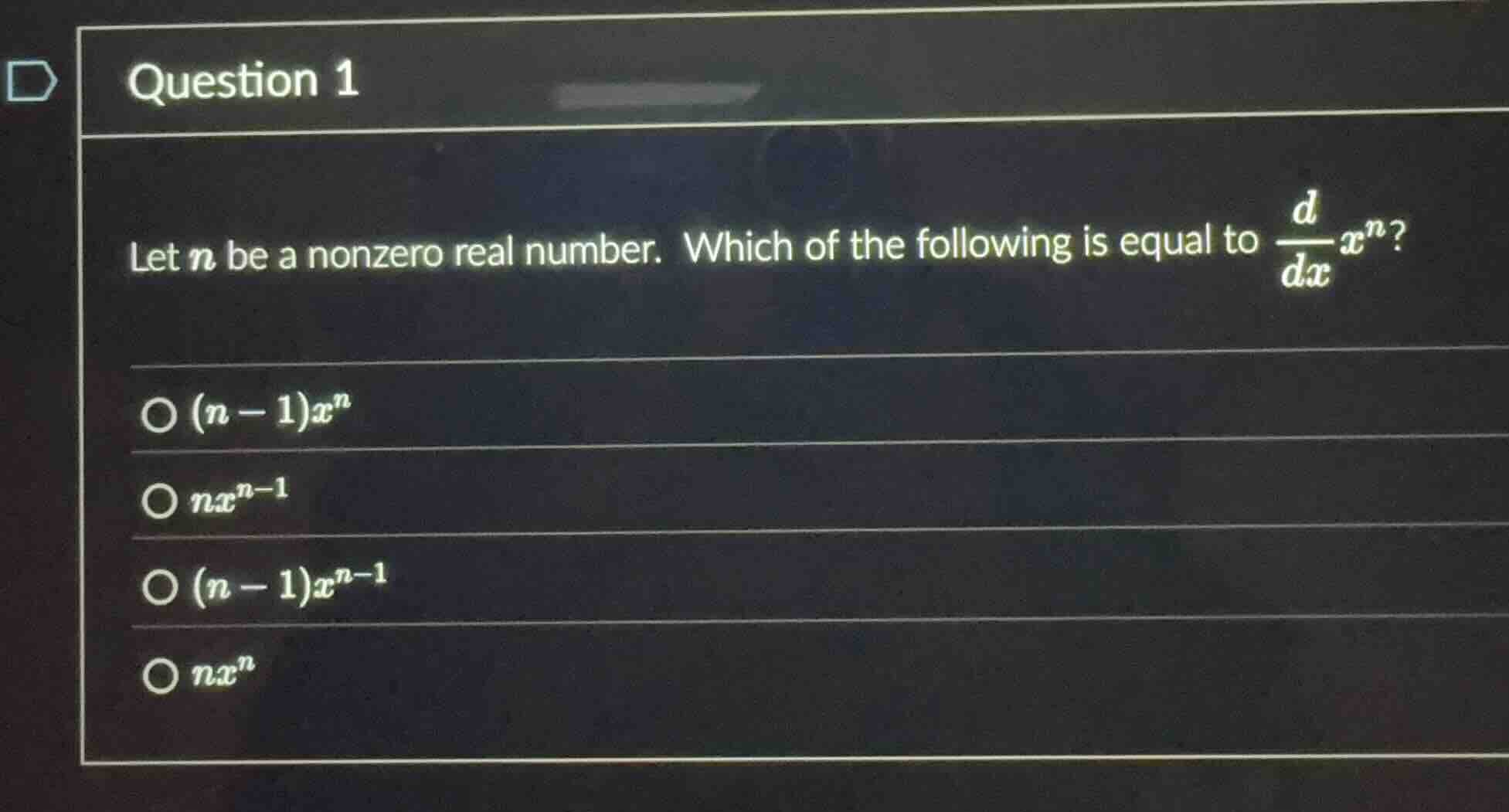
let ( n ) be a nonzero real number. which of the following is equal to ( \frac{d}{dx}x^n )?
( \bigcirc (n - 1)x^n )
( \bigcirc nx^{n - 1} )
( \bigcirc (n - 1)x^{n - 1} )
( \bigcirc nx^n )
Step1: Recall the Power Rule of Differentiation
The power rule states that for a function \( y = x^n \) (where \( n \) is a real number), the derivative with respect to \( x \) is given by \( \frac{d}{dx}x^n = n x^{n - 1} \).
Step2: Apply the Power Rule to the Given Function
We are asked to find \( \frac{d}{dx}x^n \) where \( n \) is a non - zero real number. Using the power rule, we directly get \( \frac{d}{dx}x^n=nx^{n - 1} \).

Snap & solve any problem in the app
Get step-by-step solutions on Sovi AI
Photo-based solutions with guided steps
Explore more problems and detailed explanations
\( nx^{n - 1} \) (the option corresponding to \( nx^{n - 1} \))