QUESTION IMAGE
Question
question 7 module 8-1 dilations practice homework
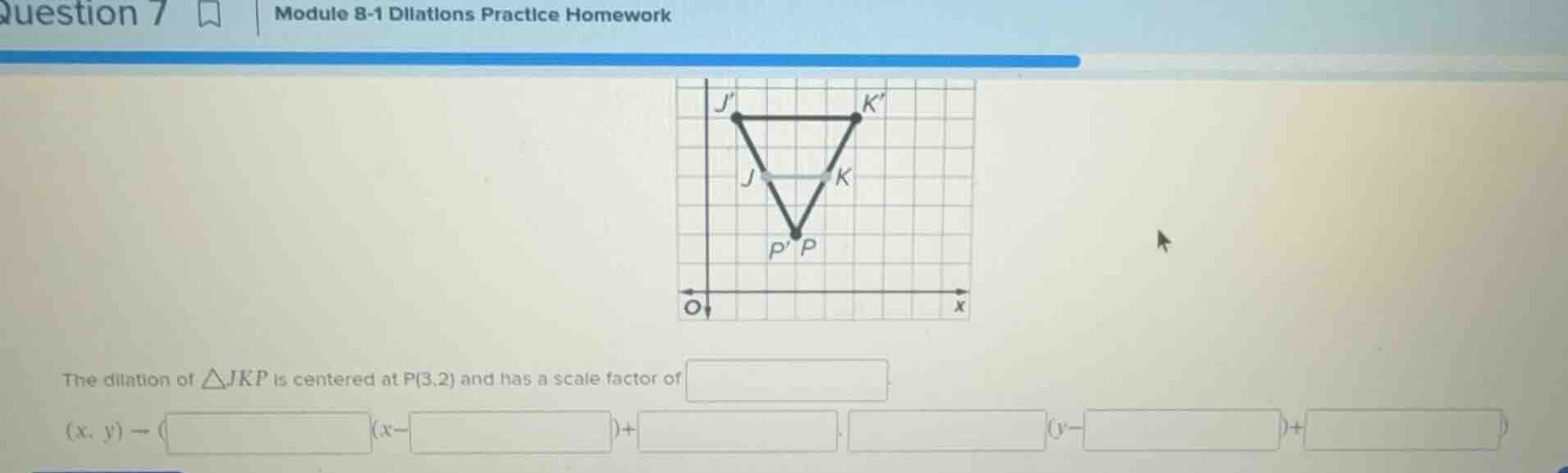
the dilation of △jkp is centered at p(3,2) and has a scale factor of
(x, y) → ( (x - ) + , (y - ) + )
Step1: Determine the scale factor
First, we can observe the lengths of corresponding sides. Let's assume the length of \( JK \) and \( J'K' \). From the graph, we can see that the distance between \( J \) and \( K \) is, say, \( d \), and the distance between \( J' \) and \( K' \) is \( 2d \) (by counting the grid units). So the scale factor \( k \) is \( 2 \).
Step2: Recall the dilation formula centered at \( (h,k) \)
The general formula for a dilation centered at \( (h,k) \) with scale factor \( k \) is \( (x,y)\to(k(x - h)+h,k(y - k)+k) \). Here, the center is \( P(3,2) \), so \( h = 3 \) and \( k = 2 \) (the scale factor, not to be confused with the y - coordinate of the center). Wait, no, the scale factor is \( k \), and the center is \( (h,k)=(3,2) \). So substituting into the formula, we get \( (x,y)\to(2(x - 3)+3,2(y - 2)+2) \). Let's verify:
If we take a point, say \( P(3,2) \), applying the transformation: \( 2(3 - 3)+3=3 \), \( 2(2 - 2)+2 = 2 \), which is correct. For another point, let's assume \( J \) has coordinates, say, \( (2,4) \) (by looking at the grid). Then \( J' \) should be \( (1,6) \)? Wait, no, maybe better to count the distance from the center. The distance from \( P \) to \( J \) and from \( P \) to \( J' \). Let's say the vector from \( P \) to \( J \) is \( (a,b) \), then the vector from \( P \) to \( J' \) should be \( k(a,b) \). From the graph, the length from \( P \) to \( J \) is, say, 2 units (in some direction), and from \( P \) to \( J' \) is 4 units, so scale factor \( k = 2 \).
So the scale factor is \( 2 \), and the transformation is \( (x,y)\to(2(x - 3)+3,2(y - 2)+2) \)

Snap & solve any problem in the app
Get step-by-step solutions on Sovi AI
Photo-based solutions with guided steps
Explore more problems and detailed explanations
The scale factor is \( \boldsymbol{2} \). The transformation is \( (x,y)\to(\boldsymbol{2}(x - \boldsymbol{3})+\boldsymbol{3},\boldsymbol{2}(y - \boldsymbol{2})+\boldsymbol{2}) \)