QUESTION IMAGE
Question
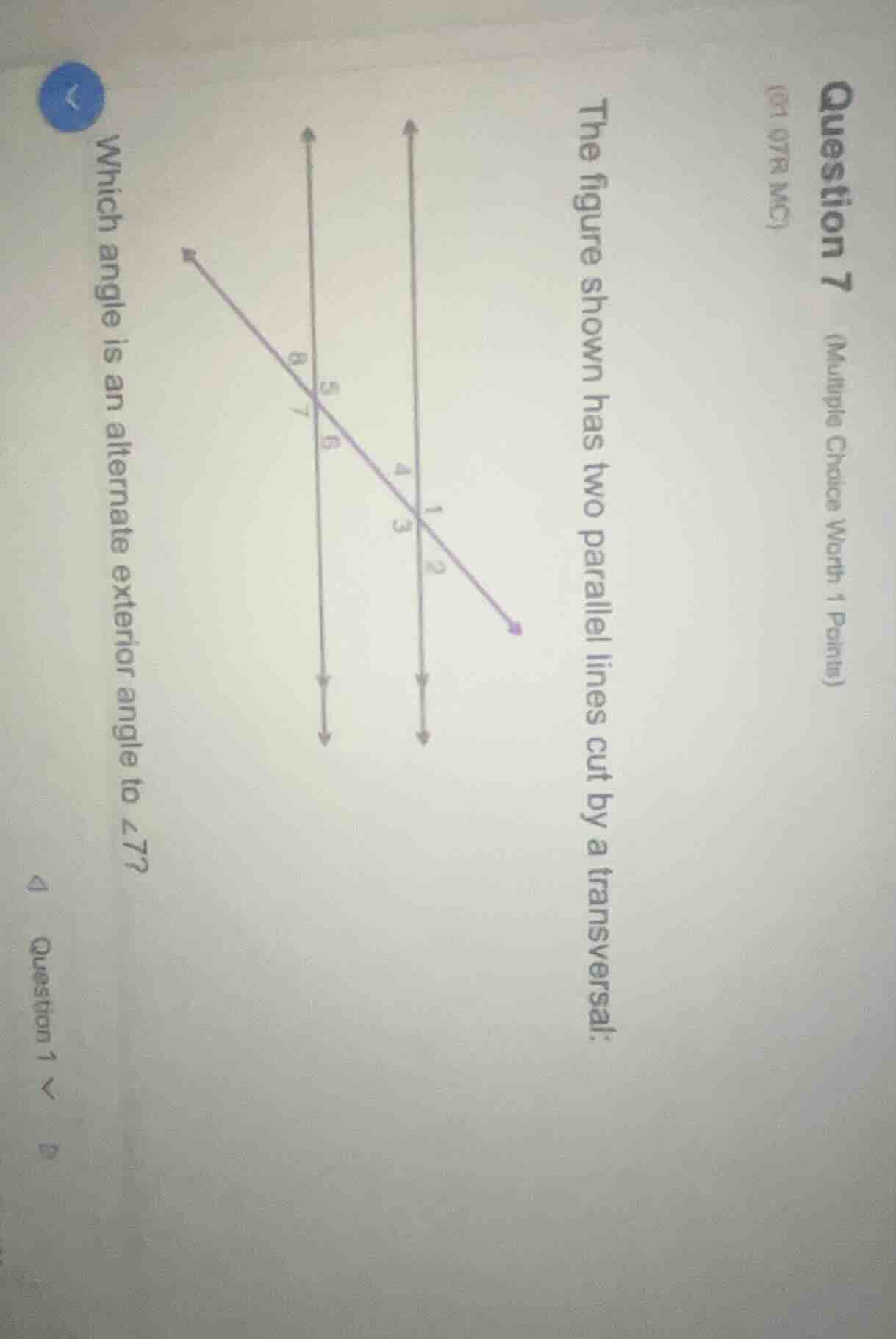
question 7 (multiple choice worth 1 points) (04.07b mc) the figure shown has two parallel lines cut by a transversal: image of two parallel lines cut by a transversal with angles labeled 1,2,3,4,5,6,7,8 which angle is an alternate exterior angle to ∠7? question 1
To determine the alternate exterior angle to \( \angle 7 \), we first recall the definition of alternate exterior angles: two angles are alternate exterior angles if they lie outside the two parallel lines and on opposite sides of the transversal.
Step 1: Identify the position of \( \angle 7 \)
\( \angle 7 \) is inside the two parallel lines? No, wait—let's visualize the diagram. The two parallel lines are cut by a transversal. \( \angle 7 \) is on one side of the transversal, between the two parallel lines? Wait, no, let's correct: Alternate exterior angles are outside the "block" formed by the two parallel lines and the transversal, and on opposite sides of the transversal.
Step 2: Analyze the angles
- \( \angle 7 \) is at the intersection of the transversal and the left parallel line, below the transversal (assuming the diagram: left parallel line, transversal crossing it and the right parallel line).
- Alternate exterior angle to \( \angle 7 \) should be outside the two parallel lines, on the opposite side of the transversal. Looking at the angles: \( \angle 2 \) is on the right parallel line, outside the two lines (since the two lines are vertical/parallel), and on the opposite side of the transversal from \( \angle 7 \). Wait, let's confirm:
- \( \angle 7 \) is between the two parallel lines? No, maybe the diagram has \( \angle 7 \) as an interior angle? Wait, no—alternate exterior angles: exterior means outside the two parallel lines. So if \( \angle 7 \) is on the left line, below the transversal, then its alternate exterior angle would be on the right line, above the transversal but outside? Wait, maybe the correct angle is \( \angle 2 \)? Wait, no, let's re-express:
Wait, the standard definition: When two parallel lines are cut by a transversal, alternate exterior angles are congruent and lie outside the two lines, on opposite sides of the transversal.
Looking at the diagram (as described: two parallel lines, transversal crossing them; angles labeled 1,2,3,4 on the right line, 5,6,7,8 on the left line).
- \( \angle 7 \) is at the left line, below the transversal (between the two lines? No, maybe \( \angle 7 \) is below the transversal, outside? Wait, maybe the correct alternate exterior angle to \( \angle 7 \) is \( \angle 2 \)? Wait, no, let's think again.
Wait, let's list the angles:
- Left line (parallel to right line), transversal crosses it: angles 5 (top, above transversal), 8 (top, above transversal, opposite? No, labels: 8,5,6,7 on left line, 4,1,2,3 on right line.
Wait, maybe \( \angle 7 \) is on the left line, below the transversal (between the two lines? No, alternate exterior: outside the two lines. So \( \angle 7 \) is on the left line, below the transversal, inside the two lines? No, that would be interior. Wait, maybe the diagram has \( \angle 7 \) as an interior angle, but alternate exterior would be outside. Wait, perhaps the correct angle is \( \angle 2 \)? Wait, no, let's check:
Wait, the alternate exterior angle to \( \angle 7 \) (if \( \angle 7 \) is on the left line, below the transversal, inside the two lines) would be... Wait, maybe I made a mistake. Let's recall: alternate exterior angles are outside the two parallel lines, so \( \angle 7 \) is on the left line, below the transversal. The alternate exterior angle would be on the right line, above the transversal, outside the two lines. Wait, \( \angle 2 \) is on the right line, below the transversal? No, maybe \( \angle 2 \) is on the right line, below the transversal, outside? Wait, no, the two parallel lines are vertical (or hori…

Snap & solve any problem in the app
Get step-by-step solutions on Sovi AI
Photo-based solutions with guided steps
Explore more problems and detailed explanations
\( \angle 2 \) (assuming the options include \( \angle 2 \); if the options are, e.g., \( \angle 2 \), \( \angle 3 \), \( \angle 4 \), \( \angle 1 \), then the correct answer is \( \angle 2 \)).