QUESTION IMAGE
Question
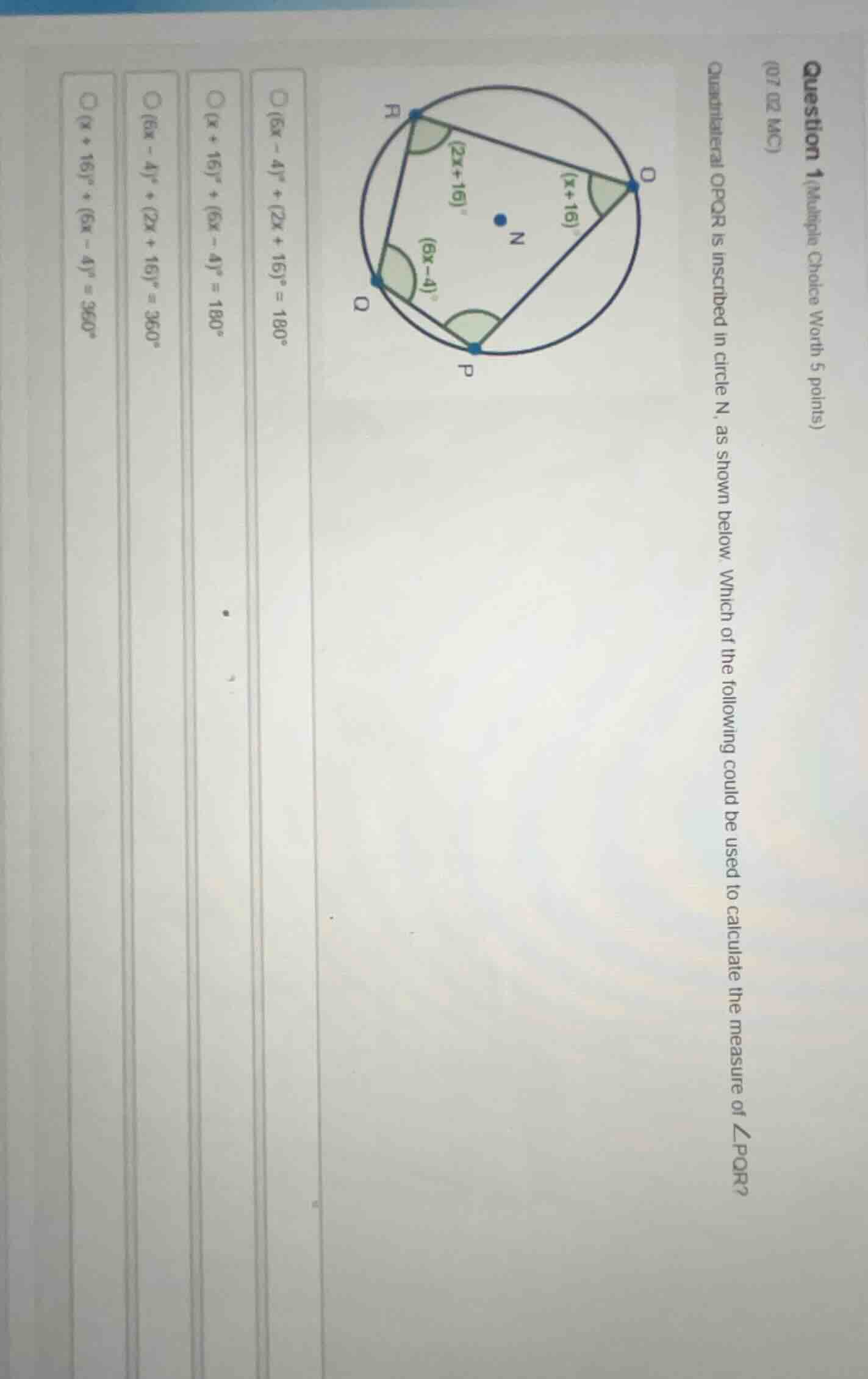
question 1 (multiple choice worth 5 points) (07.02 mc) quadrilateral opqr is inscribed in circle n, as shown below. which of the following could be used to calculate the measure of ∠pqr? (6x - 4)° + (2x + 16)° = 180° (x + 16)° + (6x - 4)° = 180° (6x - 4)° + (2x + 16)° = 360° (x + 16)° + (6x - 4)° = 360°
For a cyclic quadrilateral (a quadrilateral inscribed in a circle), the sum of each pair of opposite angles is \(180^\circ\). In quadrilateral \(OPQR\), \(\angle O\) and \(\angle Q\) are opposite, \(\angle P\) and \(\angle R\) are opposite? Wait, no, looking at the angles: \(\angle O=(x + 16)^\circ\), \(\angle R=(2x + 16)^\circ\), \(\angle P=(6x - 4)^\circ\), and \(\angle Q\) is the one we might relate. Wait, actually, the key property is that in a cyclic quadrilateral, opposite angles are supplementary (sum to \(180^\circ\)). So let's identify opposite angles. From the diagram, \(\angle O=(x + 16)^\circ\) and \(\angle Q\)? Wait, no, the angles given: \(\angle O=(x + 16)^\circ\), \(\angle R=(2x + 16)^\circ\), \(\angle P=(6x - 4)^\circ\), and the other angle (let's say \(\angle Q\))? Wait, no, the options: let's check the options. The first option: \((6x - 4)^\circ+(2x + 16)^\circ = 180^\circ\). Let's see: in a cyclic quadrilateral, opposite angles are supplementary. So if \(\angle P=(6x - 4)^\circ\) and \(\angle R=(2x + 16)^\circ\) are opposite, then their sum should be \(180^\circ\). So the equation \((6x - 4)+(2x + 16)=180\) (in degrees) would be used. So the first option is \((6x - 4)^\circ+(2x + 16)^\circ = 180^\circ\), which matches the supplementary property of cyclic quadrilateral opposite angles.

Snap & solve any problem in the app
Get step-by-step solutions on Sovi AI
Photo-based solutions with guided steps
Explore more problems and detailed explanations
A. \((6x - 4)^\circ + (2x + 16)^\circ = 180^\circ\)