QUESTION IMAGE
Question
question 1 (1 point)
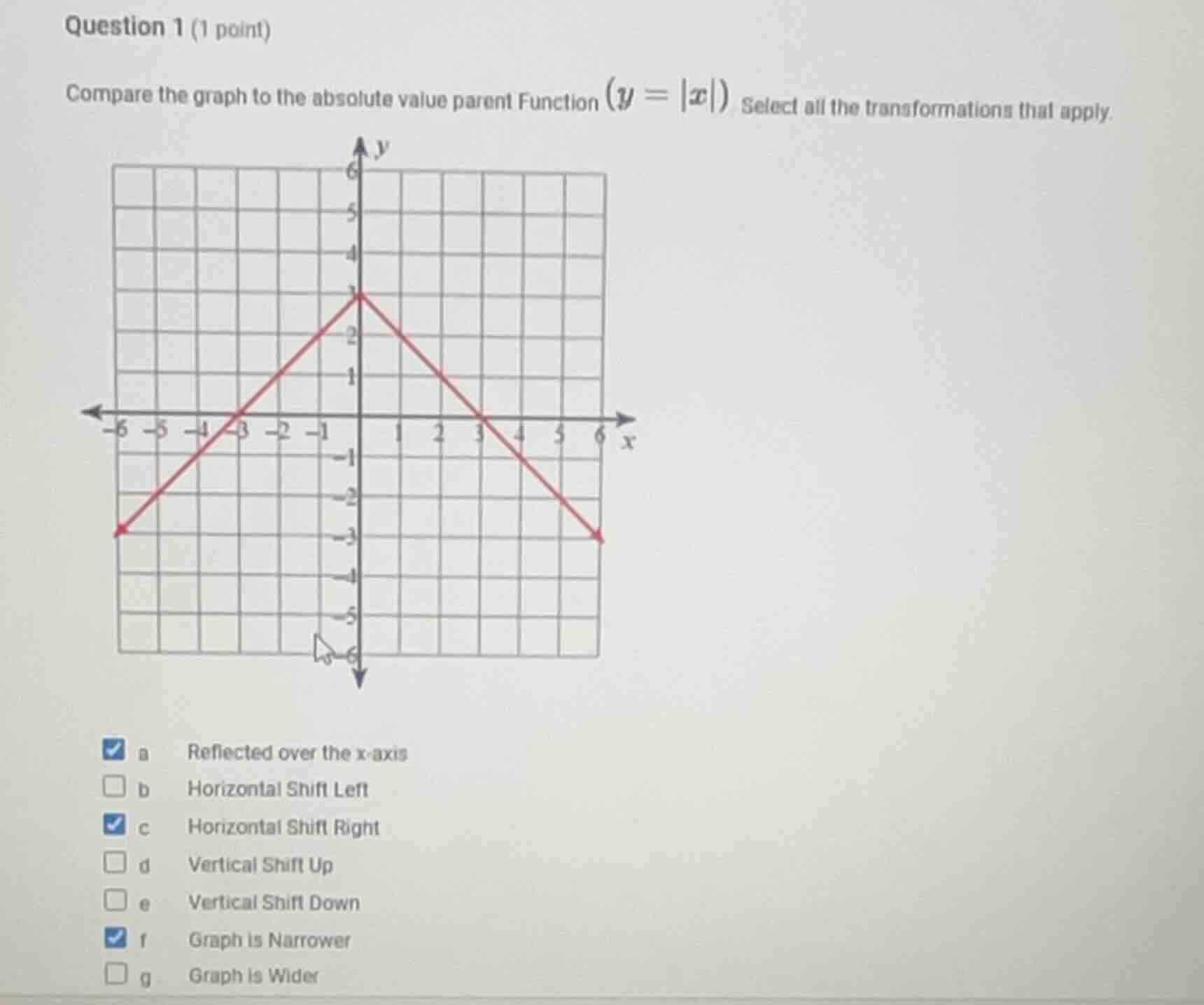
compare the graph to the absolute value parent function ($y = |x|$) select all the transformations that apply.
graph of a v - shaped function with vertex at (0, 3), x - intercepts at (-3, 0) and (3, 0), and endpoints at (-6, -3) and (6, -3)
✓ a reflected over the x - axis
□ b horizontal shift left
✓ c horizontal shift right
□ d vertical shift up
□ e vertical shift down
✓ f graph is narrower
□ g graph is wider
- Reflected over the x - axis: The parent function \(y = |x|\) opens upwards (V - shape with vertex at \((0,0)\) and arms going up). The given graph opens downwards, which indicates a reflection over the \(x\) - axis. So option a is correct.
- Horizontal Shift Left/Right: The vertex of the parent function \(y=|x|\) is at \((0,0)\). The vertex of the given graph is at \((0,3)\)? Wait, no, looking at the graph, the vertex is at \((0,3)\)? Wait, no, the graph intersects the \(y\) - axis at \((0,3)\) and the \(x\) - axis at \((- 3,0)\) and \((3,0)\). Wait, the parent function \(y = |x|\) has \(x\) - intercepts at \(x = 0\) (vertex) and for \(y=0\), \(x = 0\). Wait, no, the given graph: let's find the equation. The slope of the left arm (from \((-6,-3)\) to \((0,3)\)): slope \(m=\frac{3 - (-3)}{0-(-6)}=\frac{6}{6} = 1\), but since it's opening down, the equation should be \(y=-|x|\)? Wait, no, the \(x\) - intercepts are at \(x=-3\) and \(x = 3\), and the vertex is at \((0,3)\). Wait, the parent function \(y = |x|\) has vertex at \((0,0)\), and for the given graph, when \(x = 0\), \(y = 3\), and when \(y = 0\), \(x=\pm3\). So the equation of the given graph is \(y=-|x|+3\)? Wait, no, if we consider the reflection first: reflection over \(x\) - axis gives \(y=-|x|\), then vertical shift up by 3 units? Wait, no, the vertex of the parent function \(y = |x|\) is \((0,0)\), the vertex of the given graph is \((0,3)\)? Wait, no, looking at the graph, the highest point (vertex) is at \((0,3)\), and it goes down to \((-6,-3)\) and \((6,-3)\). Wait, maybe my initial analysis was wrong. Let's re - examine the options:
- Reflection over x - axis: The parent function \(y = |x|\) has a minimum at \((0,0)\), the given graph has a maximum at \((0,3)\), so it is reflected over the \(x\) - axis (since the direction of opening is reversed), so option a is correct.
- Horizontal Shift: The \(x\) - intercepts of the parent function \(y = |x|\) are at \(x = 0\) (vertex). The \(x\) - intercepts of the given graph are at \(x=-3\) and \(x = 3\). For the function \(y=-|x - h|+k\), the horizontal shift is \(h\). If we write the equation of the given graph, let's assume it is \(y=-|x|+3\)? Wait, no, when \(x = 3\), \(y=-|3|+3=0\), and when \(x = 0\), \(y = 3\). So the vertex is at \((0,3)\), and the \(x\) - intercepts are at \(x=\pm3\). The parent function \(y = |x|\) has \(x\) - intercept at \(x = 0\) and for \(y = 0\), \(x = 0\). Wait, maybe the horizontal shift is not present? Wait, the original check - box for c (Horizontal Shift Right) was marked, but maybe that's incorrect. Wait, no, let's think again. The parent function \(y = |x|\) has a vertex at \((0,0)\), and the given graph has a vertex at \((0,3)\) and \(x\) - intercepts at \(x=-3\) and \(x = 3\). The equation of the given graph can be written as \(y=-|x|+3\)? Wait, no, if we consider the transformation from \(y = |x|\):
- Reflection over \(x\) - axis: \(y=-|x|\)
- Vertical shift up by 3 units: \(y=-|x| + 3\)
But the options given: a is reflected over \(x\) - axis (correct), d is vertical shift up (since we go from \(y=-|x|\) (vertex at \((0,0)\)) to \(y=-|x|+3\) (vertex at \((0,3)\)), so vertical shift up. Wait, but in the original check - boxes, a and c were marked, but maybe that's wrong. Wait, the \(x\) - intercepts of the given graph are at \(x=-3\) and \(x = 3\), while the parent function \(y = |x|\) has \(x\) - intercept at \(x = 0\). Wait, no, for \(y = |x|\), when \(y = 0\), \(x = 0\). For the given graph, when \(y = 0\), \(x=\pm3\). So the graph of the giv…

Snap & solve any problem in the app
Get step-by-step solutions on Sovi AI
Photo-based solutions with guided steps
Explore more problems and detailed explanations
a. Reflected over the x - axis, d. Vertical Shift Up