QUESTION IMAGE
Question
question 3 (1 point)
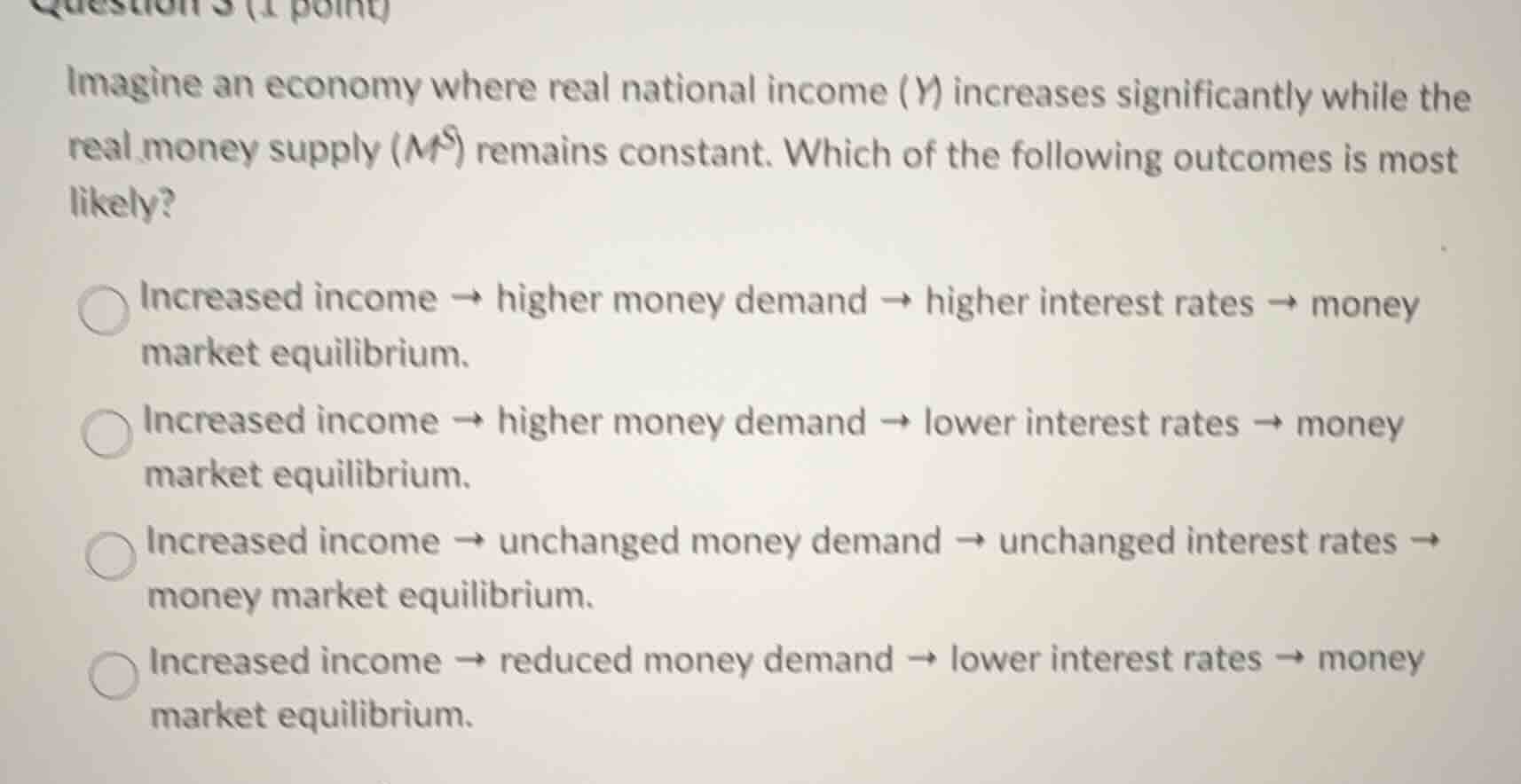
imagine an economy where real national income (y) increases significantly while the real money supply (m^s) remains constant. which of the following outcomes is most likely?
increased income → higher money demand → higher interest rates → money market equilibrium.
increased income → higher money demand → lower interest rates → money market equilibrium.
increased income → unchanged money demand → unchanged interest rates → money market equilibrium.
increased income → reduced money demand → lower interest rates → money market equilibrium.
- Recall the relationship between income, money demand, and interest rates in the money market: As real national income (\(Y\)) increases, people need more money for transactions (higher money demand, \(M^D\)).
- With a constant real money supply (\(M^S\)), to restore equilibrium in the money market (where \(M^D = M^S\)), interest rates must rise. Higher interest rates make holding money less attractive, reducing money demand until it equals the fixed supply.
- Analyze each option:
- First option: Increased income leads to higher money demand. To balance with constant supply, interest rates rise, reaching equilibrium. This matches the theory.
- Second option: Higher money demand should increase, not decrease, interest rates. Eliminate.
- Third option: Income increase should increase money demand (more transactions), so "unchanged money demand" is incorrect. Eliminate.
- Fourth option: Income increase increases, not reduces, money demand. Eliminate.

Snap & solve any problem in the app
Get step-by-step solutions on Sovi AI
Photo-based solutions with guided steps
Explore more problems and detailed explanations
A. Increased income → higher money demand → higher interest rates → money market equilibrium.