QUESTION IMAGE
Question
question 2 (1 point)
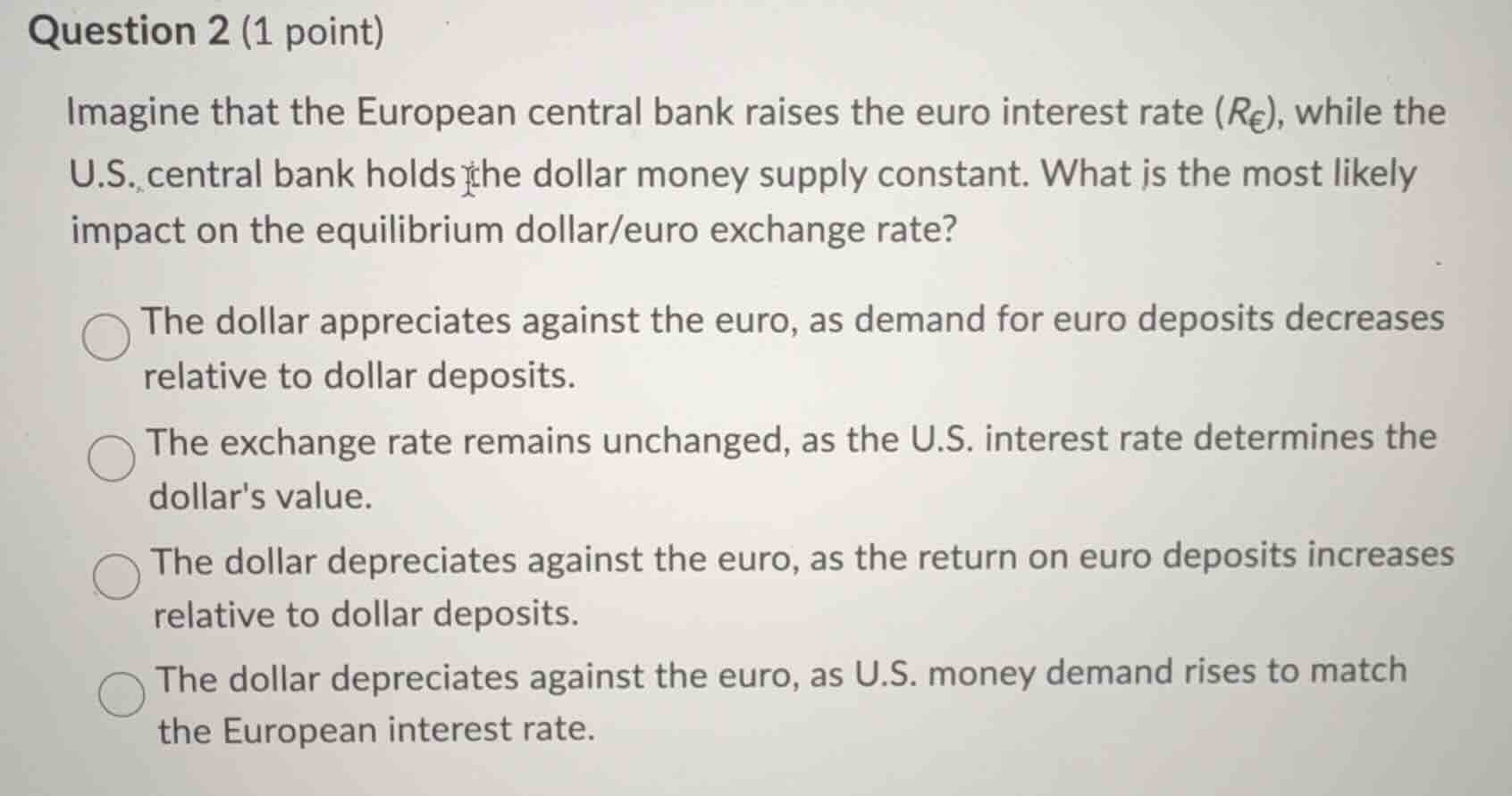
imagine that the european central bank raises the euro interest rate ($r_{€}$), while the u.s. central bank holds the dollar money supply constant. what is the most likely impact on the equilibrium dollar/euro exchange rate?
the dollar appreciates against the euro, as demand for euro deposits decreases relative to dollar deposits.
the exchange rate remains unchanged, as the u.s. interest rate determines the dollars value.
the dollar depreciates against the euro, as the return on euro deposits increases relative to dollar deposits.
the dollar depreciates against the euro, as u.s. money demand rises to match the european interest rate.
When the euro interest rate (\(R_{\epsilon}\)) rises and the U.S. dollar money supply is constant, the return on euro deposits increases relative to dollar deposits. This makes euro deposits more attractive, so people will demand more euros (and supply more dollars) to invest in euro - denominated assets. An increase in the supply of dollars (relative to euros) will cause the dollar to depreciate against the euro.
- The first option is incorrect because the demand for euro deposits should increase (not decrease) as their return is higher.
- The second option is incorrect because exchange rates are affected by relative interest rates between countries, not just the U.S. interest rate.
- The fourth option is incorrect because the U.S. money supply is constant, and the change in the euro interest rate affects the relative attractiveness of euro deposits, not U.S. money demand in a way that would directly cause the dollar to depreciate for that reason.

Snap & solve any problem in the app
Get step-by-step solutions on Sovi AI
Photo-based solutions with guided steps
Explore more problems and detailed explanations
C. The dollar depreciates against the euro, as the return on euro deposits increases relative to dollar deposits.