QUESTION IMAGE
Question
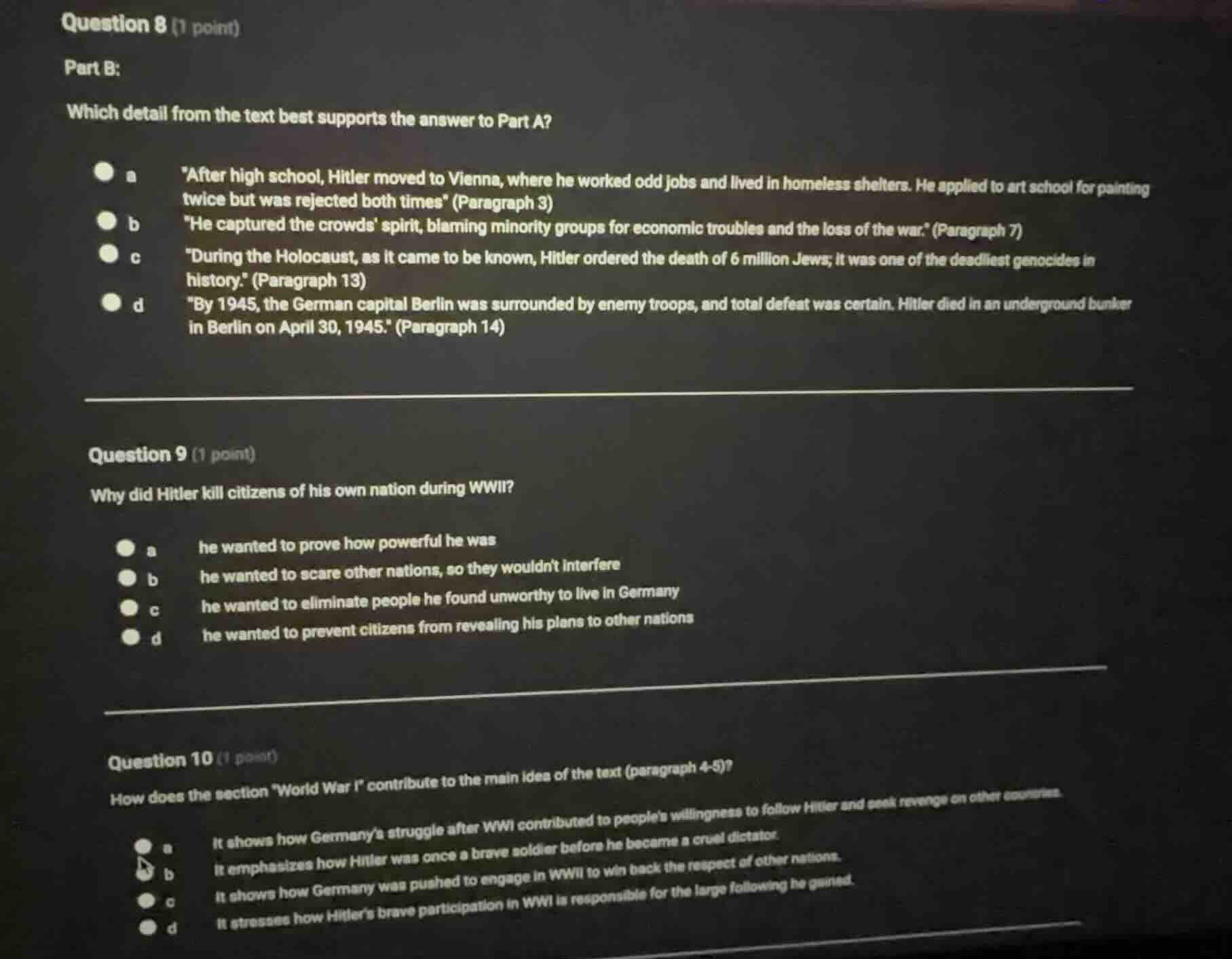
question 8 (1 point)
part b:
which detail from the text best supports the answer to part a?
a \after high school, hitler moved to vienna, where he worked odd jobs and lived in homeless shelters. he applied to art school for painting twice but was rejected both times\ (paragraph 3)
b \he captured the crowds spirit, blaming minority groups for economic troubles and the loss of the war.\ (paragraph 7)
c \during the holocaust, as it came to be known, hitler ordered the death of 6 million jews; it was one of the deadliest genocides in history.\ (paragraph 13)
d \by 1945, the german capital berlin was surrounded by enemy troops, and total defeat was certain. hitler died in an underground bunker in berlin on april 30, 1945.\ (paragraph 14)
question 9 (1 point)
why did hitler kill citizens of his own nation during wwii?
a he wanted to prove how powerful he was
b he wanted to scare other nations, so they wouldnt interfere
c he wanted to eliminate people he found unworthy to live in germany
d he wanted to prevent citizens from revealing his plans to other nations
question 10 (1 point)
how does the section \world war i\ contribute to the main idea of the text (paragraph 4 - 5)?
a it shows how germanys struggle after wwi contributed to peoples willingness to follow hitler and seek revenge on other countries.
b it emphasizes how hitler was once a brave soldier before he became a cruel dictator.
c it shows how germany was pushed to engage in wwii to win back the respect of other nations.
d it stresses how hitlers brave participation in wwi is responsible for the large following he gained.
Question 8:
Since the answer to Part A is not provided, we assume Part A focused on Hitler's rise to power by scapegoating groups. Option b shows his tactic of blaming minorities to gain crowd support, which aligns with a common core claim about his ascent.
Question 9:
Hitler's ideology centered on a "master race," leading him to target groups he deemed "unworthy," including Jewish people, disabled individuals, and other minorities within Germany during the Holocaust.
Question 10:
Germany's post-WWI economic crisis, humiliation from the Treaty of Versailles, and widespread resentment created an environment where Hitler's calls for revenge gained traction, directly linking WWI's aftermath to his rise.

Snap & solve any problem in the app
Get step-by-step solutions on Sovi AI
Photo-based solutions with guided steps
Explore more problems and detailed explanations
Question 8: b. "He captured the crowds' spirit, blaming minority groups for economic troubles and the loss of the war." (Paragraph 7)
Question 9: c. he wanted to eliminate people he found unworthy to live in Germany
Question 10: a. It shows how Germany's struggle after WWI contributed to people's willingness to follow Hitler and seek revenge on other countries.