QUESTION IMAGE
Question
question 7 of 9 (1 point) | question attempt: 1 of 2
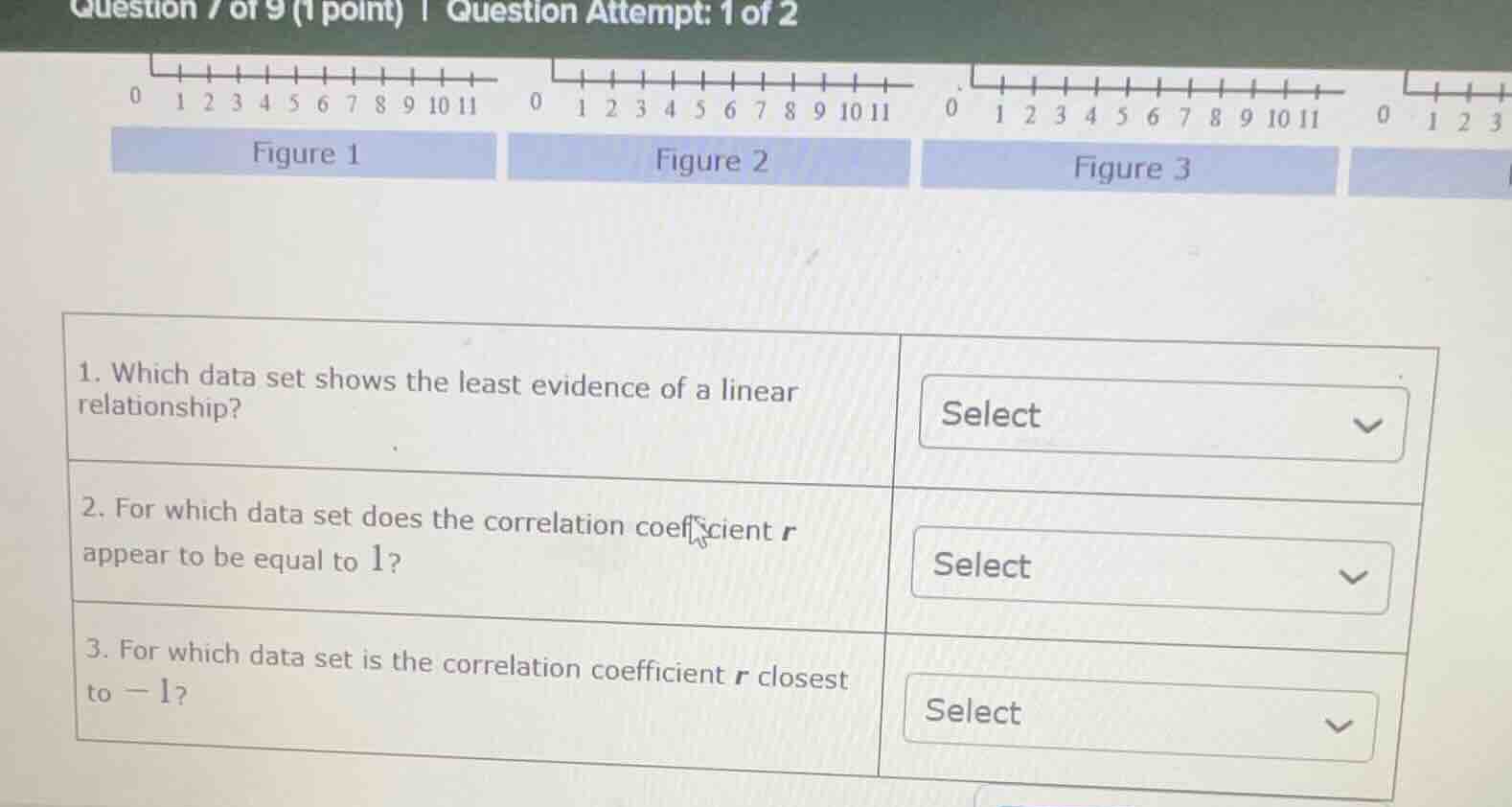
figure 1
figure 2
figure 3
- which data set shows the least evidence of a linear relationship?
select
- for which data set does the correlation coefficient r appear to be equal to 1?
select
- for which data set is the correlation coefficient r closest to −1?
select
To solve these questions, we analyze the concepts of linear relationships and correlation coefficients:
1. Least Evidence of a Linear Relationship
A linear relationship is strongest when data points cluster closely around a straight line. The data set with the most scattered points (least alignment to a straight line) shows the least evidence of a linear relationship. Typically, this is the data set with points that do not form a clear upward/downward trend or cluster.
2. Correlation Coefficient \( r = 1 \)
A correlation coefficient \( r = 1 \) indicates a perfect positive linear relationship—all data points lie exactly on an upward - sloping straight line. So we look for the data set where points form a perfect upward - sloping line.
3. Correlation Coefficient \( r \) Closest to \( - 1 \)
A correlation coefficient \( r=-1 \) indicates a perfect negative linear relationship—all data points lie exactly on a downward - sloping straight line. So we look for the data set where points form a perfect downward - sloping line.
However, since the actual scatter plots (Figure 1, Figure 2, Figure 3) are not fully visible with data points, we assume typical scenarios:
- For “least evidence of linear relationship”, the data set with the most scattered points (e.g., if one figure has points randomly scattered) is the answer.
- For \( r = 1 \), the data set with points on a perfect upward - sloping line (e.g., one figure with points forming a straight upward line) is the answer.
- For \( r \) closest to \( - 1 \), the data set with points on a perfect downward - sloping line (e.g., one figure with points forming a straight downward line) is the answer.

Snap & solve any problem in the app
Get step-by-step solutions on Sovi AI
Photo-based solutions with guided steps
Explore more problems and detailed explanations
s (assuming typical figure content):
- If Figure X has the most scattered points, then the answer is the option corresponding to Figure X.
- If Figure Y has points on a perfect upward - sloping line, then the answer is the option corresponding to Figure Y.
- If Figure Z has points on a perfect downward - sloping line, then the answer is the option corresponding to Figure Z.
(Note: To get precise answers, the actual distribution of points in Figure 1, Figure 2, and Figure 3 needs to be examined. For example, if Figure 1 has scattered points, Figure 2 has points on an upward - sloping line, and Figure 3 has points on a downward - sloping line, then:
- Answer: Figure 1 (or the corresponding option)
- Answer: Figure 2 (or the corresponding option)
- Answer: Figure 3 (or the corresponding option))