QUESTION IMAGE
Question
question 2
1 point
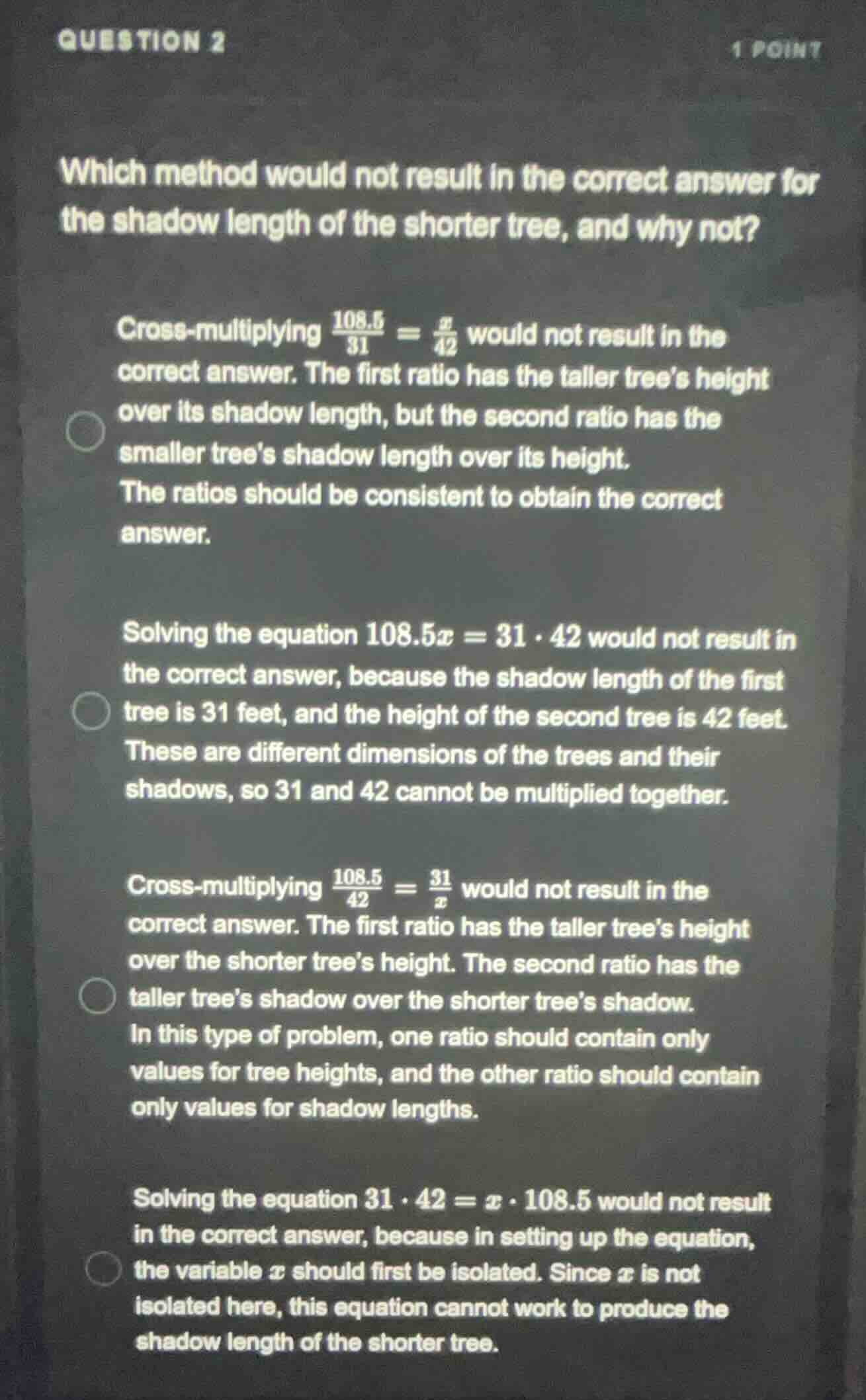
which method would not result in the correct answer for
the shadow length of the shorter tree, and why not?
cross - multiplying \\(\frac{108.5}{31} = \frac{x}{42}\\) would not result in the
correct answer. the first ratio has the taller trees height
over its shadow length, but the second ratio has the
smaller trees shadow length over its height.
the ratios should be consistent to obtain the correct
answer.
solving the equation \\(108.5x = 31\cdot42\\) would not result in
the correct answer, because the shadow length of the first
tree is 31 feet, and the height of the second tree is 42 feet.
these are different dimensions of the trees and their
shadows, so 31 and 42 cannot be multiplied together.
cross - multiplying \\(\frac{108.5}{42} = \frac{31}{x}\\) would not result in the
correct answer. the first ratio has the taller trees height
over the shorter trees height. the second ratio has the
taller trees shadow over the shorter trees shadow.
in this type of problem, one ratio should contain only
values for tree heights, and the other ratio should contain
only values for shadow lengths.
solving the equation \\(31\cdot42 = x\cdot108.5\\) would not result
in the correct answer, because in setting up the equation,
the variable \\(x\\) should first be isolated. since \\(x\\) is not
isolated here, this equation cannot work to produce the
shadow length of the shorter tree.
For similar triangle problems (tree height and shadow length), ratios must be consistent: either (height/shadow) for both trees or (shadow/height) for both trees, or (taller height/shorter height) = (taller shadow/shorter shadow).
- The first option's ratio $\frac{108.5}{31}$ (taller height/taller shadow) and $\frac{x}{42}$ (shorter shadow/shorter height) are inconsistent, so cross-multiplying gives the wrong answer. The reasoning is correct.
- The second option is wrong: $108.5x = 31 \cdot 42$ comes from inconsistent ratios, but the stated reason (31 and 42 can't be multiplied) is false; cross-multiplication of mismatched ratios is the issue, not multiplying different dimensions.
- The third option is wrong: the ratio $\frac{108.5}{42} = \frac{31}{x}$ (taller height/shorter height = taller shadow/shorter shadow) is a valid consistent ratio, so cross-multiplying would give the correct answer.
- The fourth option is wrong: isolating the variable is not required to set up the equation; $31 \cdot 42 = x \cdot 108.5$ is a valid cross-product of a correct ratio pair, and it can be solved for $x$ to get the right answer.
Only the first option correctly identifies a method that fails and explains why.

Snap & solve any problem in the app
Get step-by-step solutions on Sovi AI
Photo-based solutions with guided steps
Explore more problems and detailed explanations
Cross-multiplying $\frac{108.5}{31} = \frac{x}{42}$ would not result in the correct answer. The first ratio has the taller tree's height over its shadow length, but the second ratio has the smaller tree's shadow length over its height.
The ratios should be consistent to obtain the correct answer.