QUESTION IMAGE
Question
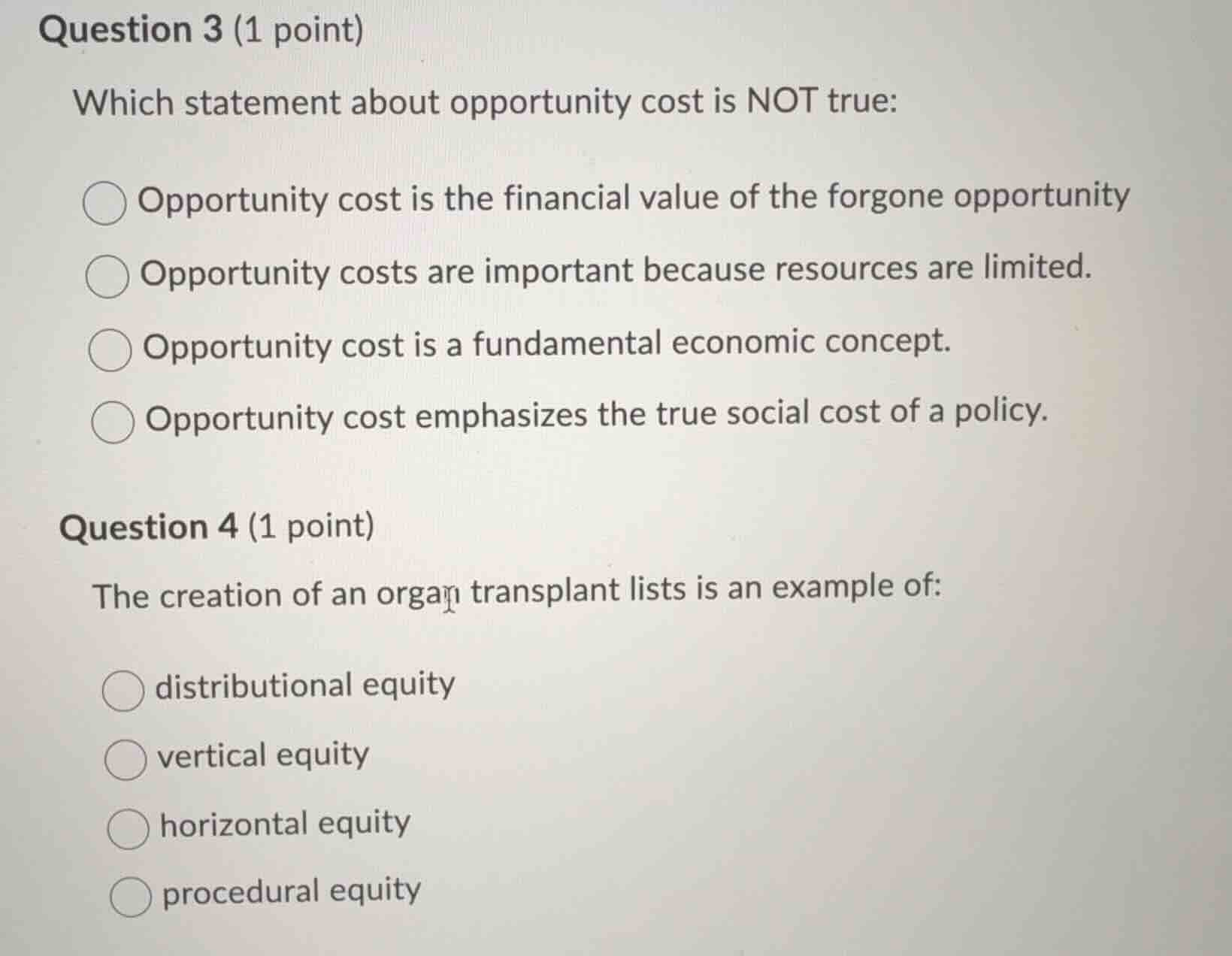
question 3 (1 point)
which statement about opportunity cost is not true:
○ opportunity cost is the financial value of the forgone opportunity
○ opportunity costs are important because resources are limited.
○ opportunity cost is a fundamental economic concept.
○ opportunity cost emphasizes the true social cost of a policy.
question 4 (1 point)
the creation of an organ transplant lists is an example of:
○ distributional equity
○ vertical equity
○ horizontal equity
○ procedural equity
Response
Question 3
Brief Explanations
- Option 1: Opportunity cost is not just financial; it can be non - financial (e.g., time, satisfaction). So this statement is not true.
- Option 2: Since resources are limited, we have to choose between alternatives, making opportunity costs important. This is true.
- Option 3: Opportunity cost is a basic concept in economics as it deals with trade - offs in resource allocation. This is true.
- Option 4: Opportunity cost helps in understanding the true cost (including social costs) of a policy by considering what is given up. This is true.
Brief Explanations
- Distributional equity: Organ transplant lists aim to distribute a scarce resource (organs) fairly among those in need. This fits.
- Vertical equity: Relates to different treatment based on ability to pay/need level in a graduated way, not about organ distribution.
- Horizontal equity: Treating equals equally, organ transplant lists are about distributing among those with different needs (not equals in terms of organ need), so not this.
- Procedural equity: About fair procedures, not about the distribution of organs.

Snap & solve any problem in the app
Get step-by-step solutions on Sovi AI
Photo-based solutions with guided steps
Explore more problems and detailed explanations
A. Opportunity cost is the financial value of the forgone opportunity