QUESTION IMAGE
Question
question 7 (1 point)
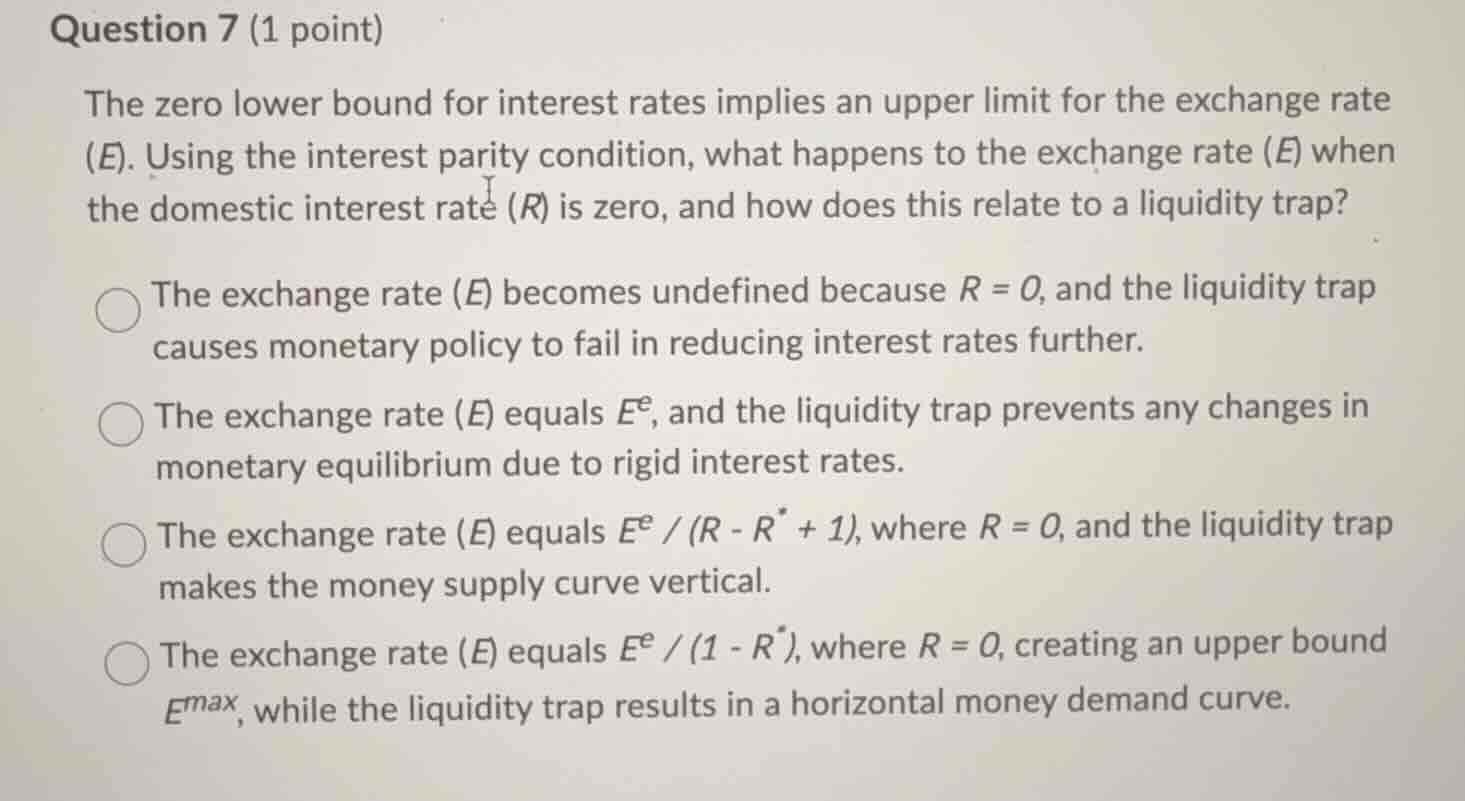
the zero lower bound for interest rates implies an upper limit for the exchange rate (e). using the interest parity condition, what happens to the exchange rate (e) when the domestic interest rate (r) is zero, and how does this relate to a liquidity trap?
the exchange rate (e) becomes undefined because r = 0, and the liquidity trap causes monetary policy to fail in reducing interest rates further.
the exchange rate (e) equals ( e^e ), and the liquidity trap prevents any changes in monetary equilibrium due to rigid interest rates.
the exchange rate (e) equals ( \frac{e^e}{(r - r^* + 1)} ), where r = 0, and the liquidity trap makes the money supply curve vertical.
the exchange rate (e) equals ( \frac{e^e}{(1 - r^*)} ), where r = 0, creating an upper bound ( e^{max} ), while the liquidity trap results in a horizontal money demand curve.
- Recall the interest parity condition: \( R = R^* + \frac{E^e - E}{E} \), which can be rearranged. When \( R = 0 \), we solve for \( E \):
\( 0 = R^* + \frac{E^e - E}{E} \)
\( -R^*=\frac{E^e - E}{E} \)
\( -R^*E = E^e - E \)
\( E - R^*E = E^e \)
\( E(1 - R^*) = E^e \)
\( E=\frac{E^e}{1 - R^*} \).
- Analyze the liquidity trap: In a liquidity trap, the money demand curve is horizontal (people are indifferent to holding money or bonds at the zero lower bound, so monetary policy cannot lower rates further). The exchange rate formula \( E=\frac{E^e}{1 - R^*} \) creates an upper bound \( E^{\text{max}} \) because \( R \) cannot fall below 0, limiting how much \( E \) can rise.
- Evaluate the options:
- First option: \( E \) is not undefined (we derived a formula), so incorrect.
- Second option: \( E \) does not equal \( E^e \) (from the derivation), and the liquidity trap explanation about "rigid rates" is inaccurate (it’s about horizontal money demand), so incorrect.
- Third option: The formula \( \frac{E^e}{R - R^* + 1} \) is wrong (derivation shows \( \frac{E^e}{1 - R^*} \)), and the money supply curve is not vertical in a liquidity trap (money demand is horizontal), so incorrect.
- Fourth option: Matches the derived formula \( E=\frac{E^e}{1 - R^*} \) and correctly explains the liquidity trap’s horizontal money demand and the upper bound on \( E \).

Snap & solve any problem in the app
Get step-by-step solutions on Sovi AI
Photo-based solutions with guided steps
Explore more problems and detailed explanations
D. The exchange rate (E) equals \( E^e / (1 - R^* ) \), where \( R = 0 \), creating an upper bound \( E^{\text{max}} \), while the liquidity trap results in a horizontal money demand curve.