QUESTION IMAGE
Question
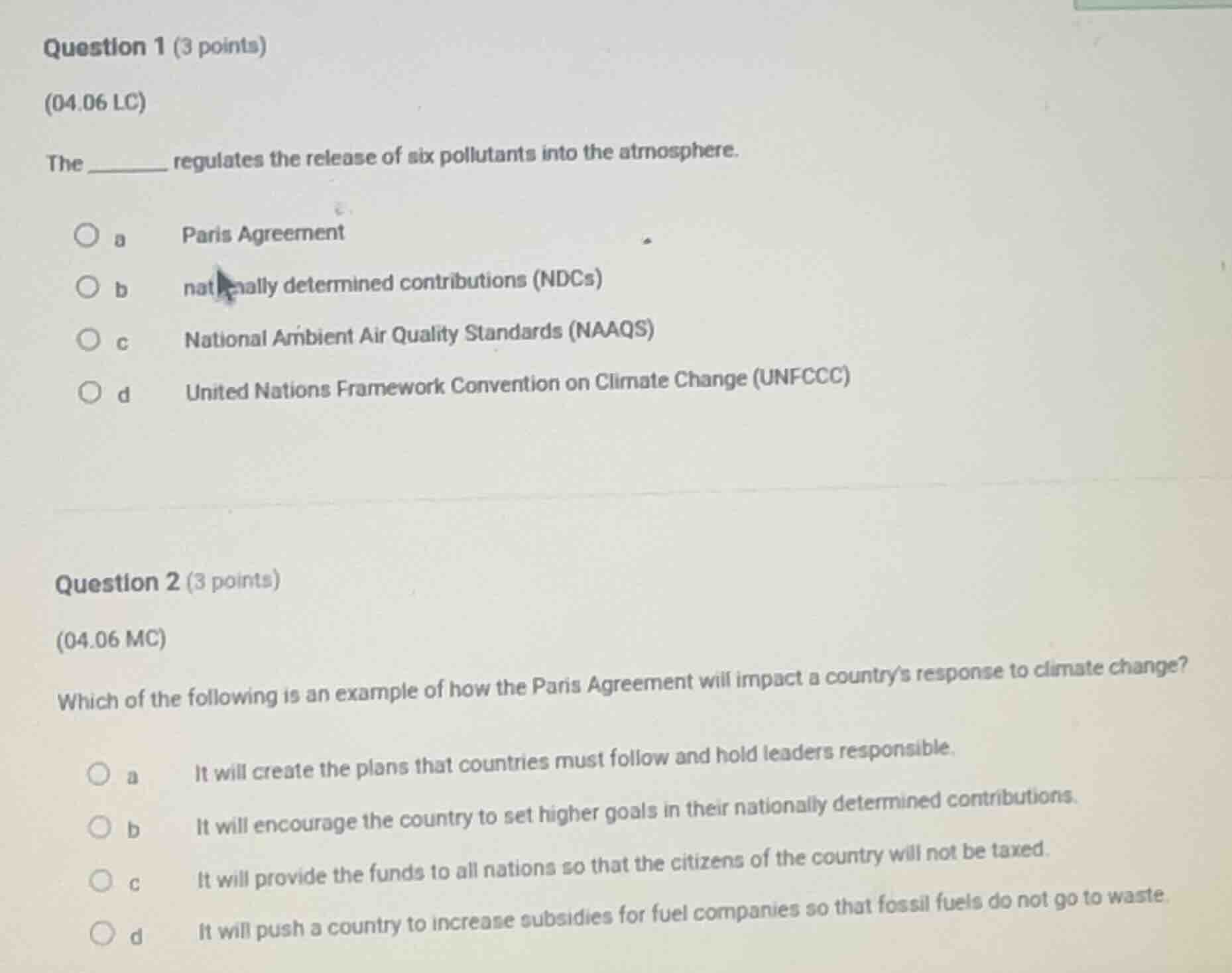
question 1 (3 points)
(04.06 lc)
the ______ regulates the release of six pollutants into the atmosphere.
a paris agreement
b nationally determined contributions (ndcs)
c national ambient air quality standards (naaqs)
d united nations framework convention on climate change (unfccc)
question 2 (3 points)
(04.06 mc)
which of the following is an example of how the paris agreement will impact a country’s response to climate change?
a it will create the plans that countries must follow and hold leaders responsible.
b it will encourage the country to set higher goals in their nationally determined contributions.
c it will provide the funds to all nations so that the citizens of the country will not be taxed.
d it will push a country to increase subsidies for fuel companies so that fossil fuels do not go to waste.
Question 1
- Option a: Paris Agreement focuses on climate change mitigation and adaptation, not regulating six specific air pollutants.
- Option b: Nationally determined contributions (NDCs) are countries' climate action plans, not related to air pollutant release regulation.
- Option c: National Ambient Air Quality Standards (NAAQS) are designed to regulate the release of six common air pollutants (like particulate matter, ozone, etc.) into the atmosphere.
- Option d: United Nations Framework Convention on Climate Change (UNFCCC) is a framework for climate change efforts, not for regulating specific air pollutants.
- Option a: The Paris Agreement does not create mandatory plans for countries to follow; it is based on voluntary NDCs.
- Option b: The Paris Agreement encourages countries to enhance their climate action, including setting higher goals in their nationally determined contributions (NDCs) over time.
- Option c: The Paris Agreement does not provide funds to all nations to avoid taxation; funding mechanisms are more targeted (e.g., for developing countries) and not for this purpose.
- Option d: The Paris Agreement aims to reduce fossil fuel use, not increase subsidies for fuel companies.

Snap & solve any problem in the app
Get step-by-step solutions on Sovi AI
Photo-based solutions with guided steps
Explore more problems and detailed explanations
c. National Ambient Air Quality Standards (NAAQS)