QUESTION IMAGE
Question
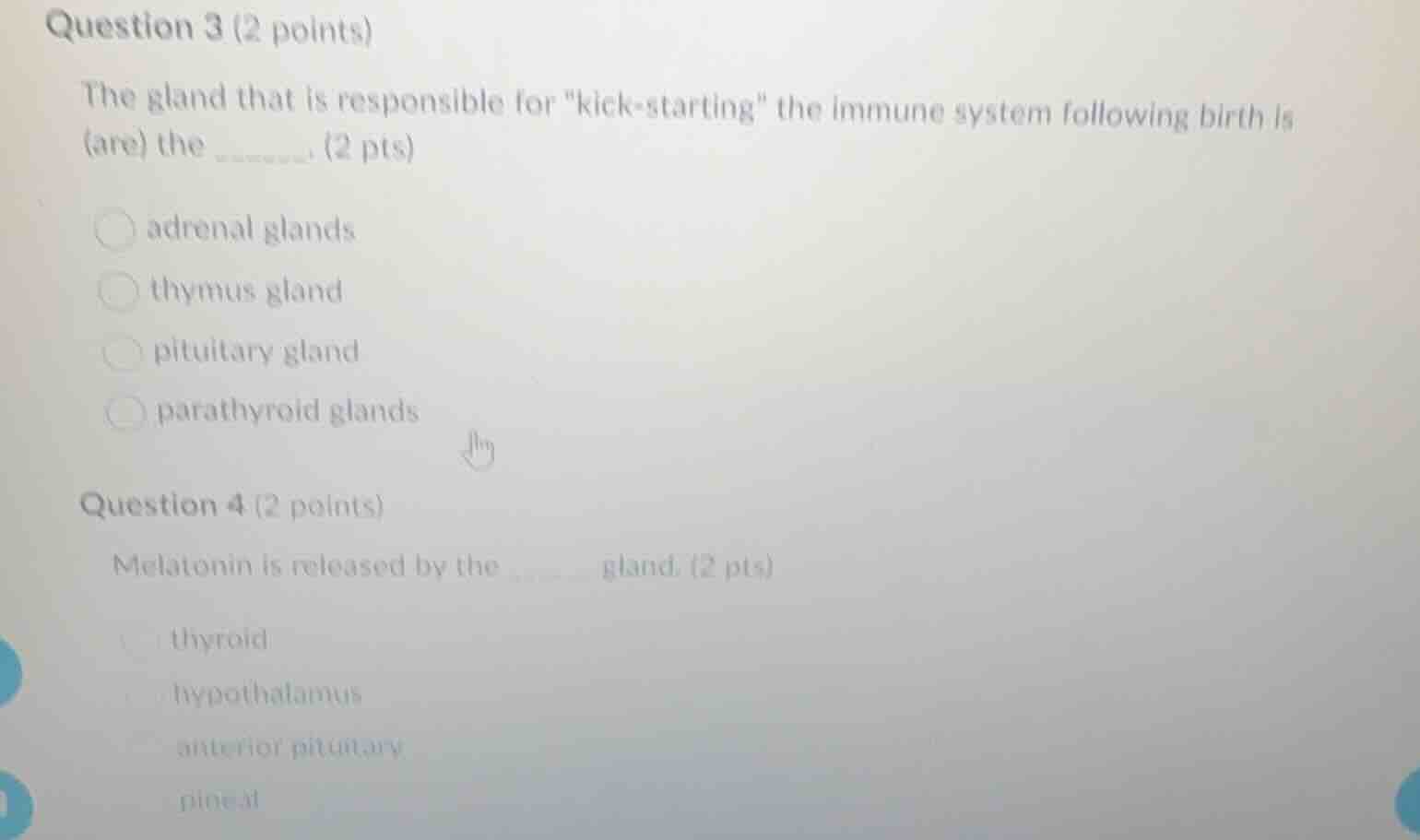
question 3 (2 points)
the gland that is responsible for \kick - starting\ the immune system following birth is (are) the ______. (2 pts)
○ adrenal glands
○ thymus gland
○ pituitary gland
○ parathyroid glands
question 4 (2 points)
melatonin is released by the ______ gland. (2 pts)
○ thyroid
○ hypothalamus
○ anterior pituitary
○ pineal
Response
Question 3
Brief Explanations
To determine the gland that kick - starts the immune system after birth, we analyze each option:
- Adrenal glands: They are mainly involved in the body's stress response and the production of hormones like cortisol and adrenaline. They do not have a direct role in kick - starting the immune system.
- Thymus gland: The thymus is crucial for the development and maturation of T - lymphocytes (a key part of the immune system). After birth, it plays a major role in "kick - starting" the immune system by helping T - cells mature.
- Pituitary gland: It is often called the "master gland" as it regulates other endocrine glands. Its main function is to secrete hormones that control growth, metabolism, and other endocrine functions, not the immune system's initiation.
- Parathyroid glands: These glands are responsible for regulating calcium levels in the blood, and they have no role in the immune system.
Brief Explanations
To find out which gland releases melatonin, we examine each option:
- Thyroid gland: The thyroid gland produces hormones like thyroxine and triiodothyronine, which are related to metabolism, not melatonin.
- Hypothalamus: It is a part of the brain that regulates the endocrine system by releasing releasing and inhibiting hormones. It does not release melatonin.
- Anterior pituitary: It secretes hormones such as growth hormone, prolactin, and thyroid - stimulating hormone. It does not release melatonin.
- Pineal gland: The pineal gland is known to secrete melatonin, which plays a role in regulating the sleep - wake cycle.

Snap & solve any problem in the app
Get step-by-step solutions on Sovi AI
Photo-based solutions with guided steps
Explore more problems and detailed explanations
B. thymus gland