QUESTION IMAGE
Question
question 9
1 pts
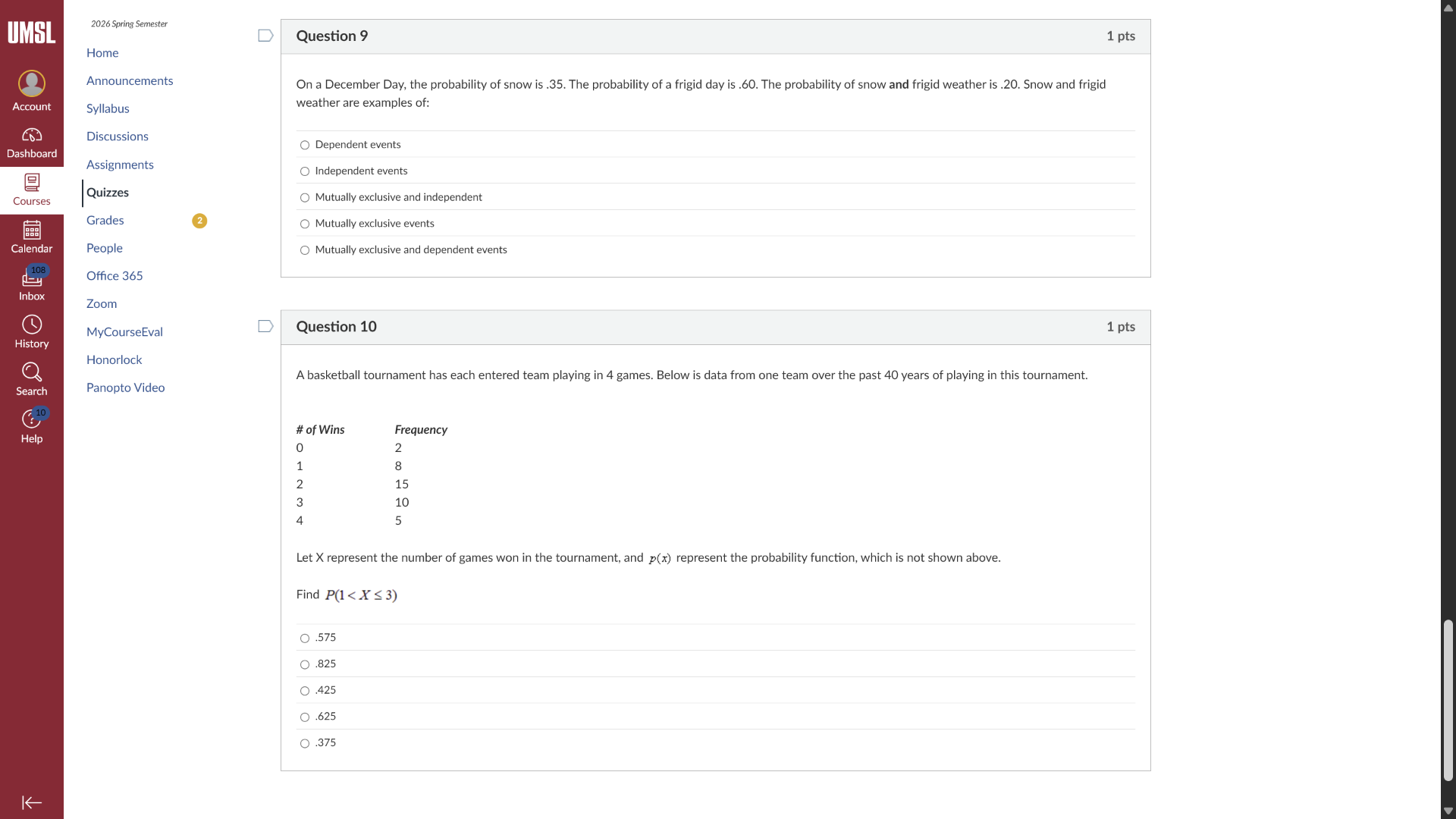
on a december day, the probability of snow is.35. the probability of a frigid day is.60. the probability of snow and frigid weather is.20. snow and frigid weather are examples of:
- dependent events
- independent events
- mutually exclusive and independent
- mutually exclusive events
- mutually exclusive and dependent events
question 10
1 pts
a basketball tournament has each entered team playing in 4 games. below is data from one team over the past 40 years of playing in this tournament.
of wins frequency
0 2
1 8
2 15
3 10
4 5
let x represent the number of games won in the tournament, and ( p(x) ) represent the probability function, which is not shown above.
find ( p(1 < x leq 3) )
- .575
- .825
- .425
- .625
- .375
Question 9
To determine the type of events (snow and frigid weather), we use the definitions of event types:
- Independent events: \( P(A \cap B) = P(A) \times P(B) \). Let \( A \) be snow (\( P(A)=0.35 \)) and \( B \) be frigid (\( P(B)=0.60 \)). Then \( P(A) \times P(B) = 0.35 \times 0.60 = 0.21 \), but \( P(A \cap B) = 0.20
eq 0.21 \), so not independent.
- Mutually exclusive events: \( P(A \cap B) = 0 \), but here \( P(A \cap B) = 0.20
eq 0 \), so not mutually exclusive.
- Dependent events: Events where \( P(A \cap B)
eq P(A) \times P(B) \). Since \( 0.20
eq 0.35 \times 0.60 \), snow and frigid weather are dependent events.
Step1: Find total frequency
Sum all frequencies: \( 2 + 8 + 15 + 10 + 5 = 40 \).
Step2: Identify relevant \( x \) values
For \( P(1 < X \leq 3) \), \( X \) can be 2, 3 (since \( X > 1 \) and \( X \leq 3 \)).
Step3: Find frequencies for \( X=2,3 \)
Frequency for \( X=2 \) is 15, for \( X=3 \) is 10. Total relevant frequency: \( 15 + 10 = 25 \).
Step4: Calculate probability
Probability \( P(1 < X \leq 3) = \frac{\text{Relevant Frequency}}{\text{Total Frequency}} = \frac{25}{40} = 0.625 \).

Snap & solve any problem in the app
Get step-by-step solutions on Sovi AI
Photo-based solutions with guided steps
Explore more problems and detailed explanations
A. Dependent events