QUESTION IMAGE
Question
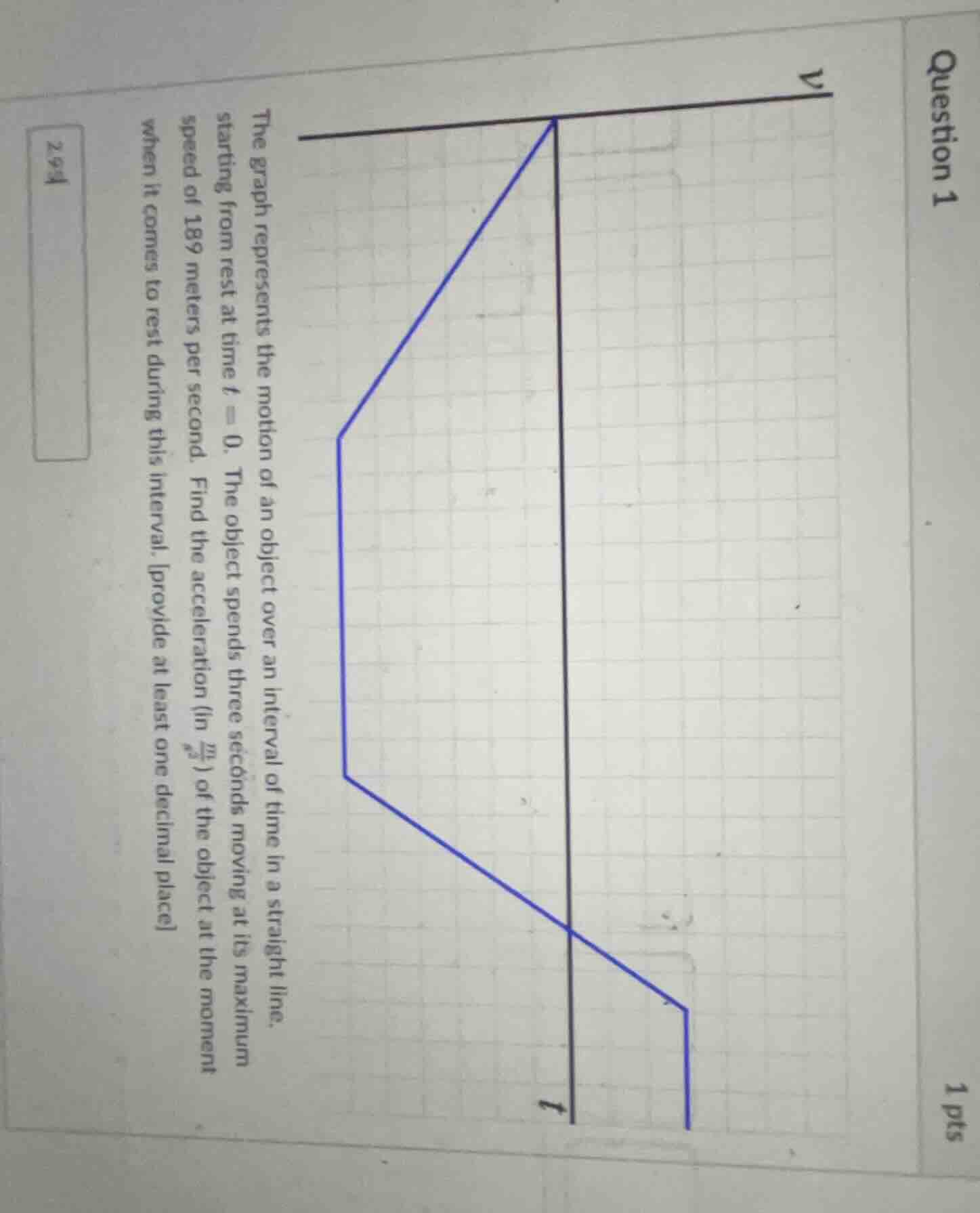
question 1 1 pts the graph represents the motion of an object over an interval of time in a straight line. starting from rest at time t = 0. the object spends three seconds moving at its maximum speed of 189 meters per second. find the acceleration (in m/s²) of the object at the moment when it comes to rest during this interval. provide at least one decimal place
Step1: Calculate total distance
First, we find the total distance the object travels, which is the area under the v-t graph. The graph is a trapezoid (or we can split it into a rectangle for the constant speed part, and two triangles for acceleration/deceleration, plus the final deceleration triangle). But we know:
- The object starts from rest, accelerates to max speed $v_{max}=189$ m/s, travels at this speed for 3 seconds, then decelerates to rest.
Let the time to accelerate be $t_1$, time to decelerate to rest be $t_3$, and constant speed time $t_2=3$ s.
Total distance $d = \frac{1}{2}v_{max}t_1 + v_{max}t_2 + \frac{1}{2}v_{max}t_3$
But we also know that the area under the v-t graph is equal to the total displacement, and for the entire motion, the change in velocity from start to end is 0, so the area of the acceleration triangle equals the area of the deceleration triangles? No, wait, no—wait, the final part is decelerating to rest, so the last segment is the deceleration to rest. Wait, no, let's re-express:
Wait, the problem says we need the acceleration when it comes to rest, which is the slope of the final segment (deceleration to rest). Let's denote:
Let the time taken to accelerate to 189 m/s be $t_1$, time at constant speed is 3 s, time to decelerate to the lower constant speed? No, wait no—the graph: starts at 0, accelerates to a speed, stays constant, decelerates to another constant? No, no, the problem says "starting from rest at t=0, reaches max speed 189 m/s, spends 3 seconds at that speed, then comes to rest". So the v-t graph is:
- Line from (0,0) to $(t_1, 189)$: acceleration phase
- Horizontal line from $(t_1,189)$ to $(t_1+3, 189)$: constant speed
- Line from $(t_1+3,189)$ to $(t_1+3+t_3, 0)$: deceleration to rest
But wait, the total distance is the area under the graph:
$d = \frac{1}{2} \times 189 \times t_1 + 189 \times 3 + \frac{1}{2} \times 189 \times t_3$
But we also know that the change in velocity for acceleration is $189 = a_1 t_1$, and for deceleration, $0 = 189 + a_3 t_3$ (so $a_3 = -\frac{189}{t_3}$). But wait, no—wait, the problem says "the graph represents the motion... starting from rest at t=0. The object spends three seconds moving at its maximum speed of 189 meters per second. Find the acceleration (in $\frac{m}{s^2}$) of the object at the moment when it comes to rest during this interval."
Wait, no—wait, the v-t graph: the area under the graph is the total distance, but we are missing the total time? No, wait, no—wait, the graph is a trapezoid? No, wait, looking at the graph: it has 4 segments:
- Acceleration from 0 to $v_1$
- Constant speed $v_1$
- Deceleration to $v_2$
- Constant speed $v_2$
- Deceleration to 0? No, no, the problem says maximum speed is 189, so the highest vertical line is 189. So the top horizontal segment is 189 m/s, duration 3 s.
Wait, let's count the grid squares:
- The constant speed segment (top horizontal) is 3 squares wide, which equals 3 seconds. So each grid square on the t-axis is 1 second.
- The maximum speed is 189 m/s, which is 7 grid squares tall (count the vertical squares for the top segment). So each vertical square is $\frac{189}{7}=27$ m/s.
- The final deceleration segment: it goes from 1 square tall (27 m/s) to 0, over 1 square of time (1 s)? No, wait no—the last segment: from the end of the lower horizontal line to rest: the lower horizontal line is 2 squares tall? Wait no, let's do this properly:
Wait, the problem states that the time spent at maximum speed (189 m/s) is 3 seconds. On the graph, the horizontal line at maximum spee…

Snap & solve any problem in the app
Get step-by-step solutions on Sovi AI
Photo-based solutions with guided steps
Explore more problems and detailed explanations
$\boldsymbol{-54.0}$ $\frac{m}{s^2}$ (or magnitude 54.0 $\frac{m}{s^2}$ deceleration)